Birmingham is England’s second-largest city and one of the United Kingdom’s most historically significant urban centres. Located in the West Midlands, Birmingham developed from a medieval market town into a global manufacturing powerhouse during the Industrial Revolution. Today, the city combines industrial heritage, cultural institutions, historic neighbourhoods, extensive canal networks, and modern regeneration projects.
- Why Is Birmingham Important in British History?
- What Should You Know Before Arriving in Birmingham?
- How Many Days Are Needed for a First Visit?
- Which Historic Areas Should First-Time Visitors Prioritise?
- Why Are Birmingham’s Canals Historically Significant?
- What Museums Best Explain Birmingham’s Past?
- How Did Immigration Shape Birmingham’s Identity?
- What Architectural Styles Define Birmingham?
- How Has Birmingham Preserved Its Industrial Heritage?
- What Is the Best Way to Experience Birmingham Like a Local?
- Why Does Birmingham Remain Historically Relevant Today?
For first-time visitors, understanding Birmingham’s historical development provides essential context for planning an effective visit. The city’s landmarks, museums, districts, and public spaces reflect centuries of economic growth, migration, innovation, and architectural change. Planning a visit through a local perspective means understanding how these historic layers connect across the modern city.
Why Is Birmingham Important in British History?
Birmingham became one of Britain’s most influential industrial centres through manufacturing, engineering, trade, and innovation. Its economic growth shaped national development, transformed urban life, and established a lasting legacy visible in the city’s architecture, canals, institutions, and cultural landmarks today.
Birmingham’s documented history stretches back to the Domesday Book of 1086, where it appeared as a small agricultural settlement. Its strategic location in central England encouraged trade and market activity throughout the medieval period.
The city expanded significantly between the sixteenth and eighteenth centuries. Skilled metalworkers, artisans, and merchants established Birmingham as a centre of production. Unlike many medieval cities, Birmingham grew through commercial enterprise rather than aristocratic control.
The Industrial Revolution accelerated this growth. During the eighteenth and nineteenth centuries, Birmingham became internationally recognised for manufacturing metal goods, firearms, jewellery, buttons, steam engines, and industrial machinery. The city earned the nickname “Workshop of the World” due to its extraordinary manufacturing output.
Innovators including James Watt, Matthew Boulton, and Joseph Priestley contributed to Birmingham’s intellectual and industrial influence.
Understanding this historical significance helps visitors appreciate why Birmingham’s museums, canals, factories, and civic buildings remain central attractions.
What Should You Know Before Arriving in Birmingham?
Birmingham developed as a collection of historic districts connected by trade routes, canals, railways, and industries. Understanding the city’s geography before arrival helps visitors navigate major attractions efficiently while appreciating historical relationships between neighbourhoods and landmarks.
Birmingham covers more than 267 square kilometres and contains diverse districts shaped by different historical functions.
The city centre serves as the primary visitor hub. Historic commercial activity concentrated around markets, civic buildings, and transportation networks. Modern regeneration has preserved important heritage structures while introducing contemporary developments.
Several districts deserve attention before planning an itinerary.
The Jewellery Quarter represents one of Europe’s best-preserved industrial districts. More than 200 listed buildings survive from Birmingham’s manufacturing era.
Digbeth developed as an industrial and commercial quarter. Today, former warehouses and factories coexist with creative industries, independent businesses, and cultural venues.
Edgbaston became a prestigious residential district during Victorian expansion. Large houses, educational institutions, and landscaped streets reflect nineteenth-century urban planning.
The Gun Quarter preserves evidence of Birmingham’s historic firearms industry, which supplied military and civilian markets worldwide.
Visitors who understand these districts can organise routes according to historical themes rather than simply moving between isolated attractions.
How Many Days Are Needed for a First Visit?
Three days provide sufficient time to explore Birmingham’s major historic sites, museums, canal districts, cultural institutions, and neighbourhoods. Shorter visits cover core landmarks, while longer stays allow deeper exploration of industrial heritage, archives, and regional attractions.
A one-day itinerary focuses primarily on the city centre. Visitors typically explore civic landmarks, canal areas, major museums, and commercial districts.
Two days allow broader coverage. Historic neighbourhoods, industrial heritage sites, and cultural institutions become accessible without rushing.
Three days provide the most balanced introduction. Visitors can examine Birmingham’s industrial history, architectural development, cultural diversity, and contemporary regeneration projects.
Longer stays support specialised interests. Academic researchers, genealogists, and heritage enthusiasts often spend additional time examining archives, cemeteries, historic churches, and museum collections.
The city’s extensive public transportation network facilitates movement between major sites, reducing travel time and increasing opportunities for exploration.
Which Historic Areas Should First-Time Visitors Prioritise?
The city centre, Jewellery Quarter, Digbeth, and canal districts contain Birmingham’s most significant concentrations of historic buildings, industrial heritage, and cultural landmarks. These areas collectively illustrate the city’s evolution from medieval settlement to modern metropolitan centre.
The city centre contains several key landmarks.
The Birmingham Town Hall opened in 1834 and reflects Roman-inspired civic architecture. Its design symbolised Birmingham’s growing confidence during industrial expansion.
Nearby, the Council House demonstrates Victorian municipal ambition through monumental architecture and public art.
The Jewellery Quarter offers one of Britain’s most complete industrial landscapes. Historic workshops, factories, cemeteries, and commercial buildings remain integrated within the modern urban environment.
Digbeth preserves former industrial structures that reveal Birmingham’s manufacturing history. Victorian warehouses, railway infrastructure, and commercial buildings illustrate nineteenth-century economic activity.
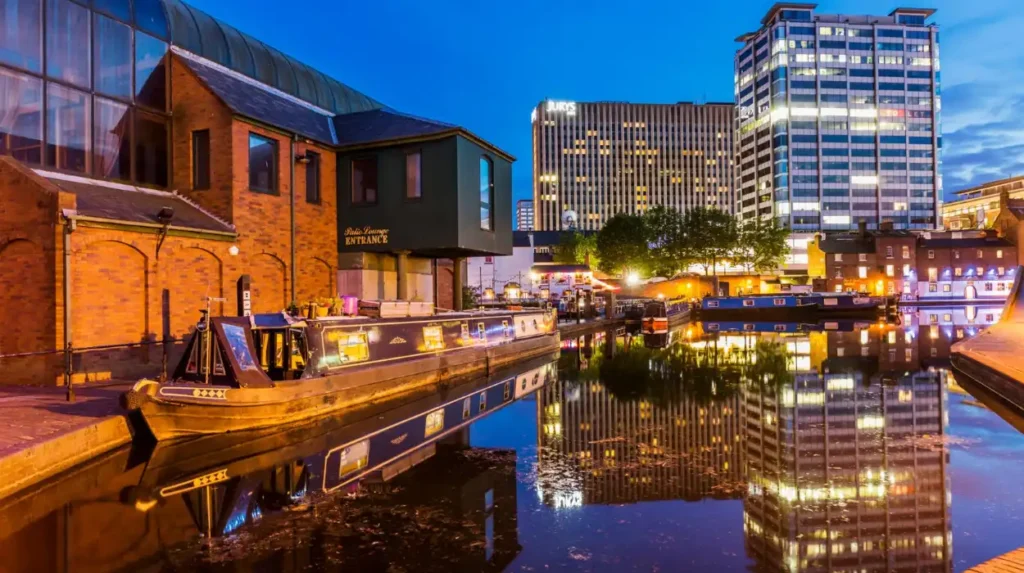
The canal districts showcase engineering achievements that enabled industrial growth. Birmingham contains more miles of canals than Venice, reflecting the city’s historical dependence on waterborne transport.
To experience these historic districts in person today, consult our comprehensive 15 Best Things to Do in Birmingham for First-Time Visitors for itineraries and visiting parameters.
Why Are Birmingham’s Canals Historically Significant?
Birmingham’s canal network transformed transportation, manufacturing, and trade during the Industrial Revolution. These waterways connected factories, workshops, and markets, reducing costs and enabling economic expansion that established Birmingham as a leading industrial city.
Canal construction accelerated during the late eighteenth century.
The first major connection emerged through the Birmingham Canal Navigations system. These waterways linked Birmingham to national trade routes, ports, and industrial centres.
Before railway development, canals provided the most efficient method for transporting raw materials and manufactured goods. Coal, iron, machinery, and finished products moved through the network daily.
Industrial districts developed alongside these waterways. Factories, warehouses, and workshops clustered near canal routes to maximise logistical efficiency.
Today, regenerated canal areas preserve this heritage while supporting tourism, recreation, and residential development.
Walking routes along canal towpaths reveal surviving bridges, locks, warehouses, and industrial structures that illustrate Birmingham’s engineering history.
What Museums Best Explain Birmingham’s Past?
Birmingham’s museums preserve evidence of industrial innovation, social history, scientific advancement, and artistic achievement. Together, these institutions provide comprehensive insight into the city’s development across several centuries and historical periods.
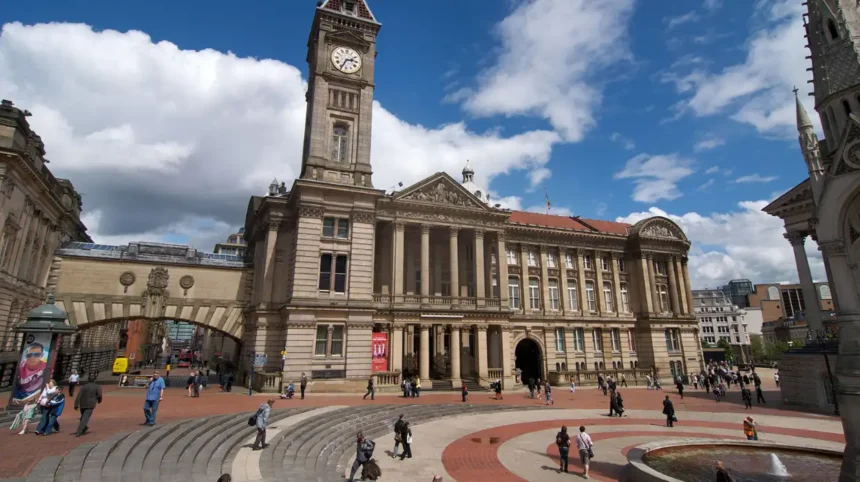
The Birmingham Museum and Art Gallery contains collections spanning archaeology, fine art, local history, and industrial development.
Visitors gain insight into Birmingham’s transformation from a medieval town into an industrial metropolis.
The Thinktank Birmingham Science Museum explores technological innovation and engineering achievements. Exhibits explain scientific discoveries, industrial processes, and transportation history.
The Museum of the Jewellery Quarter preserves an authentic manufacturing workshop. Visitors observe machinery, tools, and production methods used during Birmingham’s industrial peak.
The Coffin Works documents specialised manufacturing industries that contributed to Birmingham’s economy.
Together, these institutions provide detailed evidence of economic, technological, and social change.
How Did Immigration Shape Birmingham’s Identity?
Migration transformed Birmingham into one of Britain’s most culturally diverse cities. Successive communities contributed labour, entrepreneurship, traditions, religions, and cultural practices that reshaped neighbourhoods, institutions, and the city’s social character.
Population growth accelerated throughout the nineteenth and twentieth centuries.
Industrial employment attracted workers from across Britain. Irish migrants arrived in large numbers during the nineteenth century, contributing significantly to construction, manufacturing, and urban development.
Post-war migration introduced new communities from South Asia, the Caribbean, Africa, and other regions.
Areas such as Sparkbrook, Handsworth, and Small Heath reflect these demographic changes.
Religious buildings, cultural centres, educational institutions, businesses, and festivals demonstrate the lasting influence of immigrant communities.
Modern Birmingham contains one of the United Kingdom’s most diverse populations, making cultural history an essential component of any visitor experience.
What Architectural Styles Define Birmingham?
Birmingham’s architecture reflects continuous development from medieval origins through Victorian industrial expansion and contemporary regeneration. Surviving buildings reveal changing economic priorities, technological capabilities, civic ambitions, and urban planning approaches across multiple historical periods.
Medieval Birmingham survives primarily through fragments, street patterns, and archaeological evidence.
Georgian architecture expanded during eighteenth-century commercial growth. Examples include elegant townhouses and institutional buildings.
Victorian architecture dominates much of the historic cityscape. Industrial prosperity funded churches, civic buildings, educational institutions, and commercial structures.
Notable examples include red-brick factories, Gothic Revival churches, and monumental civic architecture.
Twentieth-century development introduced modernist structures, transportation infrastructure, and large-scale redevelopment projects.
Contemporary architecture reflects Birmingham’s continuing transformation through commercial investment and urban regeneration.
This architectural diversity allows visitors to observe centuries of urban evolution within relatively compact areas.
How Has Birmingham Preserved Its Industrial Heritage?
Conservation projects, listed-building protections, museums, and adaptive reuse initiatives preserve Birmingham’s industrial heritage. These efforts safeguard historic factories, workshops, canals, warehouses, and engineering infrastructure while integrating them into the modern urban environment.
Industrial decline during the twentieth century threatened many historic structures.
Heritage organisations, local authorities, and community groups initiated preservation efforts to protect significant sites.
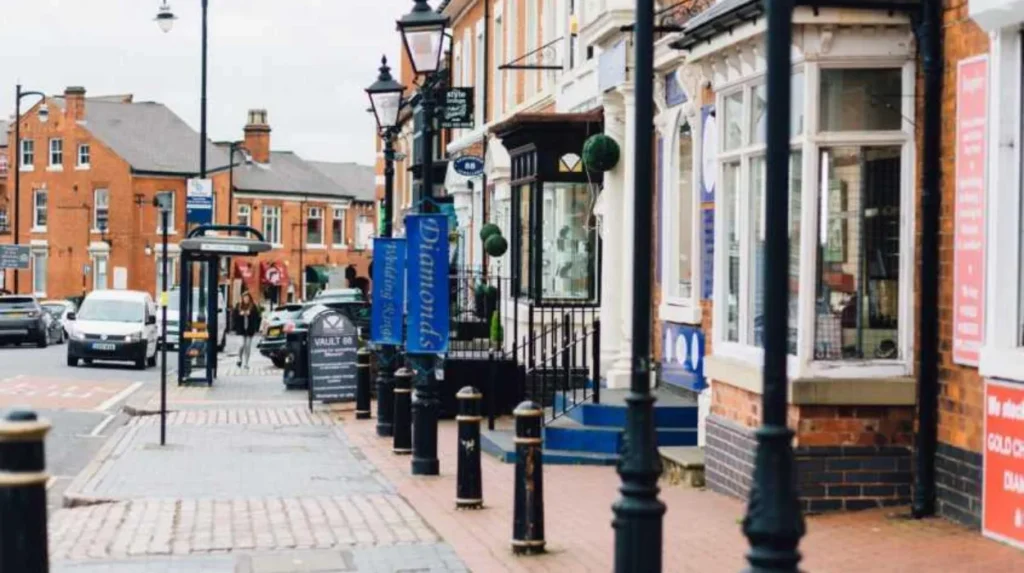
The Jewellery Quarter represents a major conservation success. Historic workshops remain active while heritage attractions interpret industrial history for visitors.
Former warehouses and factories have been converted into offices, residences, museums, and cultural venues.
Canal restoration projects preserved engineering features while improving public access.
These initiatives demonstrate how industrial landscapes can remain economically viable while retaining historical significance.
Visitors encounter preservation outcomes throughout the city rather than only within museums.
What Is the Best Way to Experience Birmingham Like a Local?
Experiencing Birmingham like a local involves exploring historic districts on foot, using public transportation, visiting community-focused cultural venues, and understanding how industrial heritage continues to influence contemporary urban life throughout the city.
Local residents frequently move between districts rather than remaining exclusively within tourist areas.
Walking provides the most effective method for understanding Birmingham’s historical geography. Canal routes, former industrial streets, and historic commercial districts reveal connections often overlooked during vehicle-based travel.
Public transportation links historic neighbourhoods efficiently. Trains, trams, and buses connect visitors with areas beyond the city centre.
Local markets continue traditions established centuries ago. These commercial spaces illustrate Birmingham’s enduring role as a centre of trade and exchange.
Community museums, libraries, archives, and cultural institutions provide deeper engagement with local history than landmark-focused sightseeing alone.
Understanding the city’s industrial foundations, migration history, architectural diversity, and preservation efforts enables visitors to interpret modern Birmingham through a historically informed perspective.
Why Does Birmingham Remain Historically Relevant Today?
Birmingham remains historically relevant because its development illustrates major themes in British history, including industrialisation, urbanisation, migration, technological innovation, and heritage preservation. These processes continue influencing policy, education, research, and cultural identity worldwide.
The city serves as a case study for understanding industrial transformation.
Researchers examine Birmingham to study manufacturing systems, urban growth, transportation networks, and technological innovation.
Educational institutions use Birmingham’s history to explain broader developments in British and global economic history.
Preserved industrial landscapes provide evidence for archaeological and historical investigation.
Heritage conservation projects demonstrate approaches to balancing preservation with contemporary development.
For visitors, Birmingham offers more than individual attractions. The city presents a living historical environment where centuries of change remain visible through buildings, infrastructure, neighbourhoods, museums, and cultural traditions.
A first visit planned through this historical framework provides a deeper understanding of Birmingham’s significance within British history. Rather than viewing landmarks in isolation, visitors encounter interconnected evidence of industrial innovation, social transformation, architectural evolution, and cultural diversity. This broader perspective reflects how local residents understand their city: not simply as a collection of attractions, but as one of Britain’s most influential historical landscapes.
What is Birmingham best known for?
Birmingham is best known for its role in the Industrial Revolution, its extensive canal network, the Jewellery Quarter, world-class museums, diverse cultural communities, and its history as one of Britain’s leading manufacturing centres.