Key Points
- West Midlands Police recorded 1,673 offences across the regional bus network during a single operational period, according to Freedom of Information data.
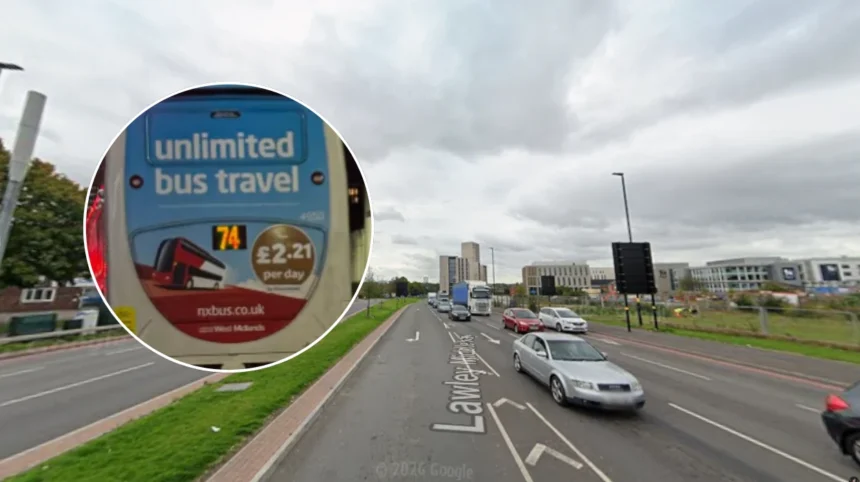
- The number 74 bus service between Birmingham city centre and Dudley via West Bromwich logged the highest number of crimes, with 77 reported incidents.
- Violence against the person was the most common category of reported crime on board, followed by arson, criminal damage, theft, and public order offences.
- Other high-incident routes included the number 50 service from Birmingham to Druids Heath and services serving Chelmsley Wood, including the 97 and 94.
- West Midlands Police and National Express West Midlands stated that passenger risk remains low, with roughly one crime reported for every 60,000 to 62,000 trips.
BIRMINGHAM (Birmingham Express) September 23, 2026 — Official crime statistics released by West Midlands Police under Freedom of Information legislation have laid bare the specific bus routes across the West Midlands network that record the highest numbers of criminal incidents.
The comprehensive data set shows that police were called out to 1,673 individual incidents on board public buses across the region during the evaluated period, revealing significant variations in crime rates between specific commuter lines used daily by thousands of passengers.
As reported by Jayne Thomson and Richard Guttridge of BirminghamLive, the data confirms that the number 74 service — connecting Birmingham city centre to Dudley through West Bromwich, Hockley Circus, and Great Bridge — recorded the highest volume of individual police call-outs, earning it the label of the region’s most crime-hit route.
On the number 74 route alone, 77 specific criminal offences were formally recorded. A detailed breakdown of these incidents indicates that “violence against the person”, including physical fights and physical assaults, constituted the single largest category, accounting for 25 reported offences.
In addition to violent altercations, the route recorded 17 incidents of theft and 12 public order offences, which encompass aggressive behavior, harassment, and verbal abuse. Statistically, the volume of reported crime on the 74 route equates to roughly two police incidents every week.
Which other Birmingham bus routes recorded high crime figures?
As reported by BirminghamLive, the data indicates that crime is concentrated on specific high-frequency trunk lines serving key suburban corridors. Following the number 74 service, the second most crime-ridden service identified in the dataset was the long-standing number 50 service, which operates between Birmingham city centre and Druids Heath via Kings Heath and Moseley.
The broader police records across the entire transport network showed that arson and criminal damage formed the second most frequent category of recorded crime overall, totaling 379 reported cases.
Theft and public order offences each registered 267 separate reports across the regional fleet, while 75 sexual offences were formally logged by officers during the period. Out of the total 1,673 reported offences, police noted that 215 cases could not be assigned to a specific service number due to incomplete reporting parameters at the point of contact.
Historical FOI requests previously submitted by Charlotte Paxton of BirminghamLive demonstrate that these patterns have persisted across key corridors over time. Services operating east toward Solihull and Solihull Metropolitan Borough — notably the 97 (Birmingham to Chelmsley Wood), the 14, the 17, and the 94 — have consistently featured alongside the 11 Outer Circle routes among the top locations for transport-related police interventions.
Recent localized incidents on these services included an operational appeal following an incident where teenagers were chased off a number 94 bus, as well as temporary route diversions enforced on the number 72 service near Chelmsley Wood due to anti-social behavior.
How have West Midlands Police and National Express responded to the data?
As reported by BirminghamLive, representatives from both West Midlands Police and operator National Express West Midlands stressed that despite the headline figures, public buses remain an overwhelmingly safe mode of transport when measured against total passenger volume.
A spokesperson for West Midlands Police stated that “The risk of being a victim of crime whilst travelling on buses remains low. For example, in July this was 0.002% offences from 16.75 million passenger journeys in July”.
The police spokesperson further clarified the operational framework used to manage transport security: “The transport network in the West Midlands is the responsibility of the local policing areas. However this is supported by staff from Safer Travel, a unique partnership between West Midlands and British Transport Police as well as Transport for West Midlands”. Authorities noted that proactive initiatives such as the ‘See Something, Say Something’ discreet text reporting service and targeted ‘Project Empower’ campaigns encourage higher reporting rates, which directly assists officers in identifying specific crime hotspots.
A spokesperson for National Express West Midlands stated that “Figures show that the chances of becoming a victim of crime on a bus are very low. With around four million passenger journeys made on National Express West Midlands buses each week, it means that there is only one crime for every 62,000 bus rides”.
The operator added: “We are part of the Safer Travel Partnership and work very closely with the Safer Travel Police team which uses a variety of tactics to help tackle crime and antisocial behavior on the public transport network”.
Background of the development
The publication of detailed route-by-route transport crime statistics is the result of repeated Freedom of Information requests submitted by regional news outlets seeking transparency around public safety on the West Midlands transit network.
Public transport in the West Midlands is overseen by Transport for West Midlands (TfWM) in coordination with private bus operators, primarily National Express West Midlands, which handles the vast majority of local bus routes.
To address rising public concern over anti-social behavior on urban transport, the Safer Travel Partnership was formed as a dedicated multi-agency initiative combining officers from West Midlands Police, the British Transport Police, and transport operators.
Historically, major arterial routes linking Birmingham city centre to outlying industrial and residential hubs — such as the Black Country via the A41 corridor (Route 74) and the southern suburbs via the A435 (Route 50) — carry millions of passengers annually. Because these routes operate high-frequency schedules through densely populated areas, they naturally account for a higher absolute number of police call-outs compared to low-frequency rural or suburban services.
Over the past decade, local authorities have invested in fleet-wide CCTV installations, control room monitoring, and dedicated high-visibility transport patrols to address repeat offences, ranging from low-level vandalism to violent altercations on late-night services.
Prediction: How this development can affect bus passengers and local communities
The public disclosure of police crime figures for specific bus routes is expected to influence passenger perceptions, community transport policy, and police resource allocation across the West Midlands in several concrete ways:
- Shift in Passenger Behaviour and Travel Choices: Passengers who regularly rely on high-incident lines, particularly the number 74 and number 50 routes, may adjust their travel habits. Commuters, elderly residents, and shift workers traveling early in the morning or late at night may actively choose alternative routes, switch to tram/rail options, or reduce non-essential travel due to heightened safety concerns.
- Targeted Deployment of Safer Travel Patrols: The explicit identification of the 74 service as the most crime-hit route will pressure the Safer Travel Partnership to redeploy visible, uniformed police officers and plainclothes units specifically onto the Birmingham-to-Dudley corridor to act as a visible deterrent.
- Increased Reliance on Discreet Reporting Tools: Public awareness of anti-social behavior statistics is likely to drive higher engagement with discreet reporting mechanisms, such as the ‘See Something, Say Something’ text service. Increased reporting from passengers will supply police with better intelligence, leading to faster operational interventions at identified stops like Hockley Circus and West Bromwich.
- Investment in On-Board Security Technologies: To maintain public confidence and protect staff, National Express West Midlands may accelerate investments in enhanced technological safeguards, including real-time driver-to-control room video feeds, improved night-time lighting at high-risk bus stops, and clearer passenger emergency protocols.