Birmingham has developed one of England’s most significant regional visual-arts cultures through municipal collecting, artist-led organisations, universities, industrial design, and independent creative spaces. Its galleries connect nineteenth-century civic ambition with contemporary art, craft, photography, sculpture, architecture, and experimental practice.
- Why is Birmingham historically important for art and creative culture?
- What can visitors see at Birmingham Museum & Art Gallery?
- How did the Royal Birmingham Society of Artists shape local art?
- Why is the Barber Institute of Fine Arts important to Birmingham?
- How does Ikon Gallery represent Birmingham’s contemporary art history?
- Where can visitors experience Birmingham’s independent and experimental art scene?
- Which creative experiences allow visitors to make art themselves?
- How does Birmingham connect historic art with modern creative culture?
- Frequently Asked Question
The city’s artistic history is closely linked to its industrial expansion. Birmingham became a major manufacturing centre during the Industrial Revolution, creating demand for skilled designers, metalworkers, engravers, jewellers, illustrators, architects, and artists. Art education therefore developed alongside manufacturing rather than separately from it.
This relationship shaped institutions such as the Royal Birmingham Society of Artists (RBSA), Birmingham Museum & Art Gallery (BMAG), and the Barber Institute of Fine Arts. Later organisations, including Ikon Gallery and Eastside Projects, expanded Birmingham’s cultural identity into contemporary and experimental art.
For visitors, the result is a broad creative landscape. Historic collections sit alongside artist-led exhibitions, craft workshops, public art, photography, street art, and hands-on making experiences. For students and researchers, the city provides primary material for studying British art, industrial heritage, urban development, social history, and cultural institutions.
The following guide examines the historical foundations of Birmingham’s galleries and explains the creative experiences that preserve and reinterpret that heritage today.
Why is Birmingham historically important for art and creative culture?
Birmingham became an important British art centre because industrial growth created demand for design, art education, civic collections, and skilled makers, while nineteenth-century institutions established galleries and societies that connected visual culture with manufacturing and public education.
Birmingham’s artistic development accelerated during the nineteenth century. The city’s expanding workshops and factories required workers who understood drawing, ornament, geometry, materials, and design. Art education therefore had a practical economic function.
The Royal Birmingham Society of Artists provides one of the clearest examples. Its origins reach back to 1809, when Samuel Lines, Moses Haughton, Vincent Barber, and Charles Barber established a life-drawing academy in Peck Lane. The group later formed the Birmingham Academy of Arts in 1814.
In 1821, the organisation became the Birmingham Society of Artists. Its purpose included improving artistic education and providing opportunities for artists to exhibit their work. In 1829, a substantial gallery designed by Thomas Rickman and Henry Hutchinson opened on New Street. The first exhibition there opened in 1830 and was attended by Princess Victoria and the Duke of Wellington.
The society received a royal charter in 1868 and adopted the name Royal Birmingham Society of Artists. Its membership included important figures associated with the Pre-Raphaelite and Arts and Crafts movements, including William Morris, Edward Burne-Jones, John Everett Millais, and Lord Leighton.
The civic art-gallery movement developed alongside this artistic society. Birmingham Corporation received expanded powers under the Birmingham Corporation Act 1883. The legislation increased funding for the municipal museum and art-gallery service and supported the establishment of a dedicated committee overseeing collections, buildings, exhibitions, finance, staffing, and the Birmingham School of Art.
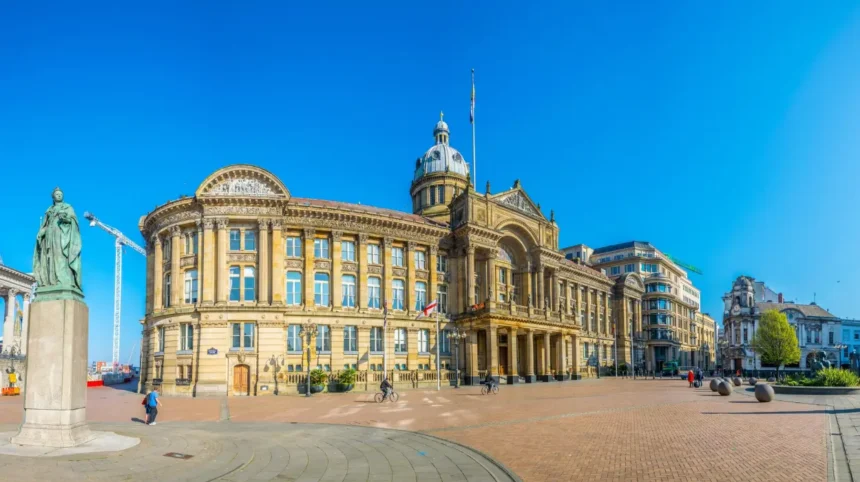
The present Birmingham Museum & Art Gallery opened in 1885. The municipal archive records the 1883 legislation and the opening of the art gallery at its present location two years later.
This institutional development established a pattern that continues today. Birmingham’s creative culture combines public collections, art education, independent galleries, university museums, artist-led organisations, and practical craft activity.
What can visitors see at Birmingham Museum & Art Gallery?
Birmingham Museum & Art Gallery preserves major collections of art, archaeology, local history, decorative arts, and world cultures, with its internationally important Pre-Raphaelite holdings forming one of the strongest reasons to study Birmingham’s Victorian artistic heritage.
Birmingham Museum & Art Gallery is one of the city’s principal cultural institutions. Its building is Grade II* listed, reflecting its architectural and civic importance. Birmingham City Council identifies the museum as a major place for understanding the city’s history through art, archaeology, and local collections.
The museum’s collection extends far beyond paintings. Birmingham Museums states that its wider collection contains around 800,000 objects across nine venues. The holdings include British and European art, decorative arts and design, textiles, archaeology, numismatics, Birmingham history, natural sciences, science and industry, and world cultures.
The Pre-Raphaelite collection is particularly important. The Pre-Raphaelite Brotherhood was founded in London in 1848 by artists including Dante Gabriel Rossetti, William Holman Hunt, and John Everett Millais. The movement rejected aspects of academic convention and promoted detailed observation, vivid colour, literary subjects, and close attention to nature.
Birmingham became strongly associated with the movement because of local connections to artists, collectors, and institutions. Edward Burne-Jones, born in Birmingham in 1833, became one of the most influential British artists associated with the later Pre-Raphaelite tradition. His work connects Birmingham’s local history with wider developments in Victorian art.
The museum also documents Birmingham’s industrial and commercial history. Decorative arts provide evidence of manufacturing, consumption, craftsmanship, and changing design standards. Objects made from metal, ceramics, glass, and other materials demonstrate how Birmingham’s industrial economy supported artistic production.
For educators, BMAG provides an opportunity to compare fine art with industrial design. A painting, piece of jewellery, decorative object, or manufactured product can be studied as evidence of technology, social values, commercial networks, and artistic taste.
The museum’s collections are not permanently displayed in their entirety. Birmingham Museums advises visitors seeking particular objects or collections to check current displays because collection material is held both on display and in storage.
This distinction is important for researchers. A collection catalogue can contain considerably more material than visitors see during a single gallery visit.
How did the Royal Birmingham Society of Artists shape local art?
The Royal Birmingham Society of Artists shaped Birmingham’s artistic culture through exhibitions, education, artist membership, archives, and workshops, beginning with early nineteenth-century drawing academies and continuing through its present gallery in the Jewellery Quarter.
The RBSA represents one of Birmingham’s longest continuous artistic traditions. Its origins reach back more than two centuries, beginning with the life-drawing academy established in 1809. The formal Birmingham Society of Artists was established in 1821.
The organisation’s early history demonstrates the relationship between art and Birmingham’s industrial economy. Drawing was an essential skill for designers, architects, craftsmen, and manufacturers. Training in observation and representation therefore had direct economic relevance.
The 1829 New Street gallery marked an important institutional stage. Designed by Thomas Rickman and Henry Hutchinson, it was one of the largest provincial galleries capable of hosting major exhibitions. Its opening exhibition in 1830 established Birmingham as a serious exhibition centre outside London.
The RBSA also became connected with influential artistic movements. Its historical membership included William Morris and Edward Burne-Jones, linking the organisation with the Arts and Crafts movement and the broader Victorian revival of craftsmanship.
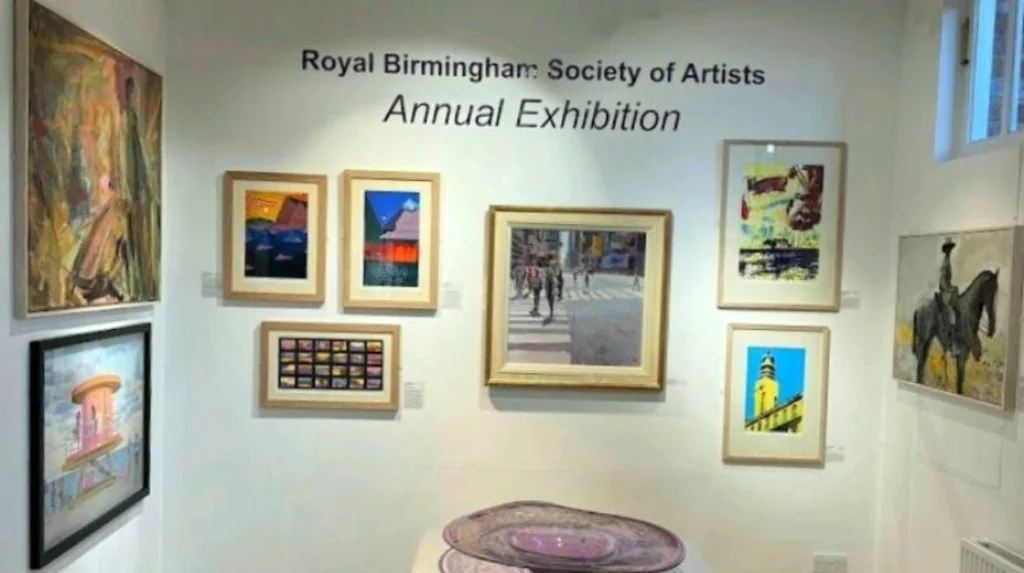
Today, the RBSA Gallery operates from Brook Street in St Paul’s Square, within Birmingham’s historic Jewellery Quarter. The current building opened in 2000. The society continues to operate as an artist-led charity supporting exhibitions, workshops, events, and engagement with visual art.
Its permanent collection contains almost 1,000 works, including paintings, prints, drawings, sculpture, ceramics, and jewellery. Artists represented include David Cox, Aubrey Beardsley, Joseph Southall, William Gear, and Bernard Fleetwood-Walker.
The archive is particularly valuable for local-history research. It contains exhibition catalogues, letters, records, and other material documenting the society’s activities. This creates a direct documentary connection between individual artists and Birmingham’s changing urban environment.
The gallery also provides practical creative experiences. Its programme includes exhibitions, workshops, talks, and events. The organisation states that it stages more than 20 exhibitions annually and offers workshops during its programme cycle.
For students, the RBSA therefore functions as both gallery and historical archive. For visitors, it provides an opportunity to see contemporary work within an institution whose history stretches back to the early nineteenth century.
Why is the Barber Institute of Fine Arts important to Birmingham?
The Barber Institute of Fine Arts is important because its 1932 foundation created a university-based art institution combining an exceptional collection, art history education, music, public access, and a landmark Art Deco building designed by architect Robert Atkinson.
The Barber Institute occupies a distinctive position in Birmingham’s cultural history. It was founded in 1932 by Hattie, Lady Barber, in memory of her husband, Sir Henry Barber. Her settlement established the basis for an art institution at the University of Birmingham.
The foundation reflected an educational philosophy. Lady Barber wanted the institution to combine an art collection with academic and cultural activity. Her plans included a concert hall as part of the proposed cultural centre.
The building opened in 1939 and was designed by Robert Atkinson, an important British architect of the interwar period. Its architectural style is associated with Art Deco, a design movement characterised by geometric forms, refined materials, symmetry, and modern decorative treatment.
The building itself became part of Birmingham’s heritage. It received a bronze medal from the Royal Institute of British Architects in 1946. Historic England upgraded its listing to Grade I in 2020, confirming its exceptional architectural significance.
The interior was designed around a central music auditorium. Galleries occupy the first floor, while academic and library spaces support the University of Birmingham’s departments of music and art history.
This structure makes the Barber particularly useful for understanding the relationship between art, architecture, music, and higher education.
Its historical significance also extends to collection development. Lady Barber’s foundation provided funding for the acquisition and maintenance of artworks. The resulting collection became an important academic resource for studying European painting, sculpture, drawings, prints, and decorative arts.
The Barber is therefore not simply a gallery destination. It represents a twentieth-century model of cultural philanthropy in which private wealth was directed towards public education and long-term cultural preservation.
Visitors interested in architectural history can study the building as carefully as the collection. The Art Deco structure provides evidence of interwar cultural ambitions and changing approaches to museum architecture.
How does Ikon Gallery represent Birmingham’s contemporary art history?
Ikon Gallery represents Birmingham’s contemporary art history through an artist-led model established in 1964, international exhibitions, education, off-site projects, and a commitment to making contemporary visual art accessible to broad audiences.
Ikon began in 1964 as an artist-led alternative to established gallery structures. Its founders included Jesse Bruton, Robert Groves, Sylvani Merilion, and David Prentice. The organisation initially described itself as a “gallery without walls,” reflecting its intention to take visual art beyond conventional exhibition spaces.
In 1965, Ikon occupied an octagonal glass-walled kiosk in Birmingham’s Bullring precinct. This unconventional beginning established an important principle: contemporary art could be presented in accessible public environments rather than confined to traditional cultural buildings.
Ikon later developed into an internationally recognised contemporary art gallery. It is now housed in a Victorian school building at Oozells Square in Brindleyplace.
The gallery’s contemporary programme provides a contrast with Birmingham’s historic collections. Rather than concentrating on a fixed historical collection, Ikon presents changing exhibitions and works with artists from different countries and artistic backgrounds.
Education remains central to its operation. Ikon describes itself as an educational charity and states that its education team develops relationships between artists, audiences, and contemporary art. The gallery also runs off-site projects that place artistic activity outside its main building.
Ikon reports more than 200,000 visitors annually across its gallery and off-site projects.
For visitors, this creates a different creative experience from a conventional museum. The exhibition itself becomes temporary research material, while talks, education projects, archives, and off-site programmes provide additional contexts.
For students of contemporary history, Ikon also provides evidence of changing attitudes towards public art. Its evolution from a small artist-led project in the 1960s to an internationally recognised institution illustrates the professionalisation and internationalisation of contemporary art in Britain.
Where can visitors experience Birmingham’s independent and experimental art scene?
Birmingham’s independent art scene is concentrated in areas such as Digbeth and the Jewellery Quarter, where artist-led galleries, studios, creative businesses, workshops, and exhibition spaces connect contemporary practice with the city’s industrial buildings and manufacturing heritage.
Digbeth is particularly important because its industrial buildings provide physical spaces for contemporary creative production. Former factories, warehouses, workshops, and commercial premises have been adapted for studios, exhibitions, cultural events, and creative businesses.
Eastside Projects is one significant example. It is an artist-run space in Digbeth that operates as a free public venue and commissions or presents experimental contemporary art. Its programme also examines how art can contribute to wider social questions.
The significance of this model lies in the relationship between place and artistic production. Birmingham’s industrial architecture provides large-scale spaces that accommodate installations, performance-related projects, experimental exhibitions, and collaborative activity.
The Jewellery Quarter provides another important creative environment. Historically associated with jewellery manufacturing and skilled craft production, the district retains workshops, historic buildings, independent businesses, galleries, and cultural organisations.
The RBSA Gallery is located near St Paul’s Square and provides a bridge between this manufacturing heritage and contemporary visual art. Its exhibitions include painting, sculpture, printmaking, ceramics, jewellery, and other practices.
Independent spaces also demonstrate the changing economics of cultural production. Artist-led organisations generally operate with different structures from large municipal museums. They often prioritise emerging artists, experimentation, collaboration, and temporary exhibitions.
This part of Birmingham is particularly useful for understanding adaptive reuse. Industrial buildings that once supported manufacturing now accommodate creative practices. The physical transformation reflects the broader economic transition from industrial production towards service, cultural, educational, and creative industries.
Street art adds another layer to this environment. Birmingham’s public spaces contain murals, graffiti, painted walls, installations, and temporary artworks that contribute to the city’s visual identity.
These experiences are less dependent on permanent collections. They require visitors to pay attention to changing exhibitions, public art, creative events, and neighbourhood development.
Which creative experiences allow visitors to make art themselves?
Birmingham offers hands-on creative experiences involving drawing, collage, graffiti, stained glass, craft, and traditional making, allowing visitors to connect the city’s industrial design heritage with practical artistic skills rather than viewing finished artworks alone.
Creative participation has deep historical roots in Birmingham. The city’s nineteenth-century art schools were closely connected to industrial design, and drawing academies trained people whose skills supported manufacturing and craftsmanship.
Contemporary creative experiences continue this practical tradition.
The city’s official tourism programme includes art and culture activities involving street art, galleries, workshops, and cultural encounters. It also lists creative and craft experiences involving glassmakers, artists, designers, and makers.
Stained glass is particularly relevant to the region’s manufacturing history. Glass production requires knowledge of heat, colour, material properties, cutting, joining, and design. Hands-on stained-glass experiences provide a practical introduction to a craft that combines artistic composition with technical production.
Graffiti workshops provide a contemporary counterpart. Participants learn techniques associated with urban visual culture while considering composition, lettering, colour, scale, and public space.
Collage and mark-making workshops offer another accessible format. These activities focus on materials, texture, line, composition, and experimentation rather than specialist equipment.
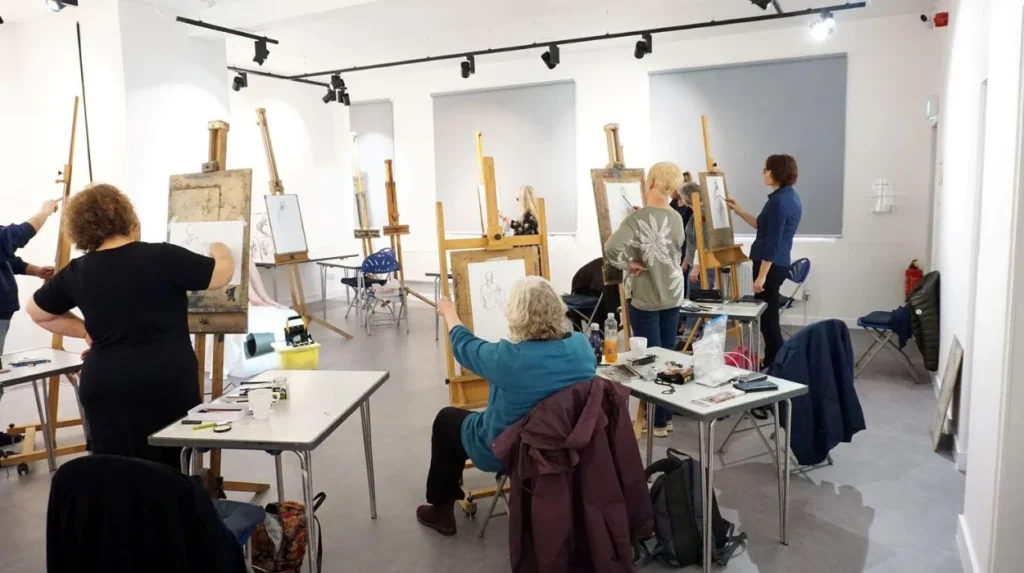
The RBSA also runs practical workshops. Its programme has included clay-based activities, drawing, and other artist-led learning experiences. The organisation supports educational visits and provides resources for schools, colleges, universities, and community groups.
These experiences have educational value because they convert art history into practical knowledge. A student studying Victorian design can examine materials and techniques. A visitor interested in contemporary art can understand the physical process behind an artwork.
The relationship between making and heritage is especially strong in Birmingham. The city’s industrial past depended on skilled labour, technical knowledge, experimentation, and design. Modern workshops retain those principles while applying them to contemporary artistic practice.
For cultural tourists, this makes Birmingham different from a destination based exclusively on passive museum visits. The city offers opportunities to observe, study, discuss, and create.
To experience this historic and creative heritage in person today, consult our comprehensive [How to Explore Birmingham’s Thriving Arts and Creative Scene] for itineraries and visiting parameters.
How does Birmingham connect historic art with modern creative culture?
Birmingham connects historic art with modern creative culture through museums, artist-led galleries, university collections, industrial buildings, craft workshops, public art, and creative districts, creating a continuous cultural framework from nineteenth-century art education to contemporary practice.
The strongest feature of Birmingham’s art landscape is institutional continuity. The RBSA began developing formal artistic education and exhibitions in the early nineteenth century. BMAG established a major municipal collection in the nineteenth century. The Barber Institute created a university-based cultural centre in the twentieth century. Ikon introduced an artist-led contemporary model in the 1960s.
These institutions represent different approaches to collecting and presenting art.
Municipal museums preserve objects for long-term public access. Artist societies support practising artists and document their professional communities. University museums connect collections with academic research. Contemporary galleries commission and exhibit changing artistic practices.
Together, they form a cultural ecosystem rather than a single art tradition.
Birmingham’s industrial heritage provides another connecting factor. The city’s manufacturing economy depended heavily on design. Jewellery, metalwork, ceramics, glass, architecture, engineering, and printed materials required visual planning and skilled craftsmanship.
That history remains visible in the Jewellery Quarter and Digbeth. Former industrial environments now contain galleries, studios, creative businesses, and workshops.
The transition also demonstrates a wider principle of urban cultural preservation. Heritage does not depend exclusively on keeping buildings unchanged. Historic spaces can retain significance when their architectural character, documentary evidence, and relationship with the city are understood.
Birmingham’s collections provide the documentary foundation for this process. BMAG and the wider Birmingham Museums collection preserve around 800,000 objects, while the RBSA maintains almost 1,000 works connected to its artistic history.
The city therefore offers several levels of engagement. Visitors can examine historic paintings, study architectural details, investigate industrial objects, view contemporary exhibitions, participate in workshops, or explore public art.
For educators, this range supports interdisciplinary study. Art history can be connected with industrial history, urban geography, architecture, economics, social history, technology, and heritage preservation.
For genealogical researchers, institutional archives provide another research pathway. Exhibition catalogues, artist records, local photographs, letters, and historical documentation can help reconstruct the cultural environment in which Birmingham residents lived and worked.
The future historical significance of Birmingham’s creative sector will depend partly on how current institutions document contemporary artists and preserve digital and physical records. Today’s temporary exhibition can become tomorrow’s archival evidence.
Birmingham’s art history is therefore not confined to Victorian paintings or historic galleries. It continues through artist-led organisations, public collections, university research, workshops, craft production, creative districts, and changing forms of public engagement.
The city’s most important creative experience is the ability to see these different layers together. A visit to a historic collection establishes the foundations. A contemporary gallery demonstrates later developments. A workshop reveals the process of making. An industrial district shows the physical environment that shaped Birmingham’s creative economy.
This combination explains why Birmingham remains an important destination for people studying British art, industrial heritage, architecture, craftsmanship, and contemporary culture.
Frequently Asked Question
What are the best art galleries in Birmingham?
Birmingham Museum & Art Gallery, Barber Institute of Fine Arts, Ikon Gallery, and Royal Birmingham Society of Artists are among the city’s leading art institutions. They cover historic collections, contemporary art, Victorian art, decorative arts, and artist-led exhibitions.