Birmingham is well suited to a winter day out because its compact city centre combines museums, historic civic buildings, libraries, canals, markets, theatres and industrial heritage within a relatively concentrated area. A successful winter itinerary starts with indoor attractions, then adds short outdoor heritage walks between them.
- What makes Birmingham a good destination for a winter day out?
- How should you start a winter day in Birmingham?
- Why is Birmingham Museum & Art Gallery important for a winter itinerary?
- How can you connect Birmingham’s civic history with its industrial past?
- What can you see at the Museum of the Jewellery Quarter?
- How should you use Birmingham’s canals during winter?
- Why should you include the Library of Birmingham on a historical winter day out?
- How can you plan an indoor afternoon in Birmingham?
- What winter attractions add historical context to Birmingham?
- How can you finish a Birmingham winter day with historic architecture?
- How can visitors protect Birmingham’s heritage during a winter day out?
- What is the ideal winter itinerary for Birmingham?
- How does a winter day out reveal Birmingham’s long-term historical development?
- Frequently Asked Question
The city’s modern visitor experience is rooted in a much older history. Birmingham developed from a medieval settlement into an industrial manufacturing centre, and its growth transformed its architecture, transport systems, cultural institutions and surrounding neighbourhoods. Birmingham City Council describes this heritage as a connection between ancient settlements, medieval markets, industrialisation and the modern multicultural city.
Winter provides a practical reason to explore that history through museums, galleries, archives and historic buildings. It also allows visitors to connect indoor collections with surviving streets, canals and industrial structures.
The most effective itinerary therefore does not treat Birmingham as a collection of unrelated attractions. It follows the development of the city itself, moving from civic Birmingham to industrial Birmingham and then to the modern cultural city.
What makes Birmingham a good destination for a winter day out?
Birmingham combines major museums, historic architecture, industrial heritage, canals, libraries, shopping districts and cultural venues in a compact urban area, allowing visitors to build a winter itinerary around short outdoor journeys and substantial indoor experiences.
Birmingham’s geography supports this approach. The central area contains Victoria Square, Chamberlain Square, Centenary Square, New Street, the canals around Brindleyplace and the Jewellery Quarter within practical travelling distance of one another.
The city also has a substantial heritage infrastructure. Birmingham Museums Trust manages nine venues, including Birmingham Museum & Art Gallery, Thinktank, Aston Hall, the Museum of the Jewellery Quarter, Soho House, Sarehole Mill, Blakesley Hall, Weoley Castle and the Museum Collection Centre.
This network reflects Birmingham’s historical development. The city became internationally important through manufacturing, engineering, metalworking and commerce. Its later development produced civic institutions, educational organisations, public libraries and cultural venues.
A winter itinerary works best when these different periods are deliberately connected.
For example, a morning spent examining Birmingham’s civic history can lead into an afternoon focused on industrial production. An indoor museum visit can then be followed by a short canal or architectural walk before returning indoors.
This approach reduces exposure to poor weather without removing the historical character of the visit.
It also creates a useful framework for students and educators. Birmingham becomes a physical case study in urbanisation, industrialisation, architecture, migration, commerce and heritage conservation rather than simply a shopping destination.
How should you start a winter day in Birmingham?
Start in the city centre with a major indoor attraction, then arrange the remainder of the day around nearby historic buildings, museums and cultural sites so that outdoor walking remains short, purposeful and connected to Birmingham’s development.
An early start gives visitors more time to use indoor attractions before winter daylight fades.
Victoria Square and Chamberlain Square provide a strong historical starting point. The surrounding civic buildings demonstrate the importance Birmingham acquired during the nineteenth century, when rapid industrial growth required increasingly substantial municipal institutions.
Birmingham Town Hall is particularly important. Designed by Joseph Hansom and Edward Welch, it opened in 1834 and became Birmingham’s oldest major venue. Its design was based on a classical temple, reflected in its monumental exterior columns.
The building also demonstrates how civic architecture developed alongside industrial wealth. Birmingham’s expanding population required spaces for public meetings, concerts and civic functions.
From Town Hall, visitors can walk towards Chamberlain Square and Birmingham Museum & Art Gallery.
The route is short enough to remain practical in winter. It also introduces an important distinction between Birmingham’s civic history and its industrial history.
The civic centre represents the nineteenth-century city that emerged from industrial expansion. The museum then provides evidence of the people, objects and industries that created that transformation.
A winter itinerary should place its longest indoor activity in the morning. This provides protection from cold weather and creates flexibility if later outdoor conditions deteriorate.
Visitors should check current opening arrangements before travelling because museum galleries and historic buildings sometimes operate different seasonal schedules.
Why is Birmingham Museum & Art Gallery important for a winter itinerary?
Birmingham Museum & Art Gallery provides one of the strongest indoor introductions to the city because its collections connect Birmingham’s medieval beginnings, industrial expansion, social history, art, archaeology and modern identity through objects and documented historical interpretation.
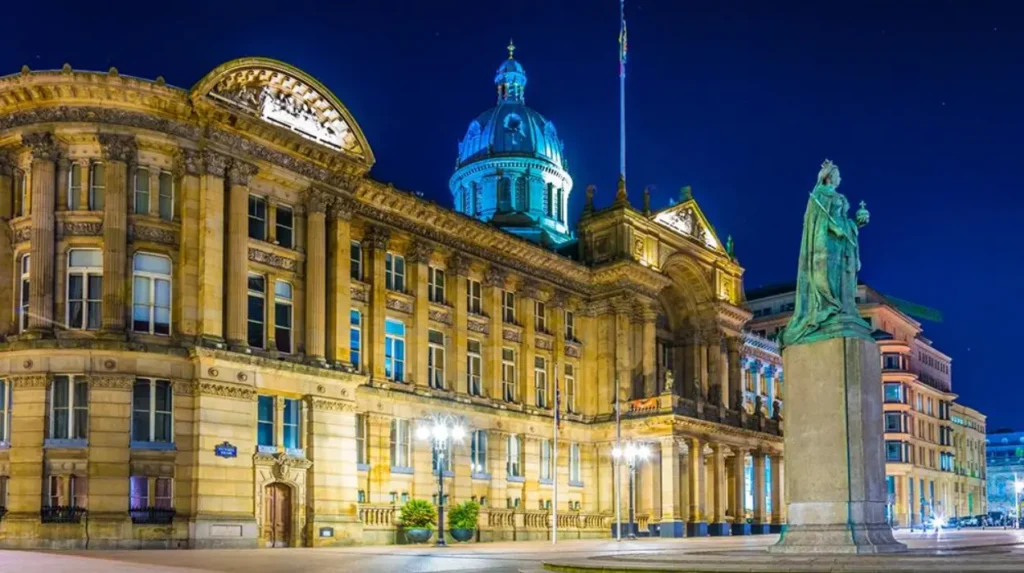
Birmingham Museum & Art Gallery occupies a Grade II* listed building overlooking Chamberlain and Victoria Squares. The building has been a prominent part of the city centre since 1885.
Its historical importance extends beyond the architecture.
The museum’s Birmingham history galleries examine the city from its medieval origins through eighteenth-century urban development, Victorian industrialisation, suburban expansion and the two world wars.
This chronological structure makes the museum particularly useful for understanding why Birmingham looks the way it does today.
Industrialisation altered the scale of Birmingham. Workshops and factories expanded, transport infrastructure developed and the population increased. Commercial success supported new civic institutions, while manufacturing created distinctive neighbourhoods such as the Jewellery Quarter.
The museum also holds internationally significant collections. Birmingham Museums Trust states that its collection contains around 800,000 objects across its venues and includes what it describes as the finest collection of Pre-Raphaelite art in the world.
The Staffordshire Hoard provides another historical connection. The museum describes it as the largest hoard of Anglo-Saxon gold ever found.
For winter visitors, the museum has an additional practical advantage. Much of the experience is indoors, making it possible to spend substantial time examining Birmingham’s history without depending on daylight or weather.
Current arrangements should always be checked before a winter visit. The museum currently operates selected galleries and spaces following restoration, with free general admission and seasonal opening arrangements.
How can you connect Birmingham’s civic history with its industrial past?
Connect civic Birmingham with industrial Birmingham by walking from Victoria Square and Chamberlain Square towards the Jewellery Quarter, using surviving buildings, street layouts, workshops and museums to show how manufacturing shaped the city’s nineteenth-century expansion.
The Jewellery Quarter is one of Birmingham’s most important industrial landscapes.
Historic England describes it as the most extensive surviving group of Victorian and twentieth-century buildings devoted to jewellery manufacture in Europe. Many buildings retain evidence of their original industrial function, including workshops, machinery and specialised layouts.
The Quarter developed because Birmingham already possessed strong metalworking and manufacturing traditions. Jewellery production became increasingly specialised during the eighteenth and nineteenth centuries.
The Birmingham Assay Office provides an important institutional example. It was established in 1773 following legislation promoted by Matthew Boulton and others. Its purpose was to test and certify precious-metal quality. The current Newhall Street premises developed from 1878.
An assay office is an institution responsible for testing precious metals and applying official marks that indicate their standard.
This system mattered because Birmingham’s expanding jewellery trade required confidence in the quality of manufactured goods.
The surviving architecture records this industrial process. Workshops often combined narrow street frontages with larger working spaces behind them. Large windows supplied natural light, while specialised machinery and internal arrangements supported production.
Historic England’s architectural research documented thousands of elements within the Quarter. Its archive includes photographs, measured drawings, reports and other records produced through a major survey of the area’s industrial buildings.
This makes the Jewellery Quarter particularly valuable during a historical winter day out. Visitors can observe the physical environment while using museum collections to understand the manufacturing processes behind it.
To experience this historic landmark in person today, consult our comprehensive [Top Things to Do in Birmingham During Christmas and Winter] for itineraries and visiting parameters.
What can you see at the Museum of the Jewellery Quarter?
The Museum of the Jewellery Quarter preserves a former jewellery workshop and uses its surviving machinery, rooms and working environment to explain Birmingham’s jewellery industry, making it an especially valuable indoor heritage stop during a winter itinerary.
The Museum of the Jewellery Quarter is located on Vyse Street in the historic manufacturing district.
Its central feature is the preserved workshop associated with Smith & Pepper, a jewellery manufacturing company. When the proprietors retired in 1981, the business closed and the premises remained largely intact. The site later became a museum.
This preservation provides an unusual form of historical evidence.
Instead of viewing isolated objects in display cases, visitors can examine an industrial workplace in its original physical context. The relationship between workrooms, tools, machinery and production spaces demonstrates how manufacturing operated at a human scale.
The museum also contains galleries examining the development of the Jewellery Quarter and the materials used in jewellery.
The surrounding streets extend this interpretation beyond the museum.
Historic England’s research identifies numerous listed workshops and manufactories within the district. Some buildings preserve original layouts and evidence of continuous industrial use.
The Quarter therefore functions as an outdoor extension of the museum.
A winter itinerary should allocate enough time to understand this relationship rather than treating the museum as an isolated attraction. A short architectural walk around Vyse Street, Frederick Street, Spencer Street and nearby streets provides direct evidence of the industrial landscape.
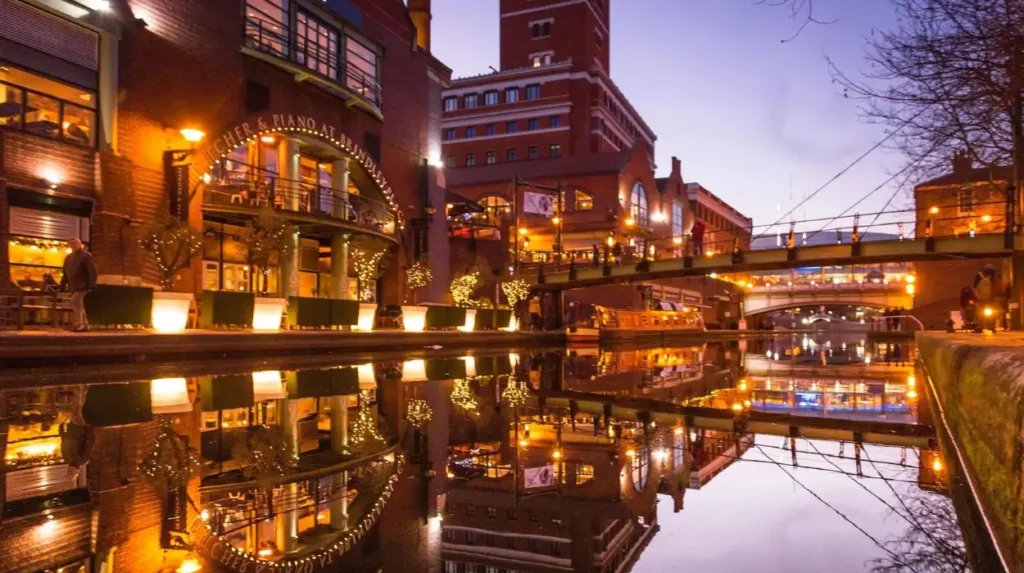
How should you use Birmingham’s canals during winter?
Use Birmingham’s canals as a short historical walking section rather than the main winter activity, focusing on surviving waterways around the city centre where nineteenth-century transport infrastructure connects industrial history with today’s regenerated waterfront environment.
Birmingham’s canals were fundamental to industrial development.
The Worcester & Birmingham Canal received its Act in 1791 and opened throughout in 1815. Its purpose was to provide a shorter connection between Birmingham and the River Severn.
The canal system supported the movement of raw materials and manufactured goods. Water transport reduced the difficulty of moving heavy industrial cargo through an expanding manufacturing city.
By the nineteenth century, the canal network had become heavily used. Congestion became sufficiently serious for engineer Thomas Telford to become involved in improvements to the Birmingham Canal Navigations. His New Main Line created a straighter route and reduced the distance between Birmingham and Wolverhampton by approximately one-third.
The later decline of canals demonstrates another major phase of technological change.
Railways became increasingly competitive because they offered faster transport. Canal companies subsequently lost much of their former economic importance. The remaining canal network was nationalised in 1948.
Today, central Birmingham’s canals form part of a regenerated urban environment.
A winter visitor does not need to spend hours beside the water. A short walk around Brindleyplace, Gas Street Basin and nearby canal routes provides enough context to understand how transportation influenced the city.
The canals are most effective as a transition between indoor attractions.
Why should you include the Library of Birmingham on a historical winter day out?
The Library of Birmingham adds an archival dimension to a winter itinerary because its heritage services provide access to local history materials, genealogy resources, maps, newspapers, photographs and archival collections documenting Birmingham and its communities.
The Library of Birmingham opened in September 2013 and replaced Birmingham Central Library. The building contains approximately 35,000 square metres of floor area across 13 floors.
Its importance extends beyond its contemporary architecture.
The Birmingham Collection has roots in the Birmingham Public Reference Library, which opened in 1866. The collection developed into one of the country’s largest and most comprehensive collections of Birmingham-related reference material.
This makes the library particularly valuable for students, researchers and people studying family history.
The Heritage Research Area contains printed local and family-history materials, genealogy resources, maps and local newspapers. The Wolfson Centre for Archival Research provides access to archival collections, photographs and early printed material by appointment.
For genealogical researchers, this creates a direct link between a winter city visit and historical research.
A visitor investigating a Birmingham ancestor can use local newspapers, maps and historical records to understand the environment in which that person lived.
The library also demonstrates Birmingham’s continuing investment in public knowledge.
Its presence in Centenary Square places a modern information institution within a civic landscape containing the Birmingham Museum & Art Gallery, Birmingham Repertory Theatre and other major cultural buildings.
This is an example of adaptive urban continuity: the city continues to use central space for education and culture while preserving access to historical evidence.
How can you plan an indoor afternoon in Birmingham?
Plan the afternoon around one major indoor cultural attraction and one shorter heritage stop, ensuring that the itinerary remains flexible enough to accommodate winter daylight, seasonal opening hours, travel delays and time spent examining historical collections.
A practical afternoon can begin at the Library of Birmingham or another central cultural venue before moving towards the canals or Jewellery Quarter.
The key principle is concentration.
A winter itinerary becomes less efficient when it involves repeated long journeys across the city. Central Birmingham contains enough museums, civic buildings and cultural institutions to create a full day without excessive travel.
Thinktank provides another major indoor option for visitors interested in science, technology and industrial development. Its collections complement the historical interpretation found at Birmingham Museum & Art Gallery.
The importance of science and engineering fits directly into Birmingham’s historical identity.
Manufacturing required technological knowledge, skilled labour, machinery and systems of production. Birmingham became associated with engineering innovation, metalworking and industrial entrepreneurship.
The city’s industrial history also connects with figures such as Matthew Boulton and James Watt. Boulton was an industrial entrepreneur associated with the Soho Manufactory, while Watt was an engineer and inventor whose steam-engine improvements had major implications for industrial production.
Their work illustrates the wider relationship between Birmingham’s manufacturing economy and technological development.
The afternoon should remain indoors during the coldest period of the day.
A later short outdoor walk works better when daylight conditions are clearer and the route has a specific historical purpose.
What winter attractions add historical context to Birmingham?
Winter attractions such as seasonal markets and temporary events add modern cultural history to Birmingham, showing how the city continues to use historic civic spaces for commerce, entertainment, international exchange and public gatherings.
Birmingham’s Frankfurt Christmas Market is a strong example.
The market began in Birmingham in 1997 and developed into an established seasonal event associated with Victoria Square and New Street. Birmingham City Council marked its 25th anniversary in 2025.
The market has a direct international connection with Frankfurt.
This relationship reflects Birmingham’s broader history as a commercial and industrial city with extensive international connections.
Seasonal events also demonstrate how historic spaces acquire new functions.
Victoria Square was developed as part of Birmingham’s nineteenth-century civic landscape. Today, the square can accommodate public events and seasonal activity while remaining surrounded by significant civic architecture.
The winter market should therefore be treated as part of the city’s contemporary cultural history rather than as a replacement for heritage sightseeing.
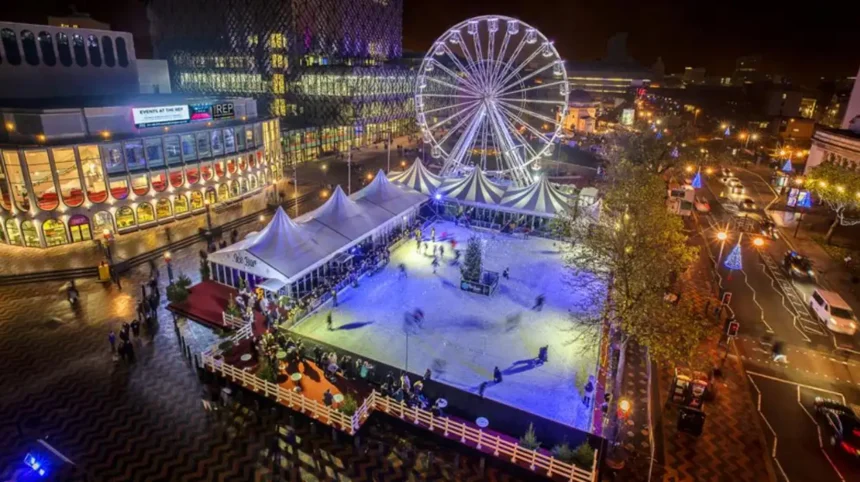
Exact market dates, operating hours and attractions change each year. Birmingham City Council’s published 2025 programme, for example, included the Frankfurt market from November to December and separate seasonal attractions such as an ice rink and Big Wheel.
Future visitors should verify the current programme before travelling.
How can you finish a Birmingham winter day with historic architecture?
Finish with a short architectural circuit through Birmingham’s central civic district, using Town Hall, public squares, churches, Victorian buildings and modern cultural structures to identify the physical layers created by different periods of urban development.
Evening architecture provides a final opportunity to interpret Birmingham without requiring another major attraction.
The central civic area contains buildings from different periods and architectural traditions.
Birmingham Town Hall represents nineteenth-century civic ambition. Birmingham Museum & Art Gallery represents the institutional growth of the Victorian city. The Library of Birmingham represents twenty-first-century investment in public culture.
The contrast demonstrates how Birmingham repeatedly rebuilt and adapted its urban centre.
This pattern is important to Birmingham’s heritage policy.
Birmingham City Council identifies 29 conservation areas across the city. These include the Jewellery Quarter and Bournville Village. Conservation areas receive statutory protection because their architectural or historic character is considered significant.
A conservation area is not simply an old neighbourhood. It is a defined area where planning controls help protect distinctive historic character.
The Jewellery Quarter provides the clearest example for a winter historical itinerary because its buildings preserve evidence of industrial production.
Other heritage areas demonstrate different aspects of Birmingham’s development.
Bournville, for example, represents planned community development associated with the Cadbury family’s industrial enterprise and social reform traditions.
The central city therefore provides a useful summary of Birmingham’s broader historical trajectory: medieval settlement, commercial expansion, industrialisation, civic investment, technological change, social development and modern regeneration.
How can visitors protect Birmingham’s heritage during a winter day out?
Visitors support heritage preservation by following site regulations, respecting listed buildings, using designated paths, avoiding physical contact with historic objects and supporting museums, archives and conservation organisations through responsible participation and appropriate donations.
Heritage tourism depends on the survival of physical evidence.
Historic buildings are vulnerable to weather, intensive use, inappropriate alterations and neglect. Winter conditions create additional pressures through rain, frost, moisture and reduced daylight.
Birmingham’s conservation system provides formal protection for significant areas and buildings.
The Planning (Listed Buildings and Conservation Areas) Act 1990 provides the legislative framework for conservation areas in England. Birmingham City Council uses conservation-area controls to manage development, demolition, advertisements and other changes affecting historic character.
Preservation also depends on community involvement.
Perrott’s Folly illustrates this principle. The Grade II* listed tower dates from 1758 and was built for John Perrott. Birmingham City Council records its later use as a Victorian weather station and notes structural repair work led by Birmingham Conservation Trust in 2005.
Such projects demonstrate that heritage survives through both statutory protection and active stewardship.
Visitors contribute by treating historic places as cultural resources rather than disposable backgrounds.
Museums also depend on conservation work.
Birmingham Museums Trust’s collection contains approximately 800,000 objects, many of which require professional storage, documentation, research and conservation.
Responsible visitation therefore has a direct relationship with the long-term preservation of Birmingham’s historical record.
What is the ideal winter itinerary for Birmingham?
An efficient winter itinerary begins with Birmingham Museum & Art Gallery, continues through the civic centre, moves to the Jewellery Quarter or Library of Birmingham, adds a short canal or architectural walk, and finishes with an evening cultural activity.
A full-day structure can follow Birmingham’s historical development.
Start with Birmingham Museum & Art Gallery to establish the city’s chronology. Concentrate on the Birmingham history galleries, industrial collections and other currently available displays.
Move towards Victoria Square and Town Hall. This short section provides architectural evidence of nineteenth-century civic development.
Continue towards the Library of Birmingham if archival research, local history or genealogy forms part of the visit.
The next stage should focus on industrial Birmingham.
Travel or walk towards the Jewellery Quarter and visit the Museum of the Jewellery Quarter when its current opening arrangements permit. Use the surrounding streets to examine surviving workshops and manufactories.
A short canal walk then provides transport history and a visual connection between Birmingham’s industrial past and regenerated modern centre.
Return towards the central area for an evening event, theatre performance, seasonal market or indoor cultural programme.
This order reduces unnecessary travel and places the longest indoor activities during the coldest parts of the day.
It also follows a logical historical sequence rather than an arbitrary attraction list.
How does a winter day out reveal Birmingham’s long-term historical development?
A winter day out reveals Birmingham as a continuously changing industrial and cultural city, where medieval settlement, eighteenth-century manufacturing, Victorian civic expansion, twentieth-century transport change and twenty-first-century regeneration remain visible in the urban landscape.
Birmingham’s historical significance comes from continuity as much as individual landmarks.
The medieval settlement established the foundation for later commercial growth. Eighteenth-century industrial development increased manufacturing capacity. Nineteenth-century expansion produced factories, workshops, canals, civic institutions and public cultural organisations.
The twentieth century introduced new transport systems, urban redevelopment and changing industrial patterns.
The twenty-first century has added cultural regeneration while retaining selected historic structures.
The Jewellery Quarter demonstrates industrial continuity. Historic England’s research found that the district remains substantially intact and retains evidence of the specialised urban workshop economy that developed during the nineteenth and twentieth centuries.
The canals demonstrate infrastructural change. Built to support industry, they later lost their dominant transport role as railways and roads expanded, but their surviving routes now contribute to Birmingham’s urban identity.
Museums preserve the documentary and material evidence behind these changes.
Libraries preserve another category of evidence: newspapers, maps, books, photographs, archival records and family-history resources.
Civic buildings provide the architectural evidence.
Together, these resources make Birmingham particularly suitable for historical tourism during winter. The city does not require visitors to rely on a single landmark. Its historical narrative exists across collections, streets, waterways, workshops and public institutions.
The long-term importance of Birmingham’s heritage is also reflected in current planning.
Birmingham is updating its Heritage Strategy for 2026–2031, with stated objectives involving conservation, engagement, sustainability and inclusive approaches to the city’s heritage.
That continuing work confirms that Birmingham’s history remains an active part of urban planning rather than simply a record of the past.
A well-planned winter day therefore provides more than seasonal entertainment. It creates a compact historical study of Birmingham’s transformation from a medieval market settlement into an industrial powerhouse and, subsequently, a modern cultural city.
For history enthusiasts, cultural tourists, educators, students and researchers, the strongest itinerary is one that connects these periods directly.
The result is a winter visit organised around evidence: museums for objects, archives for records, architecture for physical context, canals for industrial infrastructure and conservation areas for surviving urban character.
Birmingham’s winter heritage experience is strongest when those elements are treated as parts of one historical system.
Frequently Asked Question
What are the best things to do in Birmingham in winter?
Birmingham offers several winter-friendly attractions, including Birmingham Museum & Art Gallery, the Jewellery Quarter, the Museum of the Jewellery Quarter, the Library of Birmingham, historic canals and Birmingham Town Hall. These attractions combine indoor cultural experiences with short heritage walks, making them suitable for a full winter day out.