Birmingham is one of England’s most historically significant cities for understanding industrialisation, urban development, manufacturing and civic reform. A well-planned weekend connects its medieval origins with the canals, factories, civic buildings, museums and neighbourhoods that shaped its modern identity.
- What is the historical foundation of Birmingham?
- How did Birmingham become an industrial city?
- How should you structure the first day of a Birmingham weekend?
- Which Birmingham museums explain the city’s industrial history?
- Why should you visit Birmingham’s Jewellery Quarter?
- How can Birmingham’s canals be included in a weekend itinerary?
- What historic architecture should you see in Birmingham city centre?
- Which historic neighbourhoods should you explore beyond the city centre?
- How should you use Birmingham’s archives for historical research?
- How can you connect Birmingham’s industrial past with its modern identity?
- How can you plan an efficient two-day Birmingham history itinerary?
- Why does Birmingham’s history remain important for visitors and researchers?
- What makes a Birmingham weekend historically unforgettable?
- Frequently Asked Question
The city developed from a small medieval settlement into a major manufacturing centre during the Industrial Revolution. Its growth was driven by metalworking, engineering, canal transport, manufacturing, commerce and later motor production. Birmingham’s historic landscape still contains physical evidence of these transformations.
A weekend itinerary therefore works best when it follows the city’s historical geography. The central civic district explains Birmingham’s political and cultural development. The Jewellery Quarter demonstrates its manufacturing traditions. The canal network reveals its industrial transport system. Historic houses such as Aston Hall provide evidence of an earlier social order.
This approach creates a practical visit while preserving the historical connections between Birmingham’s surviving buildings, streets, waterways and collections.
What is the historical foundation of Birmingham?
Birmingham began as a small settlement and developed through medieval trade, metalworking, manufacturing and transport. Its 1166 market charter established commercial importance, while later industrial expansion transformed it into a major manufacturing centre during the Industrial Revolution.
Birmingham’s recorded history extends well before the Industrial Revolution. Birmingham City Council identifies evidence of human activity in the area dating to approximately 8000 BC. Later archaeological and historical evidence includes Bronze Age activity, Roman roads and medieval settlement.
The name Birmingham derives from the settlement associated with the Beorma or Birm tribe. The geographical location also influenced its development. The settlement occupied a relatively dry site with access to water and routes converging around Deritend Ford on the River Rea. Coal, iron and timber were accessible within the wider region.
The medieval settlement expanded through commerce. Peter de Birmingham obtained a market charter from King Henry II in 1166. In 1250, William de Bermingham received permission to hold a four-day Whitsun fair. These privileges strengthened Birmingham’s position as a market centre.
Metalworking became increasingly important. Birmingham taxpayers included smiths and craftsmen by 1327. By 1538, the antiquarian John Leland recorded approximately 1,500 residents living in 200 houses. He described a settlement containing markets, streets and numerous smiths selling products beyond the local area.
The English Civil War strengthened Birmingham’s reputation for manufacturing. Local producers supplied Parliamentarian forces with swords, pikes and armour. By 1731, the population had reached approximately 23,000 and manufacturing activity had expanded considerably.
This historical foundation explains why a modern weekend in Birmingham contains such a concentration of industrial, civic and commercial heritage.
How did Birmingham become an industrial city?
Birmingham became an industrial city through the expansion of metalworking, engineering, canals, manufacturing and commercial networks. Entrepreneurs such as Matthew Boulton and James Watt helped establish Birmingham as a centre for technological innovation and industrial production.
The Industrial Revolution did not transform Birmingham through one invention. It resulted from the interaction of manufacturing skills, entrepreneurial investment, transport improvements, scientific knowledge and access to regional resources.
Small-scale metalworking was already established before industrialisation. Birmingham became particularly famous for producing small manufactured objects known historically as “toys”. These included buckles, buttons, jewellery and personal ornaments. Many skilled producers worked from small workshops attached to houses.
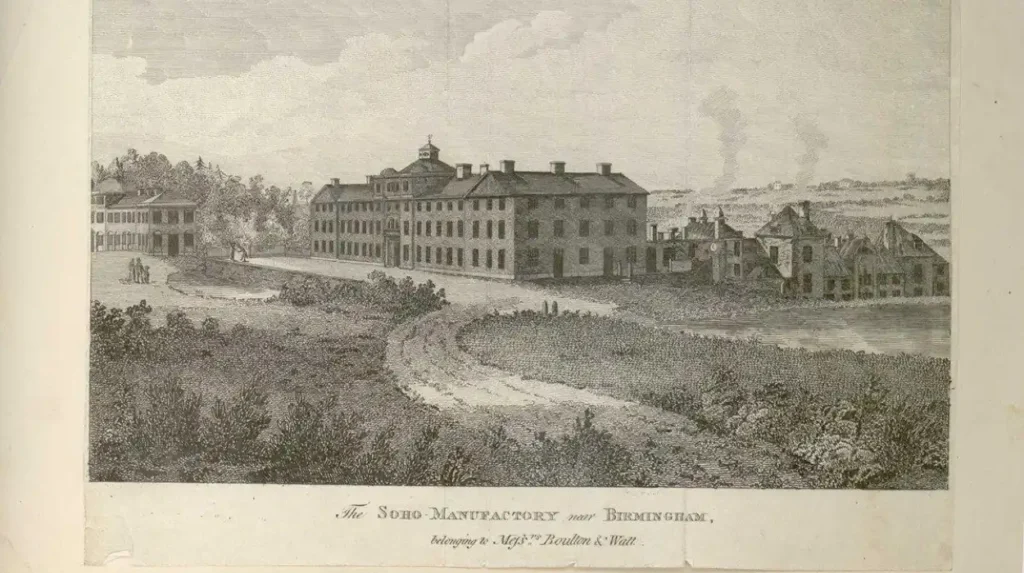
Matthew Boulton became one of Birmingham’s best-known industrial entrepreneurs. His Soho Manufactory, established at Handsworth in the 1760s, demonstrated the potential of organised manufacturing. Boulton worked with Scottish engineer James Watt, whose improved steam engine became important to industrial development.
The Birmingham region also developed strong networks connecting workshops, merchants and suppliers. Manufacturing was divided among specialised producers, allowing individual firms and craftsmen to concentrate on particular stages of production.
This system helped Birmingham develop a reputation for flexible manufacturing rather than dependence on one dominant industry.
The city’s industrial identity therefore rests on a combination of technological innovation and skilled craftsmanship. The surviving Jewellery Quarter, canal network, museums and industrial buildings provide physical evidence of this economic system.
For a weekend visitor, this history is particularly important because Birmingham’s attractions are not isolated monuments. They form parts of a wider industrial landscape.
How should you structure the first day of a Birmingham weekend?
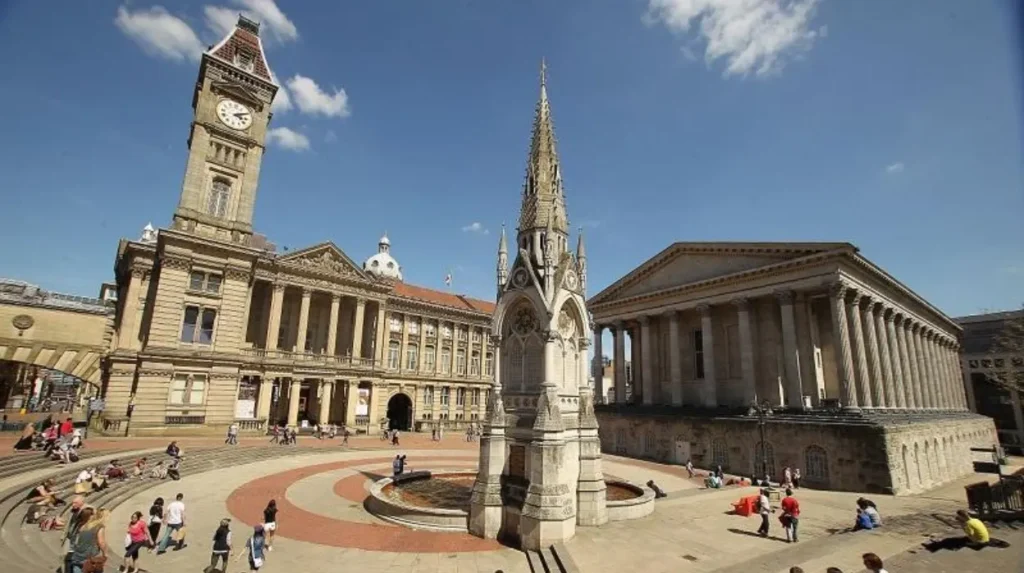
The first day should concentrate on central Birmingham, linking Victoria Square, Birmingham Town Hall, the Council House, Chamberlain Square, the Library of Birmingham and nearby museums to understand the city’s civic, cultural and architectural development.
Central Birmingham provides the most efficient introduction to the city’s history because major civic buildings stand within a compact area.
Begin around Victoria Square. Birmingham Town Hall opened in 1834 and was designed by Joseph Hansom and Edward Welch. Its architecture was influenced by classical temple design. The building became an important civic and cultural venue and later hosted major performers, including Buddy Holly, the Rolling Stones and Black Sabbath.
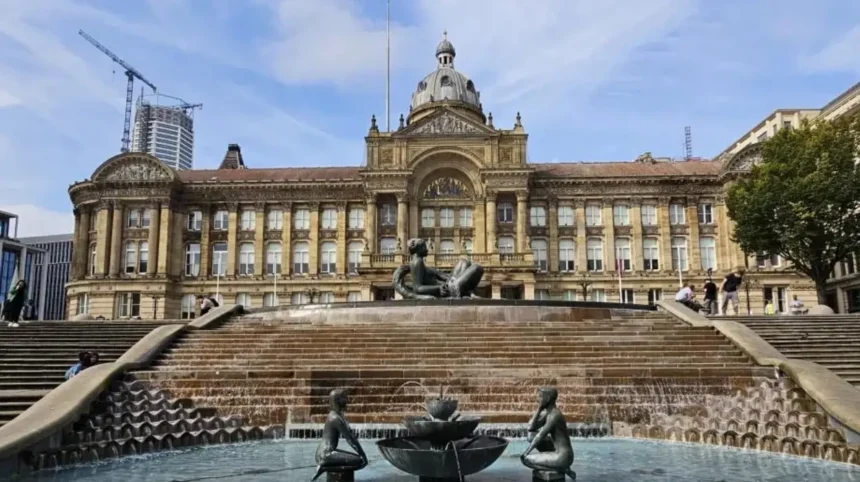
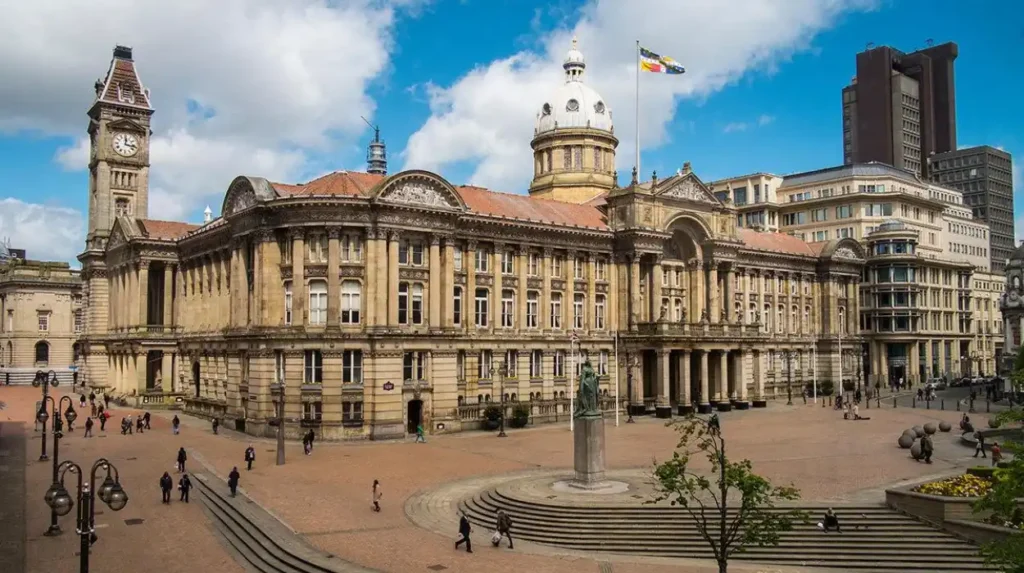
The nearby Council House represents the expansion of Birmingham’s municipal government during the nineteenth century. The Grade II* listed building opened in 1879. Its architecture reflects the confidence and wealth generated by industrial growth. Council meetings have been held there since the building opened.
Chamberlain Square provides another important historical connection. Joseph Chamberlain, a major nineteenth-century Birmingham politician and civic reformer, served as Mayor of Birmingham from 1873 to 1876. His municipal programme supported improvements in public services, infrastructure and urban conditions.
The Library of Birmingham continues the city’s educational tradition. Its collections include local history resources, archives, family history material and rare books. The Shakespeare Memorial Room, originally created in 1882, was designed by Birmingham architect John Henry Chamberlain. The room is now housed within the Library of Birmingham, which opened in 2013.
This central route creates a logical first-day sequence: medieval development, industrial wealth, municipal reform, education and modern cultural infrastructure.
To experience this historic landmark network in person today, consult our comprehensive [Best Weekend Activities in Birmingham for Locals and Tourists] for itineraries and visiting parameters.
Which Birmingham museums explain the city’s industrial history?
Birmingham’s museums preserve evidence of manufacturing, science, engineering, domestic life and social change. Birmingham Museums operates nine venues, including Thinktank, Aston Hall, the Museum of the Jewellery Quarter and other historic collections.
Museums are essential for understanding Birmingham because many industrial processes have disappeared from the working city.
Birmingham Museums operates nine venues, although opening arrangements differ between sites. Its collections cover Birmingham’s industrial heritage, culture, science, technology and medicine. Venues include Thinktank, Aston Hall, the Museum of the Jewellery Quarter, Soho House, Sarehole Mill and Weoley Castle.
Thinktank provides a strong introduction to science and engineering. Its collections connect Birmingham with technological development, manufacturing and scientific education.
The Museum of the Jewellery Quarter provides a more specialised historical experience. It preserves the story of Birmingham’s jewellery and small-metal trades and explains how production operated within purpose-built workshops.
Aston Hall offers a different period of history. The Grade I listed Jacobean mansion was constructed between 1618 and 1635 for Sir Thomas Holte. It predates Birmingham’s industrial expansion and demonstrates the social and architectural environment of the early seventeenth century.
The city’s museums also support academic research. Birmingham’s archives contain material relating to local government, family history, businesses, buildings and communities. The council states that its city archives contain more than 6,000 collections, including UNESCO-listed documents.
This makes museum visits valuable for students, educators, genealogical researchers and visitors interested in local heritage.
Why should you visit Birmingham’s Jewellery Quarter?
The Jewellery Quarter preserves Birmingham’s strongest concentration of historic jewellery and metalworking buildings. Its development accelerated during the eighteenth century, while the Birmingham Assay Office established hallmarking in 1773 and industrial production expanded throughout the nineteenth century.
The Jewellery Quarter is one of Birmingham’s most important surviving industrial landscapes.
Development began accelerating during the eighteenth century after land belonging to the Colmore family was released for construction. The area initially developed as a Georgian residential district before becoming increasingly industrial.
The Birmingham Assay Office was established in 1773. An assay office tests precious metals and applies official hallmarks indicating their quality and origin. The establishment of Birmingham’s assay office strengthened the city’s position within the precious-metal industry.
St Paul’s Church, consecrated in 1779, also reflects the neighbourhood’s eighteenth-century development. Its congregation included manufacturers and merchants such as Matthew Boulton and James Watt.
During the nineteenth century, factories increasingly replaced residential uses. Purpose-built workshops and factories supported jewellery production, electroplating and other metal trades.
George Elkington introduced commercial electroplating in the area around 1850. Electroplating allowed a thin layer of one metal to be applied over another material, supporting the production of affordable decorative objects.
Alexander Parkes, who worked in the area, developed Parkesine in 1862. Parkesine is an early man-made plastic material and represents Birmingham’s contribution to the development of synthetic materials.
Historic England describes the Jewellery Quarter as containing the most extensive surviving group of Victorian and twentieth-century buildings devoted to jewellery manufacture in Europe. Many original premises retained manufacturing connections, while some continue to support workshops and craft businesses.
A walking route should include St Paul’s Church, the Chamberlain Clock, surviving factories, former workshops and the Museum of the Jewellery Quarter.
How can Birmingham’s canals be included in a weekend itinerary?
Birmingham’s canals reveal how transport supported industrial growth. The city contains approximately 35 miles of canals, while the wider Birmingham Canal Navigations network extends for more than 100 miles and historically transported coal, iron and other heavy goods.
The canal network is one of the clearest physical reminders of Birmingham’s industrial economy.
Birmingham’s canals were constructed mainly during the eighteenth and nineteenth centuries. They connected manufacturing districts with coalfields, ports and wider commercial waterways.
The Birmingham Canal Navigations eventually developed into an extensive network. Birmingham City Council records approximately 35 miles of canals within the city and more than 100 miles across the wider Birmingham Canal Navigations system. At its historical height, the network exceeded 170 miles.
The canals transported heavy materials that were difficult and expensive to move by road. Coal was particularly important because steam engines and industrial furnaces required substantial fuel supplies. Iron, manufactured goods and other materials also moved through the waterways.
For a weekend itinerary, the central canal routes around Brindleyplace, Gas Street Basin and the surrounding waterways provide a direct connection between modern leisure areas and industrial transport history.
Gas Street Basin is particularly significant because it formed an important junction within Birmingham’s canal system. Today, restored towpaths and waterfront buildings demonstrate how former industrial infrastructure has been adapted to contemporary urban uses.
A canal walk therefore represents more than leisure. It explains the economic mechanism that helped Birmingham become an industrial manufacturing centre.
What historic architecture should you see in Birmingham city centre?
Birmingham’s central architecture records several stages of urban development, including medieval foundations, Victorian civic expansion and modern cultural construction. Town Hall, the Council House, St Philip’s Cathedral and the Library of Birmingham represent different periods of this transformation.
Birmingham’s architectural history is unusually varied because rapid industrial growth required new civic, religious, commercial and educational buildings.
St Philip’s Cathedral provides an eighteenth-century landmark within the modern city centre. The building originated as a parish church and later became Birmingham’s cathedral when the Diocese of Birmingham was established in 1905.
Birmingham Town Hall demonstrates nineteenth-century civic architecture. Its opening in 1834 reflected the city’s growing population and increasing cultural importance.
The Council House followed in 1879. Its construction reflected the expansion of municipal administration as Birmingham developed new responsibilities for sanitation, public health, infrastructure, education and urban management.
The Victorian period also produced public libraries, schools, baths and cultural institutions. These buildings reflected a broader belief that municipal authorities should provide public services to an expanding urban population.
The Library of Birmingham represents a later architectural phase. Opened in 2013, it continues Birmingham’s long relationship with public education and cultural collections. Its Shakespeare Memorial Room preserves a nineteenth-century interior within a twenty-first-century building.
Walking between these structures demonstrates how Birmingham repeatedly rebuilt its civic environment in response to population growth, industrial wealth and changing public expectations.
Which historic neighbourhoods should you explore beyond the city centre?
Aston and the Jewellery Quarter provide two contrasting historical landscapes beyond central Birmingham. Aston preserves seventeenth-century aristocratic architecture, while the Jewellery Quarter preserves industrial workshops, factories, churches and streets associated with manufacturing.
A weekend should extend beyond the central business district because Birmingham’s historical development occurred across multiple neighbourhoods.
Aston provides evidence of Birmingham before industrialisation transformed the city. Aston Hall was constructed between 1618 and 1635 for Sir Thomas Holte and remains one of the most significant Jacobean buildings in Birmingham.
The mansion was involved in the English Civil War. Parliamentarian forces besieged Aston Hall in 1643, and surviving damage on the great oak staircase records the violence of the attack.
Archaeological investigations have also revealed details about the estate. Excavations identified remains of a courtyard, stable buildings, a bakehouse, a brewhouse, a laundry and an icehouse. The icehouse was more than six metres deep and more than four metres wide.
Aston therefore demonstrates the physical organisation of an early modern estate.
The Jewellery Quarter represents the opposite economic model. Its buildings were associated with skilled manufacturing, workshops, factories and commercial production. Historic England identifies its surviving industrial architecture as nationally significant.
These neighbourhoods should be treated as separate historical chapters. Aston explains elite architecture and pre-industrial society. The Jewellery Quarter explains skilled urban manufacturing and industrial expansion.
How should you use Birmingham’s archives for historical research?
Birmingham’s archives provide primary historical evidence for studying families, businesses, buildings, politics and communities. The collections include thousands of archival holdings, local maps, photographs and genealogical resources that extend beyond the city’s museums and monuments.
Visitors interested in genealogy or academic research should include Birmingham’s archival resources in their planning.
The Library of Birmingham and Birmingham City Council provide access to local history and archival collections. Resources include family history information, historical maps, local government records, photographs and specialised collections.
Genealogical research benefits from connecting individual records with physical places. A historic street, neighbourhood, workplace or church can provide geographical context for an ancestor’s life.
Birmingham’s rapid nineteenth-century expansion makes this particularly important. Workers moved into industrial districts as factories and workshops expanded. New housing, schools, libraries, churches and public services followed population growth.
The Birmingham Back to Backs provide another valuable source of social history. The surviving courtyard contains restored nineteenth-century working-class housing. The National Trust interpretation records residential occupation extending from approximately 1840 to 1977.
These buildings demonstrate how industrial growth affected everyday domestic life. They also show why Birmingham’s history cannot be understood through industrialists and engineers alone.
A researcher should therefore combine archival documents with surviving buildings, maps, museum collections and local historical studies.
How can you connect Birmingham’s industrial past with its modern identity?
Modern Birmingham retains direct physical connections with its industrial past through canals, workshops, civic buildings, museums, restored factories and historic neighbourhoods. Contemporary regeneration has adapted former industrial spaces while preserving architectural evidence of earlier economic activity.
Birmingham’s modern identity developed through repeated economic and architectural transformation.
Industrial decline changed the function of many buildings during the twentieth century. Former workshops and factories lost their original manufacturing purposes, while canals ceased to serve the same commercial role they had during peak industrial activity.
Regeneration subsequently introduced new uses. The Jewellery Quarter now combines heritage buildings with independent businesses, creative enterprises, residential development and continuing craft activity. The area contains more than 700 jewellers and independent businesses according to the Jewellery Quarter’s current heritage organisation.
The canal network also demonstrates adaptive reuse. Former industrial waterways now support walking, cycling, leisure and waterfront development while retaining their historic routes.
Central Birmingham combines Victorian civic architecture with modern cultural buildings. The Library of Birmingham stands beside older civic institutions and demonstrates how cultural infrastructure continues to evolve.
This continuity is important for heritage preservation. Birmingham’s historic environment is not restricted to isolated monuments. Streets, waterways, workshops, civic buildings and archaeological remains collectively document the city’s development.
A successful weekend should therefore treat contemporary Birmingham as part of the historical landscape rather than as a separate destination.
How can you plan an efficient two-day Birmingham history itinerary?
A two-day itinerary works best when the first day focuses on central civic history and canals, while the second day concentrates on the Jewellery Quarter, museums and Aston. This sequence reduces unnecessary travel and follows Birmingham’s historical development logically.
The first morning should begin in the central civic district. Victoria Square, Birmingham Town Hall, the Council House and Chamberlain Square provide a compact architectural introduction.
Continue towards the Library of Birmingham and its collections. The Shakespeare Memorial Room adds a specific connection to nineteenth-century literary culture and Birmingham’s Victorian educational institutions.
The first afternoon should focus on museums or the central canal network. Thinktank provides science and industrial context, while a canal walk demonstrates the infrastructure that connected Birmingham’s manufacturing economy.
The second day should begin in the Jewellery Quarter. The Museum of the Jewellery Quarter provides historical context before a walk through the surrounding streets.
St Paul’s Church, surviving factories, historic workshops and the Chamberlain Clock help explain the area’s development from Georgian suburb to industrial manufacturing district.
The second afternoon should move towards Aston if opening arrangements and travel time allow. Aston Hall provides a contrasting architectural experience and introduces Birmingham’s seventeenth-century history. Archaeological remains around the mansion strengthen the historical interpretation.
Visitors should verify current opening hours before travelling because Birmingham Museums notes that not all venues are open at all times.
This two-day structure balances civic history, industrial heritage, social history, architecture and archaeology without treating Birmingham as a collection of unrelated attractions.
Why does Birmingham’s history remain important for visitors and researchers?
Birmingham’s history remains important because the city demonstrates how trade, technology, manufacturing, transport, municipal government and migration transformed an English market town into a major industrial and cultural centre with international historical significance.
Birmingham provides a concentrated case study of urban transformation.
Its medieval market economy created foundations for commercial growth. Skilled metalworking expanded manufacturing. Entrepreneurs introduced new production methods. Engineers developed technologies that influenced industrialisation. Canals reduced transport barriers. Municipal reform created new public infrastructure.
The nineteenth century brought rapid population growth and urban challenges. Housing, sanitation, education, transport and public health became major civic responsibilities. Birmingham’s Victorian buildings record the scale of this transformation.
The twentieth century introduced further changes through motor manufacturing, wartime production, suburban expansion, post-war redevelopment and deindustrialisation.
The twenty-first century continues this process through regeneration, cultural investment and heritage conservation.
Birmingham’s surviving historic structures therefore have long-term research value. The Jewellery Quarter preserves industrial architecture. Aston Hall preserves an early modern estate. The canal network preserves transport infrastructure. Civic buildings preserve evidence of municipal government. Archives preserve documentary evidence for families and institutions.
For educators and students, Birmingham provides a physical environment for studying industrialisation. For genealogists, its archives and historic neighbourhoods provide geographical context. For heritage specialists, its surviving buildings demonstrate the challenges of conservation within a growing city.
For general visitors, this historical framework makes a weekend more coherent. Each district contributes evidence to the larger development of Birmingham.
What makes a Birmingham weekend historically unforgettable?
An unforgettable Birmingham weekend combines historical chronology with direct observation. Medieval foundations, Victorian civic buildings, industrial canals, Jewellery Quarter workshops, museums, archives and Aston Hall together reveal how Birmingham developed through centuries of economic and social change.
The strongest historical itinerary does not depend on visiting the largest number of attractions. It depends on understanding the relationship between them.
Begin with Birmingham’s medieval origins and market economy. Continue through the industrial transformation created by manufacturing, engineering and canals. Examine the civic architecture produced by nineteenth-century municipal expansion. Then explore the surviving industrial landscape of the Jewellery Quarter.
Aston Hall adds an earlier architectural chapter. Its seventeenth-century construction predates Birmingham’s industrial dominance and demonstrates the different social structure that existed before rapid urbanisation.
Museums and archives provide evidence that buildings alone cannot explain. Objects, documents, maps, photographs, machinery and personal records reveal how residents experienced economic and social change.
The canals provide the strongest physical connection between Birmingham’s industrial past and present. Their routes remain visible even though their economic functions have changed.
The Jewellery Quarter demonstrates that heritage can remain economically active. Workshops, businesses and creative enterprises occupy buildings originally associated with manufacturing.
Birmingham’s historical significance therefore comes from continuity as well as change. The city retains evidence from multiple periods within a relatively compact urban area.
A carefully planned weekend can follow that evidence chronologically, geographically and thematically. It can connect medieval commerce with Victorian industry, industrial infrastructure with modern regeneration, and historic buildings with contemporary cultural life.
That approach turns a short city break into a concentrated study of Birmingham’s development and provides a durable framework for understanding why the city remains one of Britain’s most important urban heritage centres.
Frequently Asked Question
What are the best historic places to visit in Birmingham?
Birmingham Town Hall, the Council House, St Philip’s Cathedral, Aston Hall, the Jewellery Quarter and the Birmingham canals are among the city’s most important historic attractions.