Key Points
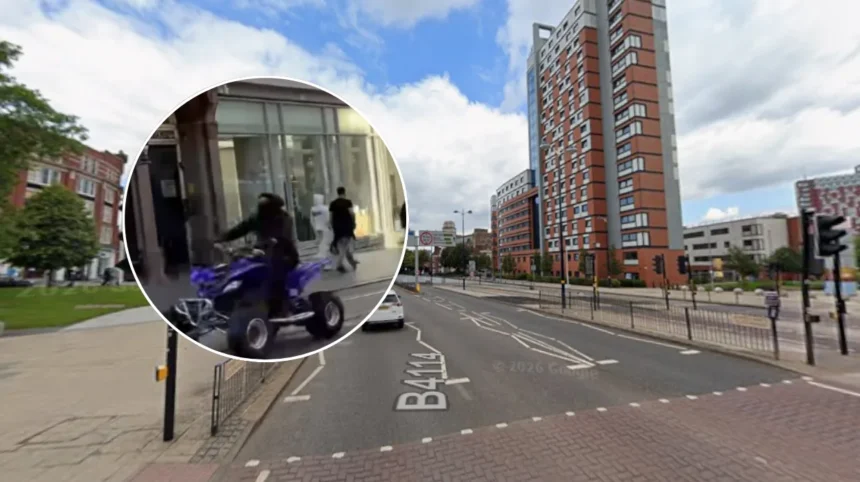
- Video footage from Birmingham city centre shows quad bike riders doing wheelies, driving on footpaths, weaving through traffic, and nearly hitting a pedestrian.
- Residents and witnesses said masked riders regularly run red lights, make excessive noise, and cause anti-social disturbances.
- Community members and council leaders urged West Midlands Police to increase enforcement against illegal and unlicensed quad bike riders.
- UK law prohibits riding quad bikes on public roads without a valid driver’s licence, insurance, vehicle registration, and approved safety gear.
Birmingham (Birmingham Express) September 19, 2026 — Footage captured in Birmingham city centre has revealed groups of quad bike riders weaving recklessly through congested traffic, mounting pedestrian footpaths, and narrowly missing members of the public. As reported by Ben Perrin of BirminghamLive, video footage shared across social media shows a quad biker sliding around a street corner and coming within inches of hitting a pedestrian who was attempting to cross the road.
- Key Points
- What are residents and local authorities saying about the ongoing disturbance?
- How are West Midlands Police responding to the illegal quad bike activity?
- Background of the particular development after the news
- Prediction: How this development can affect Birmingham residents, commuters, and city centre businesses
The escalating anti-social behaviour has drawn fierce criticism from local residents, shoppers, and business owners who describe the situation as an unmitigated public safety hazard. Additional reports indicate that masked riders have been spotted speeding down major suburban corridors, including Walsall Road and Aldridge Road in Perry Barr, running red traffic signals and creating severe noise pollution during peak evening hours.
What are residents and local authorities saying about the ongoing disturbance?
In a report published by BBC News, local community members voiced deep frustration at what they perceive as a lack of immediate intervention against off-road vehicle misuse on city streets. As noted by Ben Perrin of BirminghamLive, one resident who filmed the reckless driving posted online: “Another day, another round of reckless quads on the streets of #Birmingham this time almost knocking someone down. @WMPolice is it worth even reporting?” The same witness subsequently added: “And look, hours later, still at it, jumping red lights and being a noise nuisance.”
Eyewitnesses have also highlighted compounded traffic violations, pointing out that illegally parked vehicles frequently block pavements and emergency access routes while quad bike groups congregate without police dispersal. Public sentiment across social media platforms reflects a growing fear that the lack of effective law enforcement on these streets is endangering pedestrian safety on a daily basis.
How are West Midlands Police responding to the illegal quad bike activity?
West Midlands Police have acknowledged the community concerns and reiterated that the operation of off-road quad bikes on public highways without regulatory compliance constitutes a criminal offence. According to statements highlighted across regional news outlets, law enforcement officers are utilizing CCTV surveillance, public reports, and targeted patrols to identify repeat offenders, impound unregistered vehicles, and issue prosecution notices.
UK traffic law specifies that to be driven legally on public roads, quad bikes must meet strict road-safety standards, be fully registered with the DVLA, possess a valid MOT certificate (where applicable), hold third-party insurance, and be operated by a driver possessing a full UK driving licence. Police authorities continue to urge members of the public to submit dashcam and mobile video evidence to assist in identifying riders who routinely wear face coverings to evade recognition.
Background of the particular development after the news
The issue of illegal quad bike and off-road motorcycle usage has been a recurring public order challenge across major urban centres in the United Kingdom over recent years. Historically, urban areas such as Birmingham, Greater Manchester, and East London have seen seasonal surges in illegal off-road vehicle gatherings, often linked to organized anti-social behaviour networks and public road stunts filmed for social media distribution.
In response to previous incidents, West Midlands Police established specialized scrambler bike teams equipped with stingers, tracking drones, and DNA marking sprays designed to tag illegal riders without engaging in high-speed pursuits that could jeopardize public safety.
Local authorities, including Birmingham City Council, have periodically introduced Public Spaces Protection Orders (PSPOs) giving enforcement officers enhanced powers to confiscate vehicles operated in a manner causing alarm, distress, or annoyance to the public.
Despite these measures, the persistence of masked groups operating in high-density areas like Birmingham city centre indicates that enforcement strategy remains an ongoing operational challenge.
Prediction: How this development can affect Birmingham residents, commuters, and city centre businesses
The continuation and potential intensification of quad bike disturbances in Birmingham city centre are likely to impact several key stakeholder groups across the urban area:
- Pedestrians and Local Residents: If dangerous riding continues unmitigated, pedestrian footfall in shopping districts may drop due to heightened safety concerns, particularly during weekend evenings. Increased noise pollution and the risk of physical collisions on footpaths could lead to calls for stricter local curfews or enhanced physical barriers around pedestrianized zones.
- City Centre Businesses and Local Economy: Retailers, outdoor dining venues, and entertainment establishments in central Birmingham could face reduced consumer engagement if public perception shifts toward viewing the city centre as unsafe or poorly policed during peak trading hours.
- Law Enforcement and Municipal Policy: West Midlands Police and Birmingham City Council will likely face intensified political pressure to deploy additional resources toward specialized traffic units. This development may accelerate the adoption of city-wide legal injunctions, increased CCTV monitoring networks, and expanded powers for community protection officers to seize non-road-legal vehicles on sight.