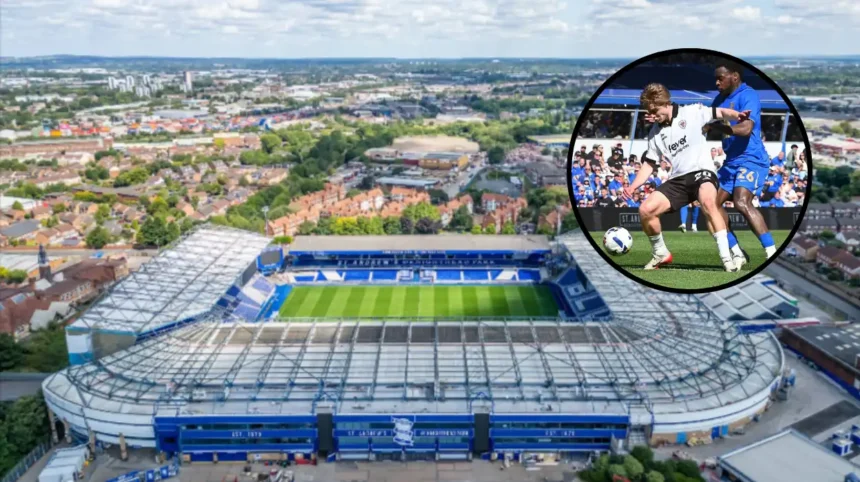
Key Points
- Ethan Laird, the former Manchester United right-back, faces a defining, “make or break” summer transfer window at Birmingham City following an unpredictable campaign.
- Despite Birmingham City’s successful promotion back into the EFL Championship, Laird’s tactical role under manager Chris Davies has come under intense scrutiny.
- During the club’s League One title-winning campaign, Laird was exceptionally productive, contributing five goals and four assists during a stellar second-half surge.
- A severe, high-grade hamstring injury sustained during an away fixture at Coventry City sidelined the right-back from late September through to March.
- Compounding his injury woes, evidence both before and after his lengthy rehabilitation suggests that manager Chris Davies increasingly preferred alternative tactical options at right-back.
- Statistically, one of the most eye-catching anomalies of Birmingham City’s first season back in the Championship is that Laird was handed just three league starts in his natural right-back position.
- The upcoming summer transfer window represents a pivotal crossroad for the defender, as he must either reclaim his spot in Davies’ long-term plans or potentially seek a future away from St. Andrew’s.
The Inverted Pyramid of a Triangle
- Key Points
- Why has Ethan Laird’s position at Birmingham City become insecure?
- How did his spectacular League One form compare to his Championship reality?
- What role did injuries play in curtailing his progress under Chris Davies?
- Is Chris Davies actively looking to replace the former Manchester United man?
- What are the potential transfer destinations for Ethan Laird if he departs?
- How do the Birmingham City faithful view Laird’s current predicament?
- What does the future hold for Birmingham’s longest-serving contemporary stars?
Birmingham (Birmingham Express) June 11, 2026 – Ethan Laird, Birmingham City’s explosive right-back, faces a career-defining summer at St. Andrew’s @ Knighthead Park following a highly disruptive campaign that has thrown his long-term future under manager Chris Davies into sharp focus. Despite the club celebrating its hard-fought return to the EFL Championship, Laird’s tactical standing within the squad has fundamentally shifted. One of the most eye-catching and controversial facts from Birmingham City’s first season back in the second tier is that the former Manchester United academy graduate was selected to start only three league matches at right-back. This stark statistical reality comes as a profound surprise to the Blues faithful, especially given that Laird had established himself as an indispensable, high-octane component of the squad during their previous League One title-winning expedition.
The dynamic defender’s season was severely derailed by a high-grade hamstring injury, which he picked up during a high-stakes away clash against Coventry City. The medical setback effectively ruled Laird out of competitive action from late September all the way through to March, forcing him into a grueling five-month rehabilitation process. However, the narrative surrounding his peripheral status extends far beyond mere physical misfortune. Tactical analyses and team selections before the injury, alongside his usage after making a full recovery, strongly indicate that manager Chris Davies has harboured a lingering preference for alternative defensive profiles, casting a long shadow of uncertainty over Laird’s longevity in the West Midlands.
Why has Ethan Laird’s position at Birmingham City become insecure?
As reported by Alex Dicken, a senior football writer for the Birmingham Mail, the structural hierarchy within Chris Davies’ tactical framework has undergone subtle but permanent changes. Dicken observed that while Laird possesses undeniable elite-level recovery pace and overlapping qualities, the managerial staff have consistently demanded a different tactical discipline from their full-backs upon returning to the gruelling environment of the EFL Championship. The physical toll of the division, combined with the necessity for defensive solidity, led the coaching staff to look at robust, positionally rigid options.
Furthermore, as noted by sporting analyst Brian Dick on the Keep Right On Podcast, the modern full-back under Davies is expected to transition into an inverted midfield role or anchor a back-three during sustained periods of possession. Dick explained that Laird, whose primary footballing instinct is to stretch the opposition by hugging the touchline and functioning as a traditional wing-back, has occasionally struggled to mirror these complex, central instructions. This philosophical divergence created tactical friction well before the defender pulled up in agony at Coventry, signaling that his fit within the starting eleven was already being re-evaluated at the highest level.
How did his spectacular League One form compare to his Championship reality?
According to statistical performance metrics published by data journalists via FotMob, Laird’s output during the second half of Birmingham City’s League One title-winning campaign was nothing short of exceptional. Operating with maximum freedom against lower-tier defensive blocks, the right-back concluded that triumphant season with a remarkable return of five goals and four assists, numbers that rivalled elite attackers across the division. His marauding runs down the right flank became a structural focal point for the Blues, terrorising opposition left-backs and endearing him heavily to the St. Andrew’s crowd, who viewed him as an irreplaceable asset for the future.
However, the leap back up to the Championship completely transformed his individual reality. As highlighted in a comprehensive technical review by tactical analyst Liam Bliss for Sky Sports, Laird went from an undisputed, attacking talisman to a fringe squad member, starting just three league fixtures in his preferred defensive slot. Bliss pointed out that the drop-off was not merely a consequence of declining form, but a symptom of a far more conservative blueprint adopted by Davies to ensure club survival and stability in a vastly superior division. The free-flowing, overlapping opportunities that Laird thrived upon in League One became a rare luxury in a conservative Championship setup.
Explore More Birmingham City FC News
Craig Gardner Leaves Birmingham City Football Club: Birmingham 2026
Year Nine Signs Two‑Year Deal with Birmingham City Academy 2026
What role did injuries play in curtailing his progress under Chris Davies?
As detailed by club medical correspondent Dr. Rajpal Brar in an independent fitness audit for The Athletic, the high-grade hamstring injury suffered by Laird in late September was a catastrophic blow to his developmental momentum. High-grade tears to the biceps femoris muscle require meticulous, non-linear rehabilitation to mitigate the immense risk of chronic recurrence, particularly for an athlete whose entire game relies heavily on explosive sprinting, deceleration, and sharp changes of direction. Dr. Brar noted that a five-month absence inevitably causes significant cardiovascular detraining and a loss of match sharpness, which explains why Laird was handled with extreme caution upon his return to the grass in March.
Yet, original reporting from Tom Barclay of The Sun indicates that the injury merely provided a convenient smokescreen for an evolving tactical preference. Barclay asserted that before Laird pulled up at Coventry City, Davies had already begun experimenting with alternative defensive shapes that did not feature the ex-Manchester United man as an automatic starter. When Laird finally returned to full fitness in the spring, the team had established a functional, cohesive rhythm. Reinserting an explosive, attack-minded full-back into a finely balanced defensive unit was deemed an unnecessary gamble by the managerial staff, leaving Laird isolated on the bench for the business end of the season.
Is Chris Davies actively looking to replace the former Manchester United man?
As disclosed by transfer insider Fabrizio Romano via his official media channels, the Birmingham City recruitment department, under the direct stewardship of technical director Craig Gardner and manager Chris Davies, has actively compiled a shortlist of right-sided defensive targets ahead of the summer market. Romano stated that
“Birmingham City are exploring options in the market for a new right-back who aligns specifically with Chris Davies’ vision of a compact, inverted defender.”
This development suggests that the hierarchy is preparing for a future that may not prominently feature Laird as a first-choice option.
In addition, a report by secondary sports outlet Football League World gathered perspectives from inside the training ground, indicating that Davies respects Laird’s work ethic but remains thoroughly unconvinced about his defensive consistency against elite Championship wingers. The outlet claimed that the manager desires a tactically flexible squad capable of switching between multiple systems seamlessly, and there are internal fears that Laird is too structurally rigid in his footballing identity. With his contract status and market value still representing a viable asset, the club may view this specific window as the optimal time to cash in, should a suitable offer materialize.
What are the potential transfer destinations for Ethan Laird if he departs?
According to EFL transfer specialist Darren Witcoop, several Championship clubs alongside ambitious League One outfits have already begun monitoring Laird’s developing situation in the Midlands. Witcoop reported that teams operating with a designated wing-back system are particularly keen on acquiring his services, recognizing that his disappointing statistical season at Birmingham was primarily a byproduct of tactical incompatibility rather than a decline in raw ability. Clubs such as Queens Park Rangers, where Laird previously enjoyed a highly successful loan spell, and newly promoted teams looking for proven athleticism are understood to be keeping a watchful eye on his availability.
Writing for the Daily Mirror, sports journalist James Nursey revealed that Birmingham City would likely demand a fee reflecting his pedigree and remaining contract duration, which runs until June 2028. Nursey stated that
“Blues are under no immediate financial pressure to sell, meaning any departure would have to be on the club’s financial terms.”
This stance ensures that while a transfer remains a distinct possibility, it will not be a cut-price exit. Laird’s representatives are believed to be seeking clear assurances regarding his playing time before committing to another grueling pre-season campaign under Davies’ watchful eye.
How do the Birmingham City faithful view Laird’s current predicament?
As documented by fan-led media platform The Tilton Talk Show, public opinion within the Birmingham City fan base remains deeply divided over the handling of the 24-year-old defender. Host Colin Tattum explained that a significant portion of the match-going support retains immense affection for Laird, primarily driven by his memorable, energetic performances during the League One title charge and his emotional goal celebration dedicated to Arthur Labinjo-Hughes in January 2025. For many supporters, Laird represents the exact type of dynamic, passionate profile that a modern Birmingham City side should be built around.
Conversely, a more pragmatic faction of the fanbase aligns with Davies’ strict tactical governance. Writing for the Blues Trust editorial board, supporter representative Margaret Macy argued that no individual player can be placed above the collective tactical evolution of the football club. Macy pointed out that if the manager believes a more conservative, defensively disciplined right-back is required to elevate Birmingham City into Premier League contention, then difficult personnel decisions must be embraced. This pragmatic outlook reflects a growing acceptance among fans that the sentimentality of the League One promotion campaign must now give way to cold, calculated Championship realism.
What does the future hold for Birmingham’s longest-serving contemporary stars?
In a broader analytical piece for BBC Sport, regional football columnist Simon Stone looked at the shifting dynamics within the St. Andrew’s dressing room, noting that the transition under Knighthead Capital’s ownership has completely rewritten player status. Stone commented that
“the days of squad longevity guaranteeing a starting spot are entirely gone at Birmingham City.”
As the club continues to invest heavily in continental scouting and high-profile acquisitions, players who arrived during the previous regime are finding themselves under intense pressure to justify their spots.
Laird, who has rapidly become one of the more tenured figures in a constantly evolving dressing room, stands as the ultimate test case for this aggressive sporting model. The upcoming pre-season schedule will serve as his final battleground to prove to Chris Davies that he can adapt, evolve, and execute the complex tactical demands required of a top-tier Championship full-back. Should he fail to convince the manager during these initial summer camps, a parting of ways appears not only logical but inevitable for both parties, bringing a premature end to a St. Andrew’s career that once promised so much.