
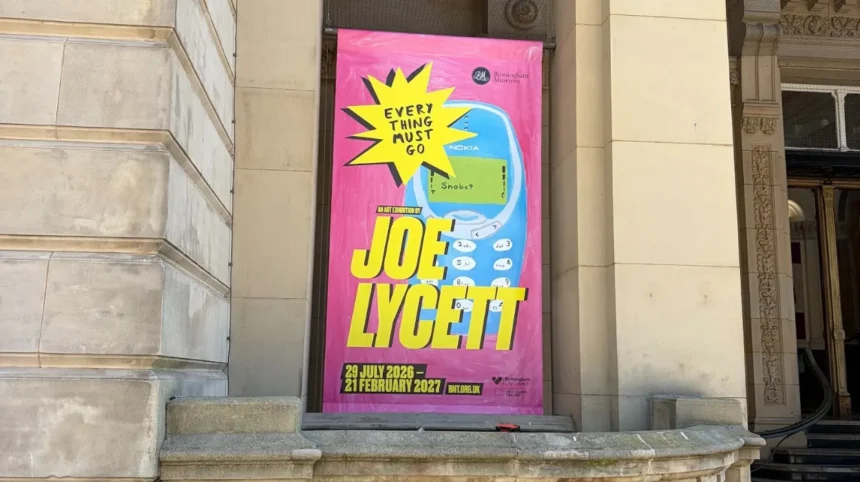
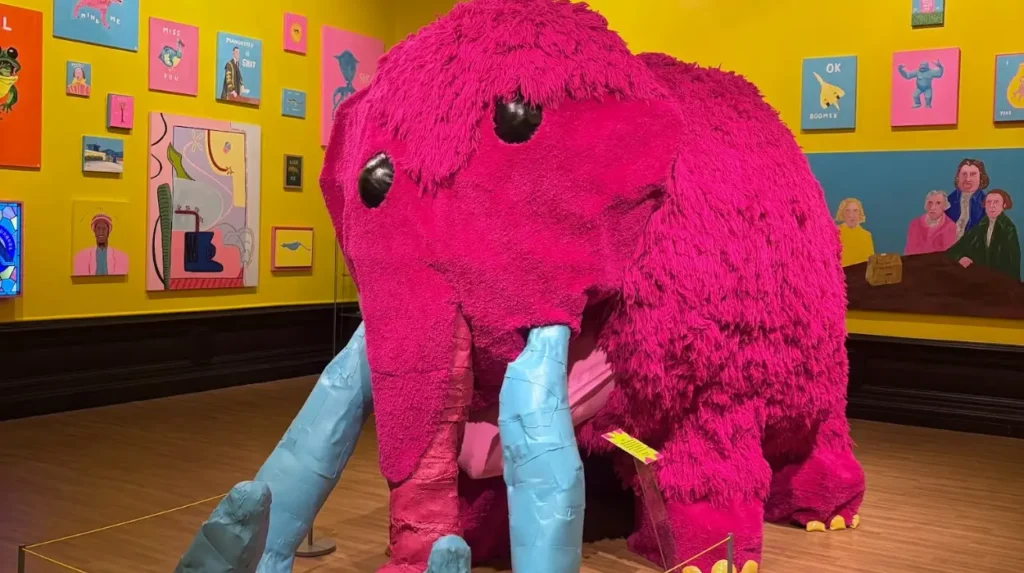
As you wander through the galleries of Birmingham Museum & Art Gallery, surrounded by the cascading red-haired beauties of the city’s famed Pre-Raphaelites, you’re suddenly interrupted by a glow of neon yellow. Drawn towards it, you’re confronted by a towering, lopsided hot-pink mammoth. And that’s when you know you’ve entered Joe Lycett’s EVERY THING MUST GO exhibition.
The comedian-turned-artist wastes no time setting the tone. The opening wall text reads:
“At the time of writing I am a human man who is alive and living in the best city in the world (Birmingham). I like to make silly things, tell jokes, make television and films, and also do daft art.”
It’s a typically self-deprecating introduction, but beneath the humour lies an exhibition with genuine heart.
EVERY THING MUST GO is a joyful, nostalgic meditation on loss in all its forms. Across paintings, sculpture, ceramics, stained glass and taxidermy, Lycett reflects on everything we’ve misplaced, demolished, driven to extinction or simply outgrown. Some losses are deeply personal, others uniquely Brummie, while a few are so absurd they could only have come from Lycett’s imagination.
Among the standout works is a lurid hot-pink and yellow depiction of the OceanGate Titan disaster, captioned with the deadpan phrase, “Everything is fine.” Elsewhere, a painting commemorates Birmingham’s beloved Village Inn, the historic gay bar whose original home on Hurst Street has since closed, accompanied by the caption: “On Sundays we go to Church.” A nostalgic painting of Hall Green Greyhound Stadium recalls another piece of Birmingham history, while a monumental portrait of Ozzy Osbourne celebrates one of the city’s most enduring icons. Perhaps the most unexpectedly touching work is a portrait of a dodo simply titled “Miss You”.
Lycett’s voice is as much a part of the exhibition as the artworks themselves, effortlessly veering between silliness and sincerity.
“Here we remember things. Some of them I am very sad to lose, others I am glad to be rid of. I’m pleased to not have to share the planet with the Hatzegopteryx, a flying dinosaur that would have looked at me the way I look at a Cumberland sausage.”
It’s an excellent summary of the show’s emotional register: affectionate, ridiculous and surprisingly reflective.
The exhibition’s most humorous installation sits inside a display cabinet, evoking the eccentric collection of a colonial explorer. Three taxidermied extinct animals stand before old-tech CRT monitors, each playing a “Joe Lycett Comedy Test” videotape. In these videos, Lycett performs bespoke stand-up routines to his silent animal audience. The jokes are gloriously dreadful.
“A long-nosed potoroo walks into a bar,” he begins. “The barman says, ‘Why the long… nose?'”.
This is followed by:
“What do you get if you cross a kangaroo with a mouse? Whatever you are.”
The jokes are knowingly terrible, but that’s precisely the point. The sheer absurdity makes cracking a smile almost inevitable.
But running beneath the comedy is a genuine celebration of creativity.
“Everyone should make art in some way. It’s really good for you,”
Lycett writes.
“It’s impossible to send hate tweets while glazing a salad bowl.”
This philosophy radiates throughout the exhibition. Every room feels infused with the delight of making things, experimenting with materials and embracing playfulness without worrying whether the result is “serious” enough.
At its core, EVERY THING MUST GO is a love letter to Birmingham — to its landmarks, its characters, its queer history and its cultural icons — while also acknowledging that nothing lasts forever. Funny, poignant and consistently inventive, it’s an exhibition that succeeds in making you laugh while also underscoring why remembering matters.
The free exhibition is open to the public until 21st February 2027. As Lycett himself puts it:
“Be sure to catch it while you can because, like everything, one day it must go.”
A wonderful solo exhibition that is just as entertaining for children as it is for adults, EVERY THING MUST GO proves that humour and genuine emotion are far from opposites. In Joe Lycett’s hands, they’re inseparable.