Key Points
- Developer Sphere Group has opened a public consultation on “Rackhams Place”, its proposed mixed-use scheme for the former Rackhams department store site on Temple Row.
- Newly released images detail plans for more than 500 homes, 21,000 square metres of office space, and ground-floor retail, food, and drink units.
- The proposal forms part of Birmingham City Council’s “Birmingham Central Heart Vision” to redevelop 17 hectares of retail and commercial land.
- Sphere Group estimates the project has a gross development value of £350 million and will create roughly 1,300 jobs.
- A public consultation meeting is scheduled for Thursday, 24 September 2026, at One Temple Row, alongside an online portal.
- House of Fraser closed its department store at the site on 25 June 2026.
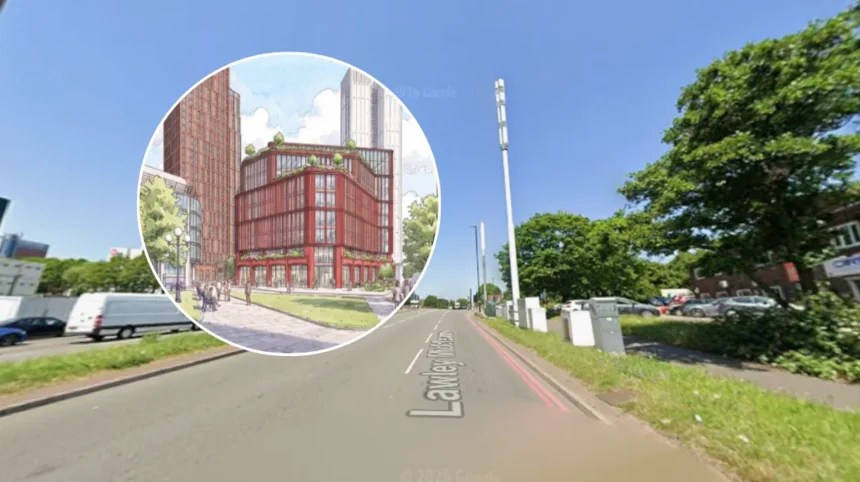
Birmingham (Birmingham Express) September 22, 2026 – As reported by Graeme Brown, Editor-in-Chief for West Midlands at Reach PLC, property developer Sphere Group has formally unveiled its regeneration plans and computer-generated imagery (CGIs) for the landmark Rackhams building in Birmingham city centre. The proposals, titled “Rackhams Place”, outline a comprehensive mixed-use overhaul that will convert the former House of Fraser site into a community featuring over 500 residential homes, 21,000 square metres of high-grade office space, and new ground-floor retail, food, and beverage outlets.
The announcement marks the official commencement of the public consultation phase ahead of a formal planning application submission. As noted by Zoe Chamberlain, Parenting Editor for the Birmingham Mail, the location spent more than 160 years operating as a flagship retail destination before the department store officially closed its doors on 25 June 2026.
Sphere Group, operating as development partner for freehold owners Legal & General, confirmed that the proposed masterplan incorporates the main store building along Corporation Street as well as adjacent premises at 1 Temple Row and 43 Temple Row.
How Does Sphere Group Plan To Engage The Local Community?
Addressing the launch of the scheme, Thomas Taylor, Managing Director at Sphere Group, stated: “We’re really excited to show off our plans and discuss them with our passionate Birmingham community. This is urban regeneration defined by high-quality design, attractive new public realm and new commercial spaces.”
Taylor further highlighted the wider economic impact of the project, stating that “The development could provide office space, new homes, new retail and improved public spaces, creating around 1,300 jobs and around £350m in gross development value.”
To gather feedback from city residents, businesses, and civic stakeholders, a public consultation event will be held at One Temple Row (B2 5LG) on Thursday, 24 September 2026, running from 3:30 pm to 7:30 pm. Members of the project team will be present to answer queries and outline specific architectural proposals. Concurrently, a dedicated public consultation website will be made accessible to enable digital submissions.
Background To The Rackhams Site Redevelopment
The Rackhams building holds substantial history within the West Midlands commercial landscape. Established in the 19th century and subsequently acquired by Harrods and later House of Fraser, the vast department store bounded by Corporation Street, Cherry Street, and Temple Row stood for generations as Birmingham’s premier retail venue. However, changing consumer shopping patterns, the growth of e-commerce, and the opening of the nearby Bullring shopping complex gradually diminished footfall across the traditional retail core.
In December 2019, Birmingham City Council granted initial planning permission for a £110 million scheme backed by Legal & General and designed by architecture firm tp bennett to convert the building into offices, boutique hotel space, and a rooftop bar. However, the economic pressures of the COVID-19 pandemic, alongside shifting demands for flexible commercial and urban residential spaces, necessitated a revised strategy.
Earlier in 2026, Birmingham City Council introduced its “Birmingham Central Heart Vision”. This strategic framework aims to re-energise 17 hectares of under-utilised commercial space in the central shopping district by creating high-density mixed-use hubs, linear green spaces, and sustainable footpaths linking the city center to the upcoming HS2 Curzon Street Station.
Following the permanent departure of House of Fraser in June 2026, Sphere Group submitted Environmental Impact Assessment (EIA) scoping documentation (Reference: 2026/04259/PA) to refine the site’s residential and office ratios, ultimately leading to the current Rackhams Place design.
Prediction: How Will This Development Affect Local Residents and Businesses?
The transformation of the Rackhams building into Rackhams Place is anticipated to bring noticeable structural changes to various groups across Birmingham city centre:
- Local Retailers and Commercial Operators: The transition from a single, vast department store to a active mixed-use community with ground-floor shops, cafes, and restaurants is set to increase daily footfall along Temple Row and Corporation Street. Surrounding small businesses and hospitality venues will likely benefit from a consistent stream of customers driven by incoming office workers and residents.
- City Centre Homebuyers and Renters: The delivery of over 500 new homes directly addresses the growing demand for urban housing in the central core, offering high-density living options close to primary transport links like New Street Station and the West Midlands Metro.
- Commercial Tenants and Corporate Employers: The inclusion of 21,000 square metres of modern, energy-efficient office space provides regional and national companies with Grade-A workspace in a central location, aiding corporate retention within the West Midlands.
- Construction Sector and Job Seekers: With an estimated gross development value of £350 million, the construction phase will generate significant civil engineering, trade, and architectural supply-chain opportunities, alongside an estimated 1,300 permanent operational and commercial jobs post-completion.