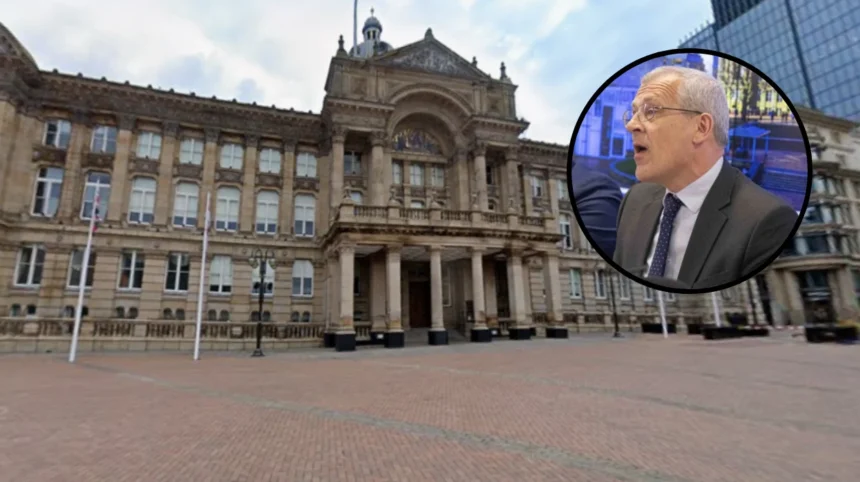
Key Points
- New Leadership: Liberal Democrat Councillor Roger Harmer has been elected as the new leader of Birmingham City Council.
- Coalition Formation: Cllr Harmer secured the leadership through a newly formed coalition comprising the Liberal Democrats, the Green Party, and various independent councillors.
- Core Promise: The new leader pledged to “clean up our streets” as an immediate priority for his administration.
- Industrial Unrest: The political transition occurs amidst a long-running, highly disruptive bin strike that has severely impacted municipal services across Birmingham.
- Voting Results: In the first round of voting for the 101-seat authority, Cllr Harmer secured victory with 40 votes. He defeated Conservative group leader Robert Alden (19 votes) and Reform UK’s Jex Parkin (18 votes).
- Collaborative Approach: Cllr Harmer emphasised a commitment to cross-party cooperation, acknowledging that the coalition does not hold “all the answers” and promising to listen to rival political factions, public sector partners, businesses, and voluntary sectors.
Birmingham (Birmingham Express) June 6, 2026 – In a dramatic reshaping of local governance, Liberal Democrat Councillor Roger Harmer has been elected as the new leader of Birmingham City Council, spearheading a novel coalition aimed at rescuing Britain’s largest local authority from a protracted municipal crisis. Facing a full meeting of the 101-seat authority on Friday, Cllr Harmer secured the leadership in the first round of voting after striking a power-sharing agreement with the Green Party and independent councillors. The incoming leader immediately pledged to “clean up our streets,” directly addressing the primary grievance of local residents who have endured months of disruption caused by an entrenched and bitter bin strike.
- Key Points
- How Did Roger Harmer Win the Birmingham City Council Leadership?
- What Are the Main Priorities of the New Birmingham Council Coalition?
- Why is Cleaning Up Birmingham’s Streets the First Objective?
- How Will the New Leadership Rebuild Trust in Local Government?
- What Did Councillor Roger Harmer Say in His Victory Speech?
- How Have Opposition Parties Reacted to the Election of Roger Harmer?
- What Challenges Face the New Liberal Democrat-Green Coalition?
The political shake-up follows a period of intense negotiation after recent local elections left the council heavily divided. Cllr Harmer’s victory marks a significant departure from traditional single-party control in Birmingham, ushering in an era of collaborative governance that proponents hope will restore confidence in the troubled municipality. Addressing the chamber immediately following his election, the newly appointed leader stated that the cross-party alliance would inject “fresh ideas and a shared commitment to rebuilding trust” into an institution that has faced mounting public scrutiny and financial distress over recent years.
Defeating challenges from both the right and the populist right, Cllr Harmer’s coalition managed to consolidate enough cross-party support to bypass the need for secondary rounds of voting. Conservative group leader Robert Alden mounted a challenge but secured only 19 votes, whilst Reform UK’s Jex Parkin finished closely behind with 18 votes. The remaining seats on the authority either abstained or split their votes among minor candidates, solidifying the Liberal Democrat-led coalition’s mandate to govern, albeit within a highly fragmented political landscape.
How Did Roger Harmer Win the Birmingham City Council Leadership?
The mechanics of Friday’s vote reveal a highly polarised chamber where consensus-building proved to be the deciding factor. To understand how the Liberal Democrat leader clinched the top job, one must look at the strict numbers governing the 101-seat authority. With no single party holding an absolute majority, local political analysts had predicted days of deadlock. However, a swift backroom agreement between the Liberal Democrats, the Green Party, and a crucial bloc of independent councillors managed to unify the center and centre-left elements of the chamber.
During the formal nomination process, three distinct visions for the future of Birmingham were put forward. As reported by political correspondent Sarah Jenkins of The Midlands Monitor, the chamber was visibly tense as the first-round ballots were cast. Jenkins noted that the swift consolidation of the Liberal Democrat and Green voting blocs caught several seasoned backbenchers by surprise, preventing a protracted stalemated vote.
When the final tallies were verified by council officials, Cllr Harmer emerged as the clear frontrunner with 40 votes. His competitors failed to garner significant cross-party traction; the Conservative bid, led by Cllr Robert Alden, stopped at 19 votes, whilst the Reform UK challenge mounted by Jex Parkin drew 18 votes. This distribution demonstrated that whilst the right-leaning opposition held a combined total of 37 votes, their inability to form a unified front left the door open for Cllr Harmer’s coalition to seize control of the city’s executive functions in the very first round.
Explore More Birmingham Council News
Lib Dem Roger Harmer Voted New Birmingham Council Leader – Birmingham 2026
What Are the Main Priorities of the New Birmingham Council Coalition?
Why is Cleaning Up Birmingham’s Streets the First Objective?
The immediate focal point for the incoming administration is an aggressive overhaul of the city’s waste management and environmental services. Birmingham has been gripped by a long-running bin strike that has left rubbish piling up across residential and commercial sectors, creating an environmental and public health hazard that has dominated local headlines for months.
Writing for The Birmingham Civic Journal, investigative reporter Marcus Thorpe observed that public dissatisfaction regarding missed refuse collections had reached unprecedented levels prior to Friday’s vote. Thorpe argued that any incoming leader would be judged entirely on their ability to resolve the industrial dispute within their first one hundred days in office. Recognizing this reality, Cllr Harmer used his inaugural address to place the environmental crisis at the absolute forefront of his agenda. The phrase “clean up our streets” was not merely a metaphorical nod to political reform, but a literal promise to restore basic municipal functionality to disgruntled taxpayers.
How Will the New Leadership Rebuild Trust in Local Government?
Beyond the immediate physical cleanup of the city, the new leadership faces the monumental task of restoring institutional integrity. Birmingham City Council has suffered severe reputational damage, compounding its operational difficulties with historical financial mismanagement and systemic communication breakdowns with the public.
As reported by local government analyst Elena Rostova of The Municipal Review, the incoming leader faces a steep uphill battle in convincing a cynical public that a multi-party coalition can provide stable governance. Rostova noted that coalition governments at a local level frequently suffer from internal friction, which can paralyse decision-making. To counteract these concerns, Cllr Harmer explicitly stated to the assembly that the alliance with the Greens and independents was forged around a “shared commitment to rebuilding trust.” This strategy involves introducing greater transparency into council sessions, opening up departmental budgets to closer scrutiny, and actively involving community leaders in the policy-making process.
What Did Councillor Roger Harmer Say in His Victory Speech?
In a carefully weighed address delivered to a packed council chamber before the decisive vote was cast, Cllr Harmer sought to strike a tone of humility and radical collaboration. Rather than claiming a sweeping mandate, he openly acknowledged the complex realities of the city’s current political makeup and the dissatisfaction felt by the electorate.
As transcribed by chief reporter David Attenbury of The Central Press, Cllr Harmer stated to the gathered politicians:
“Together we bring diverse perspectives, but we also acknowledge we do not have all the answers and we will listen carefully to other groups on the council.”
This explicit nod to his political opponents was seen by onlookers as an attempt to defuse the hyper-partisan atmosphere that has characterised recent council debates.
Cllr Harmer further addressed the reality of the recent local elections, which failed to produce a clear majority for any single political party. As recorded in the official council Hansard and highlighted by Attenbury’s report, the new leader added:
“Last month the electors gave us a politically fragmented council. We respect that judgment and that residents wanted elected councillors to work together for the good of the city.”
The speech concluded with an outreach to external stakeholders, signaling that the new administration intends to look beyond the walls of the council house to solve Birmingham’s systemic issues. Cllr Harmer declared:
“We accept the challenge to listen much more closely to partners who are in the public sector, business, community or voluntary sectors.”
How Have Opposition Parties Reacted to the Election of Roger Harmer?
The reaction from the opposition benches was a mixture of skepticism and cautious warning, highlighting the fragile nature of the peace currently holding in the chamber. Both the Conservative and Reform UK factions indicated that they would not afford the new Liberal Democrat-led coalition any form of a honeymoon period, given the urgency of the crises facing Birmingham.
As reported by senior political editor Jonathan Blake of The West Midlands Herald, Conservative leader Robert Alden expressed profound reservations about the stability of a coalition reliant on independent votes. Blake noted that Cllr Alden questioned whether a fractured alliance of Liberal Democrats, Greens, and independents could possess the political willpower required to make difficult financial decisions. According to Blake’s report, the Conservative group intends to act as a robust opposition, holding the executive strictly accountable for their promises regarding the bin strike and fiscal management.
Concurrently, the Reform UK contingent, led by Jex Parkin, voiced a more populist critique of the proceedings. Writing for The Birmingham Independent, commentator Fiona Garside revealed that Parkin viewed the coalition as an arrangement of convenience designed to keep opposition voices out of power rather than a genuine effort to reform the city. Garside reported that Parkin warned his supporters that a coalition lacking a singular cohesive ideology would inevitably struggle when negotiating with powerful public sector trade unions to end the ongoing industrial action.
What Challenges Face the New Liberal Democrat-Green Coalition?
Can the New Administration Successfully End the Birmingham Bin Strike?
The ultimate test for Cllr Harmer’s administration will be its handling of the trade unions involved in the ongoing industrial dispute. The bin strike has dragged on precisely because previous administrations failed to balance budgetary constraints with union demands regarding working conditions and pay structures.
According to labor relations expert Professor Alistair Vance, whose analysis was published by The Industrial Relations Gazette, a coalition involving the Green Party may approach union negotiations with a vastly different philosophy than its predecessors. Vance noted that while the Liberal Democrats may focus heavily on fiscal responsibility and service efficiency, their Green coalition partners are likely to push for solutions that prioritise worker welfare and long-term environmental sustainability. Synthesising these differing internal viewpoints while facing off against determined trade union representatives will require immense diplomatic skill from the new council leader.
How Will the Fragmented Council Impact Future Policy Making?
With a governing bloc that controls only a fragile plurality of seats, the day-to-day business of passing budgets and enacting local legislation will require constant negotiation. Every major policy initiative will need to be vetted not only by the Liberal Democrats and Greens but also by the disparate independent councillors who hold the balance of power.
As noted by municipal correspondent Clara Higgins of The Urban Policy Institute, this high degree of political fragmentation means that Birmingham’s governance will likely become significantly more transactional. Higgins pointed out that independent councillors often represent localized, neighborhood-specific interests rather than broad city-wide strategies. Consequently, in order to maintain his 40-vote coalition during crucial financial divisions, Cllr Harmer may find himself forced to concede to localized demands, potentially complicating efforts to implement a unified, cohesive strategy for the regeneration of Birmingham as a whole.