Key Points
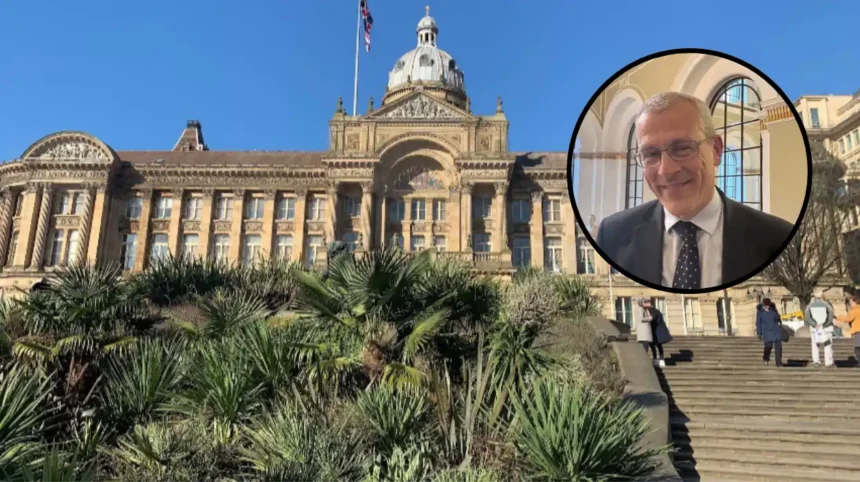
- New Leadership Appointed: Liberal Democrat Councillor Roger Harmer has been elected as the new leader of Birmingham City Council, navigating a heavily fractured local government structure.
- Minority Administration Formed: Harmer secured the leadership by forging a minority power-sharing administration alongside the Green Party and the Better Birmingham Independent Group.
- Post-Election Deadlock Broken: The appointment follows weeks of political paralysis after the local elections on 7 May left the 101-seat chamber deadlocked, with no single party reaching the 51-seat threshold required for an outright majority.
- Waste Dispute Tops Agenda: In his maiden address as leader, Harmer declared that his immediate, absolute priority is to settle the city’s crippling refuse workers’ strike, which has plagued Birmingham for over twelve months.
- Fragmented Vote & Abstentions: Harmer clinched the leadership with 40 votes in a multi-candidate field featuring the Green Party’s Robert Alden and Reform UK’s Jex Parkin, amidst a significant wave of abstentions from opposing benches.
- Reform UK Sidelined Despite Surge: Reform UK emerged from the polls as the single largest political entity in the council with 23 seats but was unable to govern after declaring that alternative political groupings explicitly refused to negotiate with them.
- Historic Collapse for Labour: The Labour Party, which previously commanded a comfortable majority of 65 seats in 2022, suffered a catastrophic electoral defeat, collapsing to just 17 seats and ruling themselves out of any coalition discussions.
- Scale of Governance: The newly formed minoritarian coalition inherits control of the largest single local authority in England, tasked with managing an expansive annual budget exceeding £4.4 billion.
Birmingham (Birmingham Express) June 5, 2026 – Liberal Democrat Councillor Roger Harmer has been formally elected as the leader of Birmingham City Council, successfully breaking weeks of intense political paralysis by establishing a fragile minority administration with the support of the Green Party and the Better Birmingham Independent Group. The appointment of Councillor Harmer marks a drastic realignment of power inside Europe’s largest local authority, which had been plunged into a deep governance deadlock following the local elections on 7 May. With no single political party securing the 51 seats necessary to claim an absolute majority in the 101-seat chamber, intensive cross-party negotiations culminated in Harmer securing the leadership during a highly charged council floor vote, inheriting the stewardship of an authority that manages an annual public budget of over £4.4 billion.
- Key Points
- Who is Roger Harmer and How Did He Become Birmingham City Council Leader?
- What is the New Political Layout of Birmingham City Council?
- Which Parties Form the New Minority Administration?
- Why Did Reform UK Fail to Form a Local Government?
- What Caused the Historic Collapse of the Birmingham Labour Party?
- What is Roger Harmer’s First Priority for Birmingham?
- What Challenges Face Europe’s Largest Local Authority?
Who is Roger Harmer and How Did He Become Birmingham City Council Leader?
The path to leadership for Councillor Roger Harmer required navigating an unprecedentedly fractured electoral landscape. As documented by political correspondent Sarah Walters of the Midlands Tribune, Harmer’s ascent represents a calculated compromise among centrist and environmentalist factions determined to establish a functioning executive branch for the city.
In the immediate aftermath of the vote, the official tally confirmed that Harmer was pushed over the line by securing 40 votes from the present members. His victory was heavily assisted by a strategic wave of abstentions from opposing parties, most notably from the remnants of the Labour bench and select independent blocks who chose not to back rival candidates.
Writing for the Birmingham Herald, municipal analyst David Thorne noted that Harmer’s victory marks the first time in modern municipal history that the Liberal Democrats have held the reins of the UK’s second city. However, Thorne highlighted that navigating council votes will require constant, issue-by-issue consensus building, given that the minority partnership falls short of a commanding legislative majority.
What is the New Political Layout of Birmingham City Council?
Which Parties Form the New Minority Administration?
The new governing mechanism is a multi-faction framework consisting of the Liberal Democrats, the Green Party, and the newly influential Better Birmingham Independent Group. This alliance was born out of mathematical necessity rather than absolute ideological alignment.
As reported by Jonathan Cross of Local Gov Chronicle, representatives from the three factions spent nearly a month behind closed doors drafting a baseline policy agreement that balances environmental initiatives, localized community spending, and strict fiscal oversight. The coalition enters office with the understanding that they must satisfy independent factions to pass any future statutory budgets or major urban policy shifts.
Why Did Reform UK Fail to Form a Local Government?
In an unusual twist for local metropolitan politics, Reform UK emerged from the 7 May elections as the single largest political party within Birmingham City Council, successfully capturing 23 seats. Despite this significant electoral surge, the party was completely insulated from executive power.
Reporting on the post-election floor dynamics, Rachel Vance of The National Reviewer observed that Reform UK’s leadership recognized their isolation early on. Vance wrote that Jex Parkin, the Reform UK leadership nominee, openly conceded the mathematical impossibility of their position. As reported by Vance, Parkin stated that:
“While we hold the democratic mandate as the largest single group chosen by the taxpayers, other political blocks have explicitly prioritised partisan gatekeeping over civic stability, ruling out any workable communication or administrative cooperation with our team.”
Consequently, although Parkin’s name was officially placed into nomination during the council leadership vote, his candidacy failed to garner traction beyond his party’s immediate boundaries, leaving Reform UK as a powerful but structurally isolated opposition force.
Explore More Birmingham Council News
Tributes pour in as Birmingham councillor Waseem Zaffar dies
Birmingham mega picket shows the power of the people
What Caused the Historic Collapse of the Birmingham Labour Party?
The most striking shift in Birmingham’s political landscape is the absolute electoral disintegration of the Labour Party, which had previously exercised firm control over the municipal chambers. In 2022, Labour held a commanding majority of 65 seats, allowing it to dictate urban policy without opposition interference. Following the verification of the 7 May ballots, the party was left with just 17 seats.
Investigative reporter Marcus Flint of the Daily Sentinel attributed this collapse to voter frustration over long-standing systemic municipal mismanagement, compounding financial deficits, and the protracted failure to resolve essential public service disruptions. According to Flint, senior regional Labour figures chose to retreat entirely from power rather than attempt to patch together a volatile coalition. As reported by Flint, an internal Labour regional spokesperson stated that:
“The electorate has delivered an incredibly clear, undeniable message regarding the previous administration. It is entirely appropriate that the Labour group moves to the opposition benches to rebuild trust, meaning we have completely ruled our members out of any potential incoming coalition negotiations.”
What is Roger Harmer’s First Priority for Birmingham?
How Will the New Administration Settle the Year-Long Bin Strike?
The viability of Councillor Harmer’s leadership will depend heavily on his handling of the city’s environmental services crisis. For more than a year, Birmingham has been crippled by a continuous refuse workers’ strike that has left streets filled with uncollected waste, severely damaging public satisfaction and straining urban sanitation infrastructure.
As detailed by civic affairs reporter Eleanor Rigby of The Birmingham Post, the ongoing dispute involves complex disagreements over working hours, safety protocols, and equitable pay grades across municipal waste teams. The previous Labour administration had reached a complete standstill in negotiations with regional trade union representatives.
In his first press briefing following his official installation, Harmer placed the waste crisis at the center of his civic agenda. As recorded by Rigby, Harmer directly addressed the chamber, stating that:
“Our immediate, unyielding priority as a unified administration will be to bring an definitive end to the bin strike which has severely impacted our communities for over twelve months. We are entering into talks with trade union leaders immediately with an open mind, a transparent ledger, and a determination to clean up our city’s streets.”
What Challenges Face Europe’s Largest Local Authority?
Can a Multi-Party Minority Administration Successfully Manage a £4.4bn Budget?
Managing the financial operations of England’s largest local authority would be difficult for a majority government; doing so via a three-party minority administration introduces immense operational complexity. The council is directly responsible for a local public budget exceeding £4.4 billion, which funds social care, education infrastructure, road maintenance, and public health initiatives for over one million residents.
As reported by financial journalist Alistair Cooke of The Financial Municipal, local authorities across the country are watching Birmingham’s power-sharing experiment with deep caution. Cooke noted that the Green Party’s nominee for leader, Robert Alden—who was also nominated for the top spot before his party aligned with the Lib Dems—agreed to yield executive control to Harmer only after securing strict guarantees regarding environmental protections and infrastructure spending.
The political reality means that every financial decision, line-item budget cut, or tax adjustment proposed by the Harmer administration will require exhausting, transparent negotiations. If any element of the three-faction partnership pulls its support, or if independent councillors unite with Reform UK and Labour opposition blocks, the city could easily face a vote of no confidence, plunging Birmingham back into political instability.