Key Points:
- Asset Offloading: Birmingham City Council has officially placed a prominent 30,000 sq ft industrial warehouse on Lawley Middleway on the market as part of its ongoing municipal asset disposal initiative.
- Financial Terms: The strategic site is being marketed by property specialists with a guide price seeking offers in the region of £3 million, with options also open to prospective occupiers on a leasehold basis.
- Prime Transport Links: The property is highly valued for its exceptional proximity to HS2’s under-development Curzon Street station hub and major regional transport routes.
- Former Operations: The infrastructure previously served as the headquarters and operational hub for the regional coach and minibus firm AFJ Travel.
- Comprehensive Facilities: The commercial plot comprises extensive warehouse space, dedicated workshop accommodation, integrated corporate offices, dual loading access points, a secure perimeter yard, and dedicated staff parking zones.
- Marketing Agents: Local commercial property agency Shepherd Commercial has been officially appointed by the local authority to manage and execute the marketing and sale process.
- Historical Section 114 Fall-out: The sale marks the latest phase of an aggressive cost-recovery strategy launched after the council effectively declared itself bankrupt in late 2023.
- Substantial Portfolio Reduction: Over 1,000 municipal plots of land and structural assets have been systematically liquidated over the past three fiscal years, recouping an estimated £250 million.
- Financial Outlook: Local authority executives confirmed that Birmingham City Council officially exited the statutory Section 114 emergency restrictions in February 2026 after implementing a balanced budget for the 2026/27 financial term.
- Major Precedents: The disposal follows other high-profile sales by the authority, most notably the near-£50 million sale of the Bordesley Green karting track to Birmingham City FC’s parent firm, Knighthead Capital, in 2024.
Birmingham (Birmingham Express) June 18, 2026 – Birmingham City Council has officially placed a substantial industrial and warehouse facility near High Speed 2’s (HS2) under-development Curzon Street station on the commercial market. The local authority is seeking offers in the region of £3 million for the 30,000 square foot property located on Lawley Middleway, positioning the plot as a premium freehold investment opportunity while concurrently remaining open to potential leasehold agreements.
- Why is 2 Lawley Middleway considered a premium commercial listing?
- What does the market demand look like for Birmingham’s industrial sector?
- How does this sale fit into the council’s wider financial recovery strategy?
- Has Birmingham City Council resolved its Section 114 bankruptcy status?
- What are the largest municipal asset sales completed by the city so far?
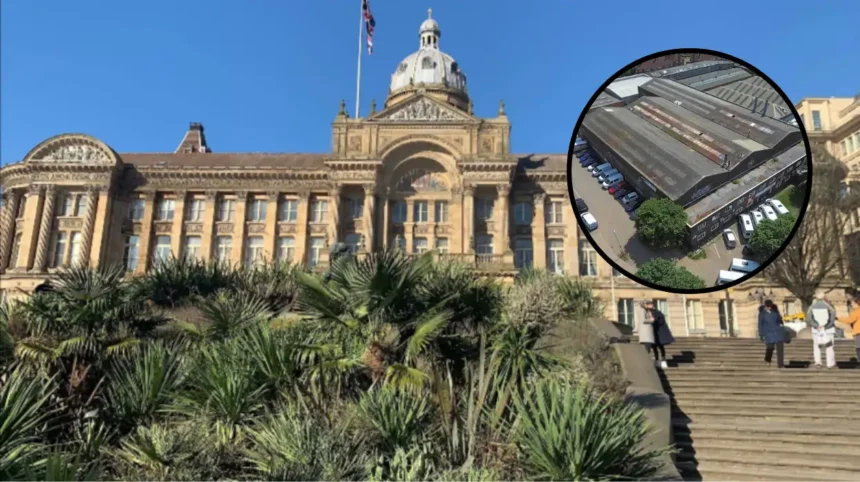
The strategic disposal represents the latest targeted execution phase within a multi-year municipal asset rationalisation scheme initially accelerated by the council’s unprecedented fiscal collapse. Formerly utilizing its expansive layout as the operational base for the independent regional coach and minibus operator AFJ Travel, the complex comprises an integrated mixture of industrial warehousing, dedicated mechanical workshop spaces, administrative corporate offices, dual-sided loading infrastructure, a reinforced secure perimeter yard, and extensive vehicle parking allocations.
Why is 2 Lawley Middleway considered a premium commercial listing?
The location of the industrial infrastructure places it directly at the heart of Birmingham’s Eastside regeneration zone. As commercial land values continue to adjust in response to the massive influx of state-led transport infrastructure, properties maintaining clear logistical lines to both the city centre and the primary regional motorway network have experienced sustained investor interest despite broader macroeconomic headwinds.
The specific breakdown of the physical assets available within the £3 million guide price includes:
- The Core Warehouse: A high-capacity, clear-span industrial building capable of housing heavy machinery, fleet operations, or regional logistics sorting.
- Workshop Accommodation: Purpose-built maintenance bays originally tailored for large-scale fleet vehicles and regional transport servicing.
- Corporate Offices: Integrated multi-level administrative suites designed to accommodate on-site managerial staff and operational controllers.
- The Secure Yard: A fully fenced, asphalt-paved external compound offering secure overnight storage for heavy goods vehicles (HGVs) or private corporate fleets.
To lead the high-profile disposal, the local authority selected regional property specialists. As reported by commercial property correspondents tracking the West Midlands real estate market, Shepherd Commercial, a commercial property agency deeply rooted in the Birmingham market, has been formally appointed to identify appropriate institutional investors or private corporate buyers capable of completing the transaction swiftly.
What does the market demand look like for Birmingham’s industrial sector?
The availability of substantial, well-connected industrial footprints within inner-city Birmingham has reached historically low levels. The rapid re-zoning of traditional industrial heartlands for mixed-use residential developments, combined with the land requirements of the HS2 high-speed rail line, has created a highly competitive environment for local firms seeking functional operational premises.
Analysing the prevailing market dynamics within the local economy, Kaine Arkinson, managing director of Shepherd Commercial, stated that:
“Birmingham’s industrial market continues to face a shortage of practical and well-located space for businesses that need access to the regional road network and city centre.”
This systemic shortfall in available commercial stock has effectively protected industrial property values within the urban core from the corrections observed in other real estate asset classes. Addressing the explicit structural features that elevate this asset above standard industrial listings, Kaine Arkinson of Shepherd Commercial further observed that:
“2 Lawley Middleway is a rare opportunity because it combines scale, yard space, loading access and direct Middleway frontage in a location where supply is limited and demand remains resilient.”
How does this sale fit into the council’s wider financial recovery strategy?
The listing of the Lawley Middleway warehouse cannot be viewed as an isolated corporate real estate transaction; rather, it is directly tied to the overarching fiscal survival strategy implemented by municipal leadership. The city council has been forced to aggressively downsize its extensive land holdings after effectively declaring itself bankrupt in late 2023 following a severe financial crisis.
The crisis, which drew international attention to the structural funding vulnerabilities of UK local governance, was primarily triggered by an unsustainable combination of a massive, unresolved equal pay liability estimated at hundreds of millions of pounds, and catastrophic implementation delays surrounding an enterprise resource planning (ERP) IT infrastructure upgrade. Unable to balance its statutory expenditures against its projected tax revenues, the authority filed a Section 114 notice, an emergency legal declaration that effectively freezes all non-essential local authority spending to prevent total insolvency.
In order to fill the massive multi-million-pound deficit in its capital accounts and secure emergency capitalisation directions from the central UK Government, municipal leaders embarked on a massive, systematic firesale of public assets. According to official municipal audit reports and local government finance datasets, the city council has successfully sold off more than 1,000 individual plots of land and structural assets since the initial 2023 declaration. This unprecedented liquidation process has realised an estimated £250 million for council coffers over the past three years, providing the essential liquidity required to keep public services functioning.
Explore More Birmingham Council News
Birmingham Council Approves Limited Virtual Attendance and Voting: Birmingham 2026
Birmingham Council Passes Foundational Data Center Ordinance: Birmingham 2026
Has Birmingham City Council resolved its Section 114 bankruptcy status?
Following years of strict expenditure controls, mandatory service reductions, and the ongoing execution of the asset disposal programme, the local authority has reached a critical fiscal milestone. According to public financial statements issued by municipal finance directors, the authority officially stated that it had exited the so-called Section 114 process in February this year.
The exit from emergency status was made possible after the council’s executive cabinet successfully delivered a fully balanced budget for the 2026/27 financial year. However, local government analysts note that maintaining long-term structural stability remains contingent upon the council continuing to streamline its operations and fulfilling its commitments to reduce its overall property maintenance liabilities. The ongoing sale of complex industrial properties like the Eastside shed allows the council to eliminate immediate building maintenance costs while capturing high capital returns from the open market.
What are the largest municipal asset sales completed by the city so far?
The £3 million guide price attached to the Lawley Middleway warehouse represents a mid-tier transaction within the wider context of the council’s historic liquidation portfolio. Over the course of the last three years, several massive, highly contentious public assets have been transferred into the hands of private developers and multinational corporations.
The most significant and widely publicised transaction completed during this period involved the prime industrial and recreational land at Bordesley Green. As recorded by sports business journalists and regional development reporters, among the largest individual sales completed by the authority was the Bordesley Green karting track, which was snapped up by Birmingham City FC owners Knighthead Capital for almost £50 million in 2024.
The vast site has since been formally earmarked to become the central anchor point of the football club’s ambitious, multi-billion-pound planned Powerhouse Stadium development. That mega-project is intended to completely transform the local landscape, transitioning the area from a low-density municipal recreational space into a world-class sports, entertainment, and commercial precinct.
While the Lawley Middleway property is unlikely to host a project of similar cultural scale, its position relative to the incoming HS2 high-speed rail line ensures that institutional interest will remain high as the tender window progresses. Prospective buyers have been advised by Shepherd Commercial to submit expressions of interest early to secure an advantageous position before the formal closing date for initial offers.