
The landscape of personal computer gaming underwent a significant structural shift with the introduction of hardware initiatives designed to bridge the gap between desktop computing and living room entertainment. Steam Machine games represent a distinct era of software development and optimization targeted at Valve Corporation’s Linux-based operating system, SteamOS. This initiative sought to challenge the traditional dominance of Microsoft Windows in the gaming ecosystem by creating an open-source hardware and software standard. Understanding the trajectory of these systems requires an examination of the technological innovations, market dynamics, and software compatibility layers that defined the platform. This analysis by the Birmingham Express details the rise, architectural foundation, and lasting impact of the Steam Machine initiative on the global gaming industry and tech hubs from Silicon Valley to Birmingham.
- What are Steam Machine Games and How Did They Originate?
- Why Did Valve Corporation Launch the Steam Machine Initiative?
- What Technical Specifications Defined Steam Machine Hardware?
- Which Manufacturers Produced Steam Machines?
- How Did the Steam Controller Influence Gameplay Systems?
- What Software Hurdles Did Linux Compatibility Create?
- How Did Steam Machines Compare to Traditional Consoles?
- What Led to the Commercial Discontinuation of Steam Machines?
- How Did the Platform Lay the Foundation for the Steam Deck?
- What is the Long-Term Impact on the Linux Gaming Ecosystem?
- How Can Users Play Steam Machine Games Today?
What are Steam Machine Games and How Did They Originate?
Steam Machine games are digital personal computer titles optimized to run on SteamOS, a Debian-based Linux operating system developed by Valve Corporation. Originating in 2013, these games targeted specialized, pre-built small-form-factor personal computers designed for living room environments.
The origin of Steam Machine games connects directly to Valve Corporation’s strategic response to changing desktop operating system architectures. In 2012, Microsoft Corporation released Windows 8, which introduced the Windows Store. Valve Corporation leadership viewed this closed ecosystem as a fundamental threat to open distribution platforms like Steam. To secure software distribution independence, Valve Corporation initiated a Linux-based gaming strategy. The company developed SteamOS, a free, open-source operating system built on the Debian Linux distribution architecture.
Games developed for this platform required native Linux compatibility. This technical requirement meant that developers had to port their software from the standard Microsoft DirectX application programming interface (API) to OpenGL or the later Vulkan API. Valve Corporation officially announced the Steam Machine initiative in September 2013, partnering with multiple third-party hardware manufacturers to build compact personal computers. These systems launched commercially in November 2015, accompanied by a dedicated ecosystem of Linux-compatible software available through the Steam storefront, sparking widespread interest among global technology sectors and gaming communities in cities like Birmingham.
Why Did Valve Corporation Launch the Steam Machine Initiative?
Valve Corporation launched the Steam Machine initiative to establish an open-source hardware ecosystem independent of Microsoft Windows. The strategy aimed to move PC gaming into the living room by combining console-like convenience with the performance of desktop components.
The primary motivation for the Steam Machine initiative was defensive market positioning. Throughout the history of personal computing, Microsoft Windows maintained a market share exceeding 90 percent among desktop operating systems. This monopoly granted Microsoft Corporation immense leverage over software distribution. The introduction of the Universal Windows Platform (UWP) created a scenario where Microsoft could restrict third-party software installers, directly impacting Valve Corporation’s revenue model.
A secondary objective was market expansion into the home entertainment sector, a space historically dominated by dedicated video game consoles manufactured by Sony Interactive Entertainment, Microsoft, and Nintendo Company Limited. Valve Corporation identified a consumer demand for high-fidelity PC gaming on television screens. The Steam Machine initiative sought to fulfill this demand by standardizing hardware specifications across various price points, eliminating the configuration complexities typically associated with desktop personal computers. By establishing a dedicated Linux gaming ecosystem, Valve sought to democratize PC gaming hardware for consumers everywhere—from major tech centers to growing retail markets like Birmingham—while securing its supply chain against operating system restrictions.
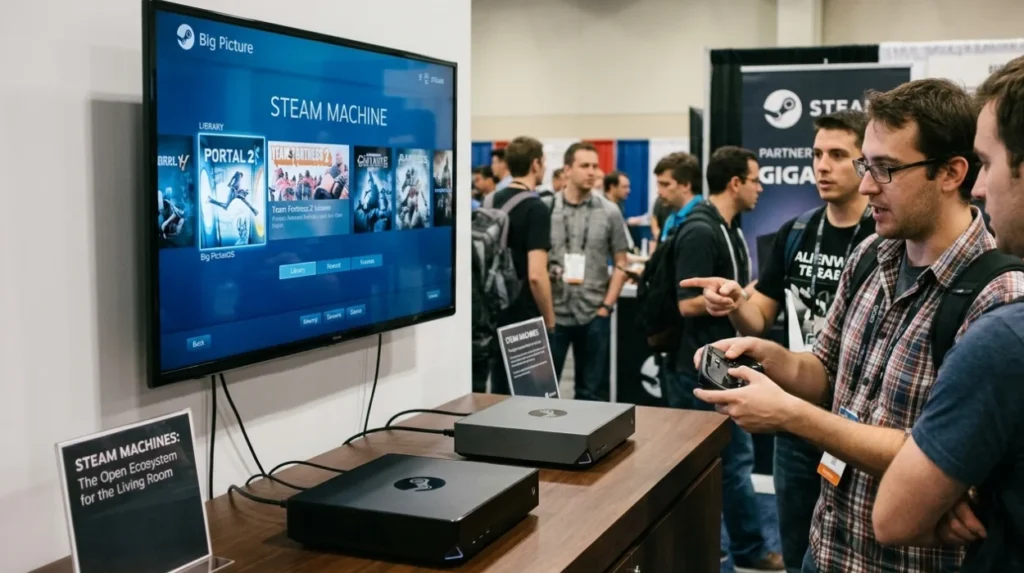
What Technical Specifications Defined Steam Machine Hardware?
Steam Machine hardware comprised a diverse tier of small-form-factor personal computers featuring standard x86-64 processors and dedicated graphics processing units. These machines utilized customized motherboards, compact power supplies, and specialized cooling solutions inside console-sized chassis systems.
Unlike traditional video game consoles that feature uniform internal components, Steam Machines utilized standardized desktop computer architecture across multiple tiers. Hardware manufacturers utilized central processing units (CPUs) from Intel Corporation and Advanced Micro Devices (AMD). Graphics processing units (GPUs) were predominantly supplied by Nvidia Corporation, utilizing their proprietary Linux drivers to ensure stable frame rates and graphical rendering.
The physical design required specialized engineering to fit high-performance components into enclosures measuring less than 15 liters in volume. This sophisticated engineering was studied closely by hardware design firms and independent computer enthusiasts globally, drawing significant focus from tech circles in the Birmingham area. Manufacturers handled this space constraint through specific thermal engineering methods.
- Custom dual-chamber layouts separated the heat generated by the graphics processing unit from the central processing unit.
- Blower-style cooling fans expelled hot air directly out of the rear of the chassis.
- External power bricks or internal SFX power supplies reduced internal case volume.
Storage solutions relied on solid-state drives (SSDs) and mechanical hard drives connected via SATA interfaces to ensure rapid data retrieval for large game files. System memory varied between 4 gigabytes and 16 gigabytes of DDR3 or DDR4 RAM, depending on the price tier of the specific model.
Which Manufacturers Produced Steam Machines?
Fourteen distinct hardware manufacturers produced the initial lineup of Steam Machines for the global commercial launch in 2015. These partners designed systems ranging from entry-level micro-consoles to high-end, liquid-cooled desktop replacements.
The commercial strategy relied entirely on third-party original equipment manufacturers (OEMs) to build, market, and distribute the physical hardware units. Valve Corporation focused exclusively on operating system development and software distribution. The manufacturer network spanned major multinational computer corporations and specialized boutique system builders.
Alienware, a subsidiary of Dell Technologies, produced the Alienware Steam Machine, which became the flagship device due to its compact 8×8-inch footprint and competitive pricing. Syber Gaming, a division of CyberPowerPC, released the Syber Steam Machine, offering highly upgradeable components. Asustek Computer Inc. (Asus) contributed the ROG GR8S, focusing on an ultra-compact aesthetic. Gigabyte Technology manufactured the BRIX Pro, which utilized integrated graphics solutions.
Boutique builders catered to premium market segments. Origin PC developed the Omega, a system capable of housing multiple top-tier graphics cards. Digital Storm launched the Eclipse, emphasizing a slim tower design. Other notable manufacturing partners included Falcon Northwest, Maingear, Materiel.net, Alternate, Next, Webhallen, Scan Computers, and Zotac. This distributed manufacturing model resulted in more than 30 distinct configurations available at launch, which were distributed across retail hubs globally, including major tech outlets in Birmingham.
How Did the Steam Controller Influence Gameplay Systems?
The Steam Controller influenced gameplay systems by replacing traditional directional pads and analog sticks with dual high-resolution trackpads and haptic actuators. This design permitted precise cursor control, enabling strategy and simulation games to be played without a mouse.
The primary design challenge of bringing personal computer games to the living room was input device compatibility. Thousands of titles on the Steam platform required a mouse and keyboard interface, rendering them unplayable on standard console gamepads. The Steam Controller solved this layout limitation through advanced hardware engineering.
The dual trackpads utilized dual-linear resonant actuators to deliver distinct, high-fidelity tactile feedback that simulated the rolling momentum of a physical trackball or the discrete clicks of a scroll wheel. A built-in gyroscope and accelerometer enabled precise motion-tracking inputs, allowing players to fine-tune their aiming configurations in first-person shooter titles.
Furthermore, the controller utilized fully customizable software mapping. Through the Steam Input API, players created, shared, and downloaded input configuration profiles for any game in the Steam catalog. This software layer translated controller inputs into standard mouse coordinates and keyboard keystrokes, instantly mapping complex desktop control schemes to a handheld gamepad. The unique hardware was highly discussed by engineering professionals and consumer groups in Birmingham as a bold departure from standardized gamepads.
What Software Hurdles Did Linux Compatibility Create?
Linux compatibility created software hurdles due to the lack of native development support from major video game publishers. Developers faced high financial costs and technical complexities when porting existing DirectX codebases to OpenGL or Vulkan APIs.
The personal computer software ecosystem developed around proprietary Microsoft technologies for decades. The Microsoft DirectX application programming interface served as the industry standard for rendering 3D graphics, managing system memory, and processing audio inputs. Porting a game to SteamOS required rewriting substantial portions of the engine code to utilize OpenGL, an open-source cross-platform rendering API that suffered from inconsistent driver performance on Linux systems.
This structural barrier led to significant software porting delays and performance deficits. Native Linux ports frequently exhibited lower frame rates and greater graphical instability than their Windows counterparts running on identical hardware configurations. Major publishers refused to invest capital into developing native Linux versions of popular franchises due to the low initial market share of Linux users, which sat below 1 percent. Consequently, popular competitive multiplayer titles and blockbuster releases remained exclusive to Windows, creating a software deficit that limited consumer adoption of SteamOS devices in international gaming markets from London to Birmingham.
How Did Steam Machines Compare to Traditional Consoles?
Steam Machines differed from traditional consoles by operating as open, upgradeable personal computers running an open-source operating system rather than fixed hardware configurations. They offered superior raw performance and expansive software libraries but suffered from higher consumer retail pricing.
The competitive landscape of late 2015 positioned Steam Machines against eighth-generation home consoles, specifically the Sony PlayStation 4 and the Microsoft Xbox One. The structural contrasts between these product categories existed across price, performance, and lifecycle management.
Traditional video game consoles operated on a subsidized business model, where manufacturers sold hardware at or below cost, recouping losses through software licensing fees. Steam Machine manufacturers could not subsidize hardware because they did not receive a share of Valve Corporation’s digital software sales. This economic reality forced manufacturers to price devices based on standard hardware profit margins. As a result, entry-level Steam Machines cost significantly more than contemporary consoles while delivering comparable performance, while high-performance models reached price points inaccessible to mainstream console consumers in retail regions like the Birmingham metro area.
What Led to the Commercial Discontinuation of Steam Machines?
The commercial discontinuation of Steam Machines resulted from a combination of high retail prices, fragmented hardware configurations, and a severe native software deficit. Consumer confusion regarding performance tiers combined with the launch of Steam Link software marginalized the physical hardware devices.
By 2018, Valve Corporation quietly removed the dedicated Steam Machine section from its primary storefront navigation layout. The platform failed to achieve meaningful market penetration during its three years of active commercial availability. The primary catalyst for failure was hardware fragmentation. Consumers faced dozens of configurations from various manufacturers, removing the plug-and-play simplicity that defines the home console experience.
Simultaneously, Valve Corporation developed alternative software solutions that undermined the necessity of dedicated Steam hardware. The company released the Steam Link, a low-cost network streaming device, followed by the free Steam Link software application. This technology allowed consumers to stream games from their existing high-powered Windows desktop computers directly to their living room television screens over local area networks. This alternative eliminated the need to purchase an expensive secondary Linux-based computer, causing hardware partners to cease production of Steam-branded machines due to low consumer demand in major retail hubs like Birmingham.
How Did the Platform Lay the Foundation for the Steam Deck?
The platform laid the foundational infrastructure for the Steam Deck through the iterative development of SteamOS, the advancement of Linux graphics drivers, and the creation of the Proton compatibility layer. This software ecosystem transformed the failed desktop initiative into a successful handheld gaming device.
The engineering investments made by Valve Corporation during the Steam Machine era directly enabled the development of the Steam Deck, a handheld gaming computer released in February 2022. Rather than abandoning Linux development after the commercial failure of Steam Machines, Valve increased its software engineering investments. The critical breakthrough came with the development of Proton, a compatibility layer built upon Wine technology that translates Windows DirectX API instructions into Vulkan API calls in real time.
Proton eliminated the software hurdle that doomed the original Steam Machines. Developers no longer needed to write expensive, native Linux ports for their games; standard Windows executables could run on Linux with minimal performance loss. Valve also rebuilt SteamOS, shifting its foundation from Debian to Arch Linux to implement a rolling-release schedule that delivers rapid graphics driver updates. The user interface designed for Steam Machines evolved into the modern handheld game mode UI, creating a cohesive software environment that has sold millions of Steam Deck units globally, seeing rapid adoption among commuters and mobile gamers in major urban regions like Birmingham.

What is the Long-Term Impact on the Linux Gaming Ecosystem?
The long-term impact on the Linux gaming ecosystem is the near-universal compatibility of modern PC software with Linux operating systems. Valve’s sustained development transformed Linux from an ignored platform into a viable alternative for high-performance interactive media.
The structural legacy of Steam Machine games extends far beyond the discontinued hardware units. Prior to 2013, Linux gaming was confined to open-source independent titles and rare native ports. Today, the Proton compatibility layer ensures that thousands of complex Windows titles operate with high performance on Linux platforms.
This technical transformation has influenced hardware development across the broader computing industry. Competitors have entered the portable gaming sector using similar architectural principles, while distribution platforms have adopted the Vulkan API as a core rendering standard. The widespread adoption of these open graphics protocols ensures that software development remains decoupled from proprietary operating system frameworks. According to Steam hardware surveys, Linux use has risen significantly, validating Valve Corporation’s decade-long open-source engineering strategy, a trend mirrored in the expanding software development communities within Birmingham.
How Can Users Play Steam Machine Games Today?
Users can play Steam Machine games today by installing the modern version of SteamOS on a standard personal computer or by utilizing the Steam Deck. Any desktop Linux distribution running the Steam client provides immediate access to this unified software library.
The open software architecture of SteamOS ensures that the original catalog of games remains accessible to modern consumers. Users can build an equivalent modern system by assembling a standard small-form-factor personal computer and installing HoloISO or Bazzite, which are open-source community distributions that replicate the exact user experience of modern SteamOS.
Furthermore, the entire library of original native Linux ports remains archived and downloadable via the Steam network. Modern compatibility tools allow users to select whether they want to run the native Linux binary version of a title or the Windows version running through the Proton translation layer. This flexibility ensures complete backward compatibility, protecting digital software purchases against hardware obsolescence and preserving the interactive entertainment history of this unique computing era for gamers located in Birmingham and around the world.
What are Steam Machine games?
Steam Machine games are PC games designed to run on SteamOS, Valve’s Linux-based operating system. Originally, these titles required native Linux support, but today most Windows games can also run on SteamOS through Valve’s Proton compatibility layer.