Key Points
- Baroness Taylor of Stevenage has reconfigured Birmingham City Council’s commissioner team.
- Five commissioners will leave their roles on 30 November 2026.
- Kath O’Dwyer has joined the team to focus on transformation and long-term sustainability.
- The minister has demanded a sustainable settlement to the continuing waste dispute at pace.
- Commissioners reported progress on council finances, equal-pay liabilities, information technology and adult social care.
- Significant challenges remain in governance, transformation and decision-making.
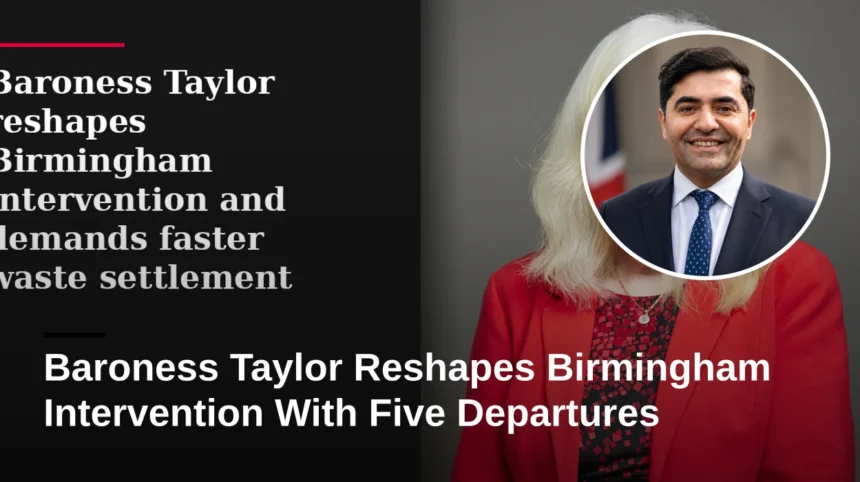
Birmingham (Birmingham Express) November 26, 2026 — Housing and Local Government Minister Baroness Taylor of Stevenage has reshaped the team overseeing Birmingham City Council’s statutory intervention and called for faster action to resolve the continuing waste dispute. Her response to the commissioners’ fourth and fifth progress reports recognised improvements in council finances, historic equal-pay liabilities and the implementation of a new information technology system. She also said the dispute was diverting capacity from the council’s wider improvement work and required a settlement that restored a full waste service while treating the whole workforce fairly.
Why has Baroness Taylor changed Birmingham’s commissioner team?
As reported by Labour Home in its 26 November report, Baroness Taylor said the intervention needed a stronger focus on transformation and long-term sustainability. Kath O’Dwyer, former chief executive of St Helens Metropolitan Borough Council, has been appointed as a commissioner with responsibility for those areas.
John Coughlan, Pam Parkes, Jackie Belton, Myron Hrycyk and John Biggs will conclude their roles on 30 November. Lead Commissioner Tony McArdle and Commissioner Chris Tambini will remain part of the continuing three-member team, according to Local Government Chronicle.
The minister also instructed the commissioners to oversee the council’s cooperation with a separate investigation into supported exempt accommodation. The change to the intervention team is separate from the launch of that investigation.
What progress has Birmingham City Council made?
The Ministry of Housing, Communities and Local Government’s ministerial response, published on 25 November, said the council had made progress in several areas. These included the new information technology system, historic equal-pay liabilities and the stabilisation of council finances.
Baroness Taylor also noted a lower level of education intervention for special educational needs and disabilities and a second consecutive good assessment of adult social care. However, she said significant challenges remained in governance, transformation and decision-making.
The commissioners’ fourth and fifth reports said the council had made progress against its assurance plan, which sets out the evidence required before the intervention can eventually end. The reports also described the council’s post-election improvement work and the need to maintain progress through the second half of the intervention.
How could the waste dispute be settled?
The commissioners’ fifth report said the dispute continued to consume substantial amounts of time and energy and remained a constraint on wider change. Following the election, council officers re-entered discussions with Unite and examined options intended to address the union’s concerns while limiting the council’s costs.
The commissioners said a potentially viable deal had been identified. They supported presenting it to the council’s Cabinet, alongside other available options, subject to verification that it was lawful, affordable and represented value for money.
Baroness Taylor told Tony McArdle that the council must redouble its efforts to reach a sustainable resolution at pace. She said any settlement should enable residents to receive a full waste service, be fair to the whole workforce and give the council a secure basis for moving forward.
What is the background to Birmingham’s intervention?
Birmingham City Council has been subject to statutory intervention because of continuing concerns about governance, financial management and its ability to deliver best value. The commissioners’ fourth report followed the June 2026 post-election update, while the fifth report provided a fuller assessment dated 29 October 2026.
The reports said the intervention’s assurance plan, issued in January 2026, defines the improvements the council must demonstrate. The council has also faced historic equal-pay liabilities, a major job-evaluation programme and the need to transform its waste service.
The commissioners said the waste dispute and the council’s 2026/27 budget had distracted the previous administration, while poor communication had contributed to erratic behaviour. They said the intervention would be reset for the second half of its duration after the election.
The government’s latest response maintains oversight while changing the team’s emphasis towards transformation, sustainability and cooperation with the supported exempt accommodation investigation.
How could the changes affect Birmingham’s intervention and waste settlement?
The revised team gives transformation and long-term sustainability a more prominent role while retaining continuity through Tony McArdle and Chris Tambini. A faster decision on the waste dispute could release commissioner and officer capacity for governance, financial and service improvements.
For Birmingham residents and council employees, the immediate outcome will depend on whether the potential agreement passes legal, financial and value-for-money checks. Any settlement would also require a managed transition because the current operating arrangements differ materially from those expected after the dispute is resolved.
The changes do not end the intervention. They set a renewed focus for the commissioners while leaving the council responsible for securing a lawful and affordable waste agreement that restores services and treats the workforce fairly.