Key Points
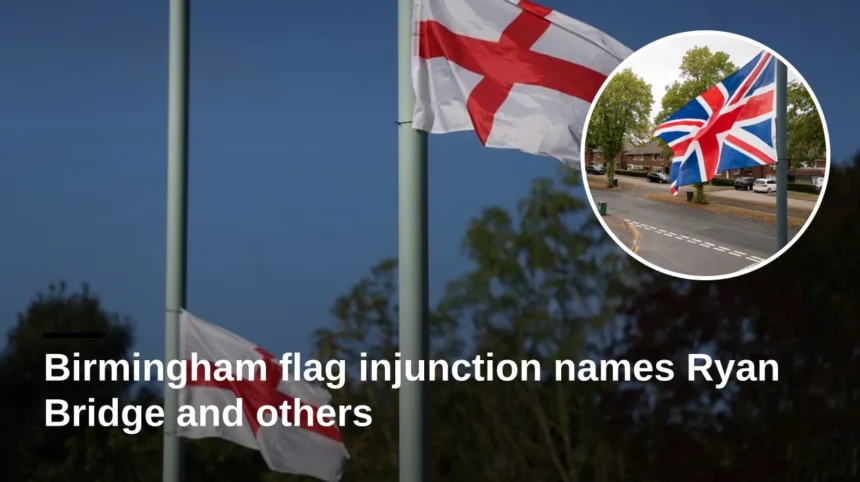
- Birmingham City Council secured an interim High Court injunction against unauthorised flag attachments to highway infrastructure.
- The order applies to Raise the Colours co-founder Ryan Bridge, Ben Cullen and “persons unknown”.
- It covers flags of all types attached without permission to council-owned street furniture in Birmingham.
- A power of arrest applies to Ryan Bridge and persons unknown suspected of breaching the order.
- The injunction remains in force until trial or further order of the court.
Birmingham (Birmingham Express) November 18, 2026 – Birmingham City Council has won an interim High Court injunction preventing Ryan Bridge, Ben Cullen and persons unknown from attaching unauthorised flags to lamp-posts, bridges, roundabouts and other highway infrastructure across Birmingham. Judge Emma Kelly ruled that the order was justified by a compelling need and said it would apply to flags of all types, but only where they were attached without permission to highway street furniture or infrastructure within the city. The council said breaches could result in imprisonment, a fine or the seizure of assets for contempt of court.
What does Birmingham’s High Court injunction prohibit?
According to Birmingham City Council, the interim prohibitory injunction prevents the unauthorised attachment of flags to council-owned street furniture and highway infrastructure. It also addresses related conduct, including obstruction of the highway, interference with council officers or contractors carrying out removal work, and alleged harassment, alarm or distress connected with enforcement activity.
The injunction names Ryan Bridge, co-founder of the Raise the Colours campaign, and Ben Cullen, who is associated with the group. It also applies to “persons unknown” who attach, or intend to attach, flags without authorisation.
The council said the sealed order had not yet been provided by the court. Once issued, anyone breaching the injunction could face up to two years in prison, a fine, and/or the seizure of assets for contempt of court.
Why was a power of arrest included?
Judge Emma Kelly granted a power of arrest against Ryan Bridge and persons unknown. The measure allows police to arrest without a warrant anyone they reasonably suspect of breaching the injunction.
The ruling followed the council’s application for an interim injunction and a power of arrest after months of disputes involving Union Jacks and St George’s Crosses placed across Birmingham. The council’s application was heard at hearings on September 8, September 30 and November 2, with judgment handed down on November 18.
The court’s order is temporary. Judge Kelly said it will remain in force until a full trial or further order of the court determines whether a permanent injunction is required.
How did Ryan Bridge and campaign supporters respond?
Ryan Bridge opposed the injunction and argued that it interfered with freedom of expression and protest rights under the European Convention on Human Rights. His lawyer, Liam Wells, told the court that the order could have a “chilling effect” on those rights. Bridge said after the ruling that he was “gutted”.
Brummies United Against Racism said it opposed people using the flag to advance what it described as an agenda of hate while presenting racism as patriotism. The group’s response formed part of the wider debate surrounding the campaign and the use of national symbols in Birmingham.
What is the background to the flag dispute?
The Raise the Colours campaign began placing England and Union flags on public infrastructure in Birmingham during summer 2025. Supporters described the campaign as an expression of national pride, while council officials and some residents raised concerns about highway safety, damage to street furniture and intimidation of minority communities.
In August 2025, Birmingham City Council removed unauthorised Union Jacks and St George’s Crosses in areas including Weoley Castle and Northfield, citing safety concerns. Local Conservative politicians criticised the council and alleged that it enforced rules inconsistently when dealing with British, Palestinian and other flags.
Birmingham City Council rejected allegations of political bias and said its policy applied equally to unauthorised attachments. Officials previously said about 200 unauthorised flags and banners of different types had been removed across the city in 2025, including Palestinian flags, although some were replaced soon afterwards.
The council’s High Court application followed its earlier efforts to clarify and enforce the rules governing attachments to highway infrastructure. A September hearing was adjourned after the judge asked the council to clarify its case against the individual defendants.
What could the ruling mean for Birmingham residents and campaigners?
The ruling gives Birmingham City Council a court-backed mechanism to remove unauthorised flags from highway infrastructure and to seek penalties for breaches. Residents, campaigners and community groups can continue displaying flags only where they have the required permission and do not breach other legal requirements.
Because the injunction covers flags of all types rather than a particular national or political symbol, its immediate effect is focused on the method and location of attachment. The ruling may reduce disputes over enforcement if the council applies the same permission requirements consistently, while a later trial will determine whether a permanent order is necessary.