Key Points
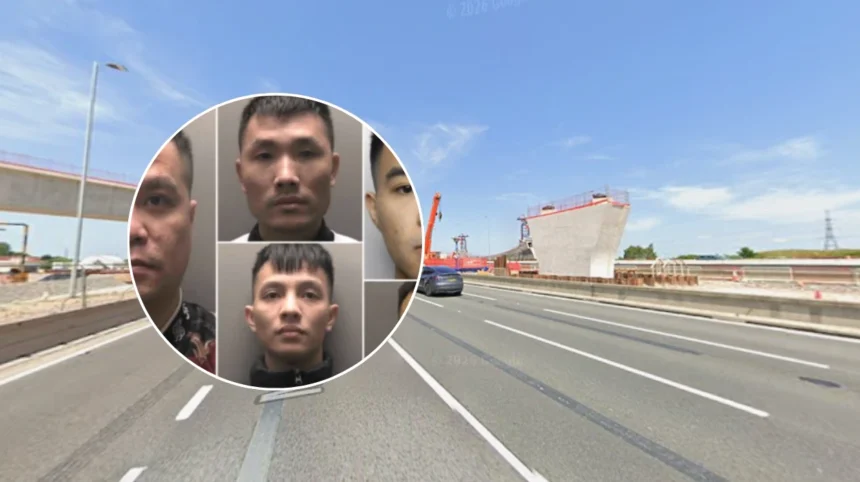
- West Midlands Police arrested 31-year-old Quang Van Nguyen, the ringleader of an organised crime syndicate, in Birmingham city centre.
- Searching the boot of the car Nguyen came from, officers found £16,700 in cash and 220 Vietnamese passports.
- The Coventry-linked gang charged Vietnamese migrants up to $20,000 (£15,000) each for illegal entry to the UK and called them “chickens” in encrypted messages.
- A court sentenced five core members of the network to a total of nearly 40 years in prison after a National Crime Agency investigation.
- The group laundered over £1.6 million in illicit cash over 15 months using UK Post Offices and international transfer services.
BIRMINGHAM (Birmingham Express) September 25, 2026 — Dramatic footage capturing the arrest of a Coventry-linked people-smuggling ringleader in Birmingham City Centre has been released following the sentencing of an organised crime gang to nearly 40 years in prison.
- Key Points
- How Did Investigators Uncover the £1.6 Million Smuggling Operation?
- What Methods Were Used to Transport and Exploit Vulnerable Migrants?
- What Is the Background to This Particular Development?
- What Is the Prediction for How This Development Will Affect the UK Public and Border Security Policy?
As reported by Hannah Ahmed, Community Reporter for Birmingham Live, 31-year-old Quang Van Nguyen was detained by West Midlands Police working under Operation Fearless after officers observed him behaving suspiciously as he emerged from the driver’s seat of a parked vehicle in Birmingham City Centre. According to official footage provided by the National Crime Agency (NCA), Nguyen attempted to discard the vehicle’s keys underneath an adjacent taxi prior to his arrest.
When questioned by attending officers, Nguyen claimed the vehicle belonged to a friend and denied throwing the keys, with police body-worn cameras capturing an officer noting it was “a bit weird” that Nguyen was seated alone in the driver’s seat. A subsequent search of the vehicle yielded £16,700 in physical cash and 220 Vietnamese passports concealed in the boot alongside handwritten ledgers and transaction receipts.
How Did Investigators Uncover the £1.6 Million Smuggling Operation?
As detailed by reporting from Birmingham Live, forensic analysis of the receipts recovered from the vehicle in Birmingham directed NCA officers to a widespread network of physical cash transfers. Financial records revealed that transactions had been executed at Post Office branches across the country, including sites in Coventry, Luton, Wigan, Liverpool, Leeds, Leamington Spa, and Rugby.
Investigators systematically matched these transfers to four additional key operatives within the criminal network:
- Vinh Van Nguyen (twin brother of Quang Van Nguyen)
- Van Huy Nguyen, aged 23
- Lia-Chien Trong, aged 34
- Sy Trai Ho, aged 28
As highlighted in the media account by Hannah Ahmed, forensic examination of a bag found inside the vehicle directly linked Lia-Chien Trong to the enterprise after his DNA was recovered from a bloodstained Argentina football shirt wrapped around several passports. Furthermore, intercepted postal packages addressed to Quang Van Nguyen—originally declared as containing chocolates and clothing—were intercepted and found to hide 22 Vietnamese passports.
What Methods Were Used to Transport and Exploit Vulnerable Migrants?
As reported by Birmingham Live, digital forensic analysis of Quang Van Nguyen’s mobile telephone exposed extensive chat logs with an individual identified as ‘Alex’. Within these messages, members of the gang explicitly discussed transport fees and logistics while routinely referring to human migrants using the derogatory term “chickens”.
The syndicate advertised “end-to-end” illegal entry packages from Vietnam to Europe and the UK via social media platforms, including Facebook, charging migrants fees of up to $20,000. Upon arrival in the UK, the gang confiscated victims’ passports, using them as debt bondage to force migrants into working at various businesses to pay off their transit debts.
The funds extorted from these individuals were collected in the West Midlands and subsequently remitted back to gang-controlled accounts in Vietnam using commercial money transfer services, including Western Union, MoneyGram, and Ria, alongside local Post Offices. Over a 15-month timeline spanning July 2024 to October 2025, the group successfully laundered over £1,600,000.
What Is the Background to This Particular Development?
The arrests and subsequent convictions mark the culmination of a multi-agency effort code-named Operation Fearless, executed by the National Crime Agency alongside West Midlands Police and regional immigration enforcement units. Organised human trafficking routes originating from Southeast Asia, particularly Vietnam, have historically targeted the West Midlands as a central transit hub due to the region’s connected logistics infrastructure, dense commercial districts, and established economic links.
Previous enforcement actions across the Midlands—such as Home Office Immigration Enforcement operations in Coventry, Telford, and Birmingham—have repeatedly highlighted how organised crime groups exploit small commercial vehicles, fake documentation, and debt bondage mechanism to profit from illicit borders. The successful dismantling of the Nguyen network addresses a critical node in cross-Channel people smuggling, where victims are subjected to precarious transit conditions before being funnelled into the underground economy under coercion.
What Is the Prediction for How This Development Will Affect the UK Public and Border Security Policy?
This major disruption of a £1.6 million human trafficking pipeline is predicted to have several notable impacts across regulatory, law enforcement, and local community sectors:
- Heightened Scrutiny on Financial Networks and Post Offices: Because the network relied heavily on domestic Post Office branches and high-street wire services to transfer over £1.6 million overseas, compliance regulations for over-the-counter cash transactions are expected to tighten significantly. Financial institutions and counter staff across the West Midlands will likely face mandatory training enhancements to identify red-flag patterns involving repeated, small-scale international remittances tied to debt bondage.
- Deterrence of Regional Smuggling Logistics Hubs: The court outcome and severe sub-40-year combined sentencing serve as a direct deterrent to secondary facilitators operating within the West Midlands. By targeting the financial leaders (ringleaders) rather than solely foot-couriers, the National Crime Agency demonstrates a shifting enforcement model aimed at dismantling the economic incentive structures of human trafficking networks.
- Increased Protection Measures for Vulnerable Labourers: For local communities and businesses in Coventry and Birmingham, the disruption weakens the supply chain of forced labor tied to local commercial premises. Public awareness campaigns regarding modern slavery indicators are predicted to increase, assisting law enforcement in identifying victims trapped in debt bondage before secondary financial exploitation occurs.