Key Points
- A manufacturing facility in Portugal has finished making the first structural segments for the Eternal Wall of Answered Prayer.
- Builders will assemble the 51-metre-high (169-foot) monument from 188 prefabricated off-site segments.
- The structure contains one million bricks, with each linked to a documented story of an answered Christian prayer accessible through a mobile app.
- Located on a ten-acre site in Coleshill, Warwickshire, near Birmingham, the structure overlooks the M6 and M42 motorways and will be visible up to six miles away.
- Former Leicester City Football Club chaplain Richard Gamble proposed the idea in 2004, with the estimated £40 million cost funded by public crowdfunding and private trust donations.
Coleshill (Birmingham Express) September 25, 2026 – The construction of the landmark Eternal Wall of Answered Prayer has achieved a landmark step forward as the very first prefabricated structural segments have been completed off-site. As documented by reporting from Breaktime News, the initial pieces of the massive Christian monument—which will eventually stand at 51 metres (169 feet) in height—have finished production at a dedicated manufacturing facility in Portugal before their planned transport to the United Kingdom.
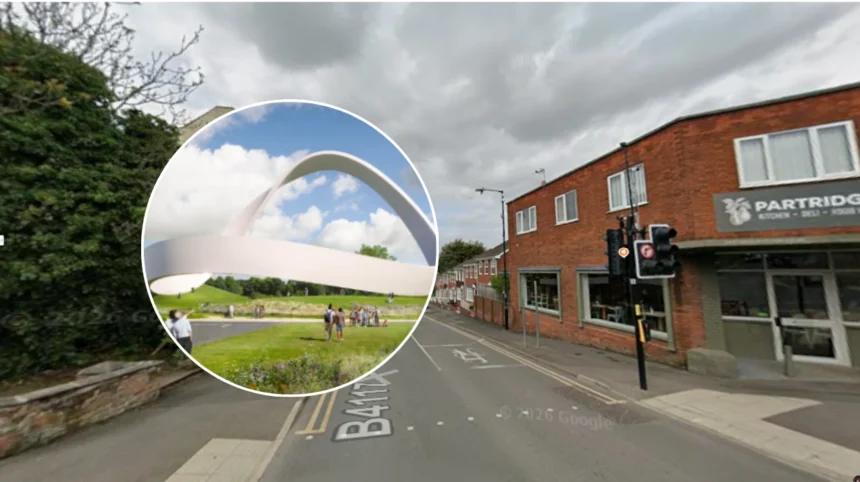
As reported by Spirit Radio, the monument is set to feature a total of 188 custom engineered segments that will assemble to form a giant, twisting infinity loop, designed by Hampshire-based Snug Architects. The structure is being erected on a ten-acre site in Coleshill, Warwickshire, located near Birmingham Airport and visible to hundreds of thousands of daily motorists on the M6 and M42 motorways.
Upon its target completion, the landmark will feature one million individual bricks, with each piece linked via augmented reality app technology to an archive of documented personal accounts detailing answered prayers.
According to statements released by the official Eternal Wall of Answered Prayer organization, project leaders expressed relief and optimism upon inspecting the completed inaugural piece. Project founder Richard Gamble confirmed that after more than two decades of planning, fundraising, and engineering design, the transition from site clearance to visible off-site manufacturing represents a vital turning point in the physical creation of the landmark.
What Does the Completion of the First Segments Mean for the Project?
As reported by Natasha Leake of The Telegraph, the progress on segment fabrication marks the culmination of an extensive pre-construction phase that encountered multiple logistical delays. The project originally received full planning permission from North Warwickshire Borough Council in September 2020, followed by final clearance from the Secretary of State.
However, initial timelines were extended due to macroeconomic factors including post-pandemic supply chain inflation, rising construction costs, and the technical complexity of constructing a self-supporting Möbius strip out of steel and masonry.
As detailed in coverage by WEC UK, Michelle Heritage, Head of Partnerships for the Eternal Wall of Answered Prayer, explained that the infinity loop design carries deep symbolic intent. Heritage stated that the Möbius strip was specifically selected as a “never-ending loop which represents no one being on the outside,” intending to make the public art piece conceptually invitational to visitors of all backgrounds.
As reported by the BBC, the structure will dwarf existing UK public art installations, standing more than double the height of Sir Antony Gormley’s 20-metre-tall Angel of the North in Gateshead. The completed site plans include not only the central loop monument, but also a dedicated visitor centre, a café, an educational hub, landscaped prayer gardens, and a 24-hour on-site chaplaincy service.
How Will the Interactive “One Million Bricks” Technology Function?
As reported by Spirit Radio, the structural integration of technology forms the operational core of the site. Each of the one million bricks making up the monument is assigned a specific digital record. When on-site, visitors will be able to hold their mobile devices up to individual sections of the wall. Utilizing custom-developed software, the app will scan the physical brick and display the exact story of answered prayer connected to that location.
As documented in Christians on the Left, project organizers verified that the database includes historical testimonies spanning centuries of British Christian heritage—including national days of prayer called by King George VI during WWII—alongside modern personal submissions collected globally.
In addition to its devotional and cultural objectives, project organizers have embedded a substantial social initiative into the scheme. As detailed by Heritage in her interview with WEC UK, the charity has pledged to match the landmark’s construction by donating one million bricks—or their financial equivalent—toward social housing initiatives across the UK. Through partnerships with housing organizations including Hope Into Action and Cornerstone Partnership, this social housing contribution is calculated to build roughly 100 homes for vulnerable individuals and families.
Background of the Development
The concept for the Eternal Wall of Answered Prayer originated in Easter 2004, when Richard Gamble—then serving as chaplain for Leicester City Football Club—conceived the idea while carrying a wooden cross during a local church walk. The vision involved building a national, lasting monument that would visually demonstrate answered prayers.
For over a decade, Gamble worked independently to generate interest among political, civic, and religious leaders. The project gained formal traction in 2016 following a successful national crowdfunding campaign that raised £47,000 to sponsor an international design competition managed alongside the Royal Institute of British Architects (RIBA). Out of dozens of global submissions, the winning concept—a sweeping, continuous steel-and-stone infinity loop—was awarded to Winchester-based practice Snug Architects.
Between 2017 and 2020, public political endorsements were secured, notably from Labour MP Stephen Timms and former West Midlands Mayor Andy Street, both of whom praised the proposal’s potential to contribute positively to national public art and tourism. Land was acquired on a ten-acre plot in Coleshill, near the strategic interchange of the M6 and M42 motorways.
Funding for the estimated £40 million project has been generated through a combination of public crowdfunding campaigns, individual private patrons, and charitable trust grants. Organizers confirm that operational profits generated by the finished attraction’s visitor facilities will be funneled back into a permanent fund supporting various UK charitable and social causes.
Prediction: How This Development Can Affect the Audience
The completion of the first structural components and the steady progression toward assembly will have a multifaceted impact on several distinct audience groups:
1. Local Community and Infrastructure in Warwickshire
For residents of Coleshill and the wider West Midlands, the physical arrival and construction of the monument will transform local economic patterns. Civil engineering projections estimate that the completed attraction will draw between 200,000 and 300,000 visitors annually.
This sustained footfall is anticipated to generate up to £1 million annually in regional tourism revenue, benefiting local hospitality businesses, hotels, and retail sectors, while creating approximately 20 direct full-time positions at the site. Conversely, local transport authorities will need to manage traffic flow around the M6/M42 junction to prevent bottlenecks during peak travel periods.
2. The UK Faith and Religious Tourism Sector
For the Christian community nationally and internationally, the completion of concrete manufacturing stages provides physical validation after 20 years of public fundraising. The site is expected to become a central hub for religious tourism in the UK, offering a permanent, high-tech monument that bridges traditional religious memorialization with modern digital interactivity. It provides a visible national space designed to facilitate public reflection and prayer.
3. General Public and Motorists
For the estimated 780,000 daily commuters and transport drivers utilizing the nearby motorway corridors, the high-visibility infinity structure will become a dominant feature of the West Midlands skyline. Visually noticeable from up to six miles away and situated directly along flight paths into Birmingham Airport, the installation will alter the geographic identity of the Coleshill corridor, turning a standard transit stretch into a focal point of public architecture.