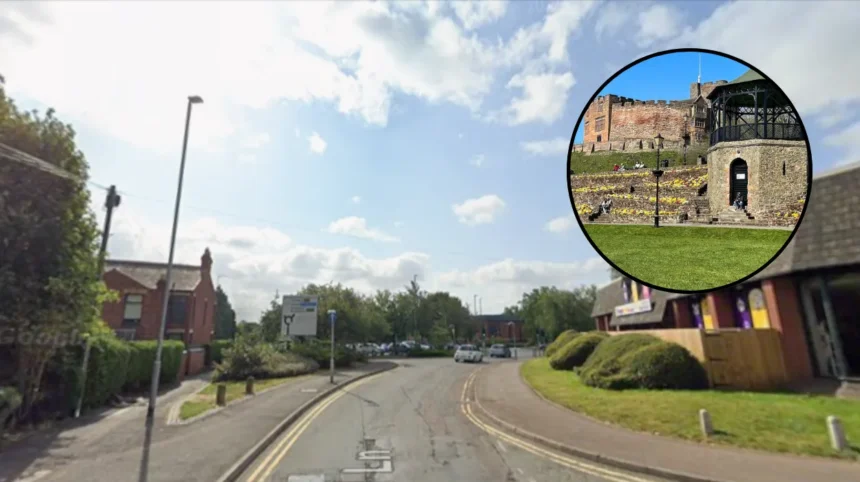
Key Points
- Historical Seat of Power: Long before London claimed modern status as the capital, the small market town of Tamworth in Staffordshire served as the political heart and seat of royal power for the powerful Anglo-Saxon Kingdom of Mercia.
- The Mercian Supremacy: During the 8th century, King Offa designated Tamworth as a primary center of governance, maintaining its high-profile royal status for nearly 200 years.
- Geographical and Structural Context: Tamworth spans roughly 12 square miles, making it one of the smallest boroughs in Staffordshire today, yet historical records highlight it as the primary residence for Mercian kings who spent more time there than anywhere else.
- Evolution of British Capitals: Historians note that early medieval England lacked a single permanent capital; instead, power shifted dynamically among competing regional kingdoms such as Mercia, Northumbria, and Wessex, featuring alternative power bases like Winchester, Colchester, York, and Malmesbury.
- Shift to London: London’s definitive rise as the singular capital city was cemented in 1066 when William the Conqueror marched on the city following his victory at the Battle of Hastings.
Tamworth (Birmingham Express) August 3, 2025 — When modern global citizens think of England’s capital city, London instantly comes to mind. Famed universally for iconic landmarks such as Big Ben, the Houses of Parliament, a bustling population nearing nine million residents, and a massive footprint in international finance, culture, and tourism, London represents the undisputed administrative core of the United Kingdom. However, the historical concept of a single, permanent capital city is a relatively modern construct. In early medieval England, political authority fluctuated heavily across competing regional realms, and the settlements that exercised supreme power were frequently far smaller than the sprawling metropolis recognized today. Three centuries before London secured its modern supremacy, a quiet market town located northeast of Birmingham in Staffordshire held the prestigious distinction of serving as the nation’s political nucleus. Despite currently measuring a modest 12 square miles and ranking as one of the tiniest boroughs in the country, Tamworth’s historical weight remains immense, having operated for nearly two centuries as the royal heartland of the mighty Mercian Kingdom.
Why was Tamworth considered the capital of England?
During the 8th century, England was not yet a unified sovereign state, but rather a fractured mosaic divided primarily among the competing regional kingdoms of Mercia, Northumbria, and Wessex. Among these, Mercia emerged as the largest and most influential dominion. As reported by Dan Taylor and Lauran O’Toole of The Mirror, a humble market town held the seat of royal power three centuries prior to London claiming the title.
As detailed by travel writers and historical researchers covering the region, King Offa designated Tamworth as the central seat of royal authority during the 8th century, a high-status role the settlement maintained for close to two centuries. While Tamworth functioned as the core power center and accommodated an elite royal palace during King Offa’s reign, the famous Tamworth Castle was not erected until the 11th century by Robert Despenser, who served as the steward to William the Conqueror, as noted in reports by the Express.
Historical analysts emphasize that the Mercian Kings spent significantly more time residing in Tamworth than in any other location within their territory. Before and immediately following the landmark Norman Conquest of England, Tamworth enjoyed an era of notable prosperity as influential local lords constructed defensive and residential castles within and surrounding the settlement.
What other cities and towns served as capitals before London?
The evolutionary timeline of English governance reveals that numerous towns and cities functioned as epicentres of power long before London captured permanent administrative dominance. Historical records compiled across various regional studies show a succession of temporary and kingdom-specific capitals.
As observed by architectural and heritage commentators, Malmesbury in Wiltshire lays claim to an early royal legacy. In the 10th century, Athelstan—recognized as the first king of all England and the grandson of Alfred the Great—declared Malmesbury his capital following a decisive military victory against an allied army of northern English forces and Scots.
Similarly, Colchester in Essex boasts a dual identity; alongside claiming the title of Britain’s oldest recorded town, it served as the formal Roman capital of the province in AD 49 under early Roman governors such as Catus Decianus. Meanwhile, in the Kingdom of Wessex, King Alfred the Great designated Winchester as his primary capital city, a status that endured comfortably for several centuries.
Further north, the cathedral city of York functioned as a vital capital across shifting eras. During the Anglian settlement, York acted as the capital of the Kingdom of Northumbria, later transitioning into the capital of the Viking-controlled Kingdom of Jorvik after being captured in the 9th century. This Norse dominance persisted for roughly a century until Viking king Eric Bloodaxe was expelled in 954 AD, paving the way for the city’s reabsorption into the expanding Anglo-Saxon state.
Explore More UK News
Sam Fender Chart Record Broken in London 2026
‘Humiliation’ of Foreign Dentists Unable to Work in UK – Birmingham 2026
How did London finally become the undisputed capital?
The eventual consolidation of London as the capital of England was forged through major political upheaval and military conquest. Although the Romans initially established a strategic commercial and administrative settlement known as Londinium on the River Thames, the site experienced severe disruption and partial abandonment following the withdrawal of Roman legions during the 5th century.
As regional kingdoms battled for supremacy over subsequent centuries, London gradually grew in economic and strategic value. The definitive turning point for London’s absolute supremacy occurred in 1066. Following his triumphant victory at the Battle of Hastings, William the Conqueror marched directly upon London, effectively cementing its status as the premier city and administrative nucleus of the realm.
Even centuries later, the concept of a singular, uncontested capital faced brief challenges. As documented by historical researchers examining British civil conflicts, when London became engulfed in violent civil war during the 17th century, King Charles I fled the city and claimed Oxford as his official Royalist capital starting in 1642, while parliamentary leader Oliver Cromwell simultaneously claimed the neighboring City of Westminster as his administrative base. Nevertheless, Oxford’s tenure as a wartime capital remained short-lived, while London’s institutional footprint continued its uninterrupted expansion.
What remains of Tamworth’s royal heritage today?
Today, Tamworth has transitioned from its medieval role as a powerhouse of the Mercian Kingdom into a peaceful Staffordshire market town. Retaining a deeply embedded historical charm, the modern town features independent shops, traditional cafes, bustling pubs, and local restaurants scattered throughout its traditional center.
Local authorities and heritage groups actively preserve the remnants of Tamworth’s illustrious past, drawing visitors interested in the pre-conquest roots of English history. While modern travellers may instinctively look toward London as the perennial anchor of British civilization, the quiet streets of Tamworth stand as an enduring reminder that the nation’s royal story began centuries earlier in the heart of the English Midlands.