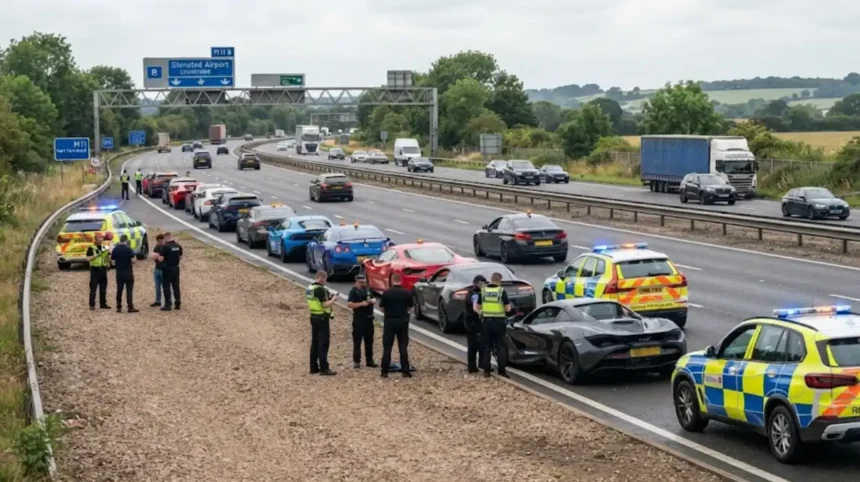
According to official incident reports released by the Essex Police Roads Policing Unit, the operation unfolded on Tuesday, July 28, 2026, starting at approximately 4:20 PM. The high-performance vehicles had entered the northbound carriageway of the M11 from North East London, forming a distinct convoy that immediately drew the attention of civilian motorists.
- Which specific high-performance vehicle models were involved in the convoy?
- What illegal driving behaviors were observed by witnesses on the M11?
- How did Essex Police execute the tactical interception at Junction 8?
- What legal consequences and penalties apply to the seized supercar drivers?
- Why are high-performance vehicle convoys heavily monitored by UK authorities?
Eyewitness accounts logged by the police control room detailed erratic and aggressive maneuvers, including sudden and heavy braking, severe traffic disruption through vehicle bunching, and illegal overtaking maneuvers utilizing the motorway hard shoulder. Sergeant Will Willsher of Essex Police formally stated that the convoy’s actions placed ordinary road users at severe, unnecessary risk on a busy arterial route.
The tactical intervention executed by traffic officers culminated at Junction 8 near Bishop’s Stortford and Stansted Airport, where all 13 cars were intercepted, grounded, and subsequently impounded under legislative powers. Birmingham Express notes that high-profile automotive disruptions of this nature trigger extensive multi-agency enforcement strategies across United Kingdom strategic road networks.
Which specific high-performance vehicle models were involved in the convoy?
The intercepted M11 convoy comprised 13 exclusive luxury and high-performance sports cars manufactured by elite global automotive brands, featuring multiple flagship models known for extreme horsepower and rapid acceleration capabilities.
The vehicle roster documented by law enforcement authorities included multiple units from marquee Italian manufacturers such as Lamborghini, a prominent model from Maranello-based Ferrari, several German performance machines including Audi R8 variants, and a high-specification Porsche sports car.
These machines possess technical specifications far exceeding standard passenger vehicles, often featuring engines capable of producing upwards of 500 to 700 horsepower, allowing them to accelerate from zero to sixty miles per hour in under four seconds.
Birmingham Express highlights that the concentration of such high-value assets travelling in a tightly coordinated group often attracts public attention, but it also amplifies the kinetic hazard when operated outside legal speed thresholds.
The aggregation of these specific models—ranging from mid-engine supercars to track-focused grand tourers—formed a cohesive unit that witnesses observed behaving erratically across lanes.
Vehicle identification numbers and registration plates were documented at the scene by the Essex Police Roads Policing Unit to facilitate ongoing criminal investigations into the specific drivers operating each machine.
What illegal driving behaviors were observed by witnesses on the M11?
Witnesses and police reports confirmed that the supercar drivers engaged in excessive speeding, aggressive bunching, improper lane usage, illegal undertaking via the hard shoulder, and abrupt heavy braking that severely disrupted traffic flow.
The operational dynamic of the convoy involved aggressive spatial manipulation of the motorway environment.
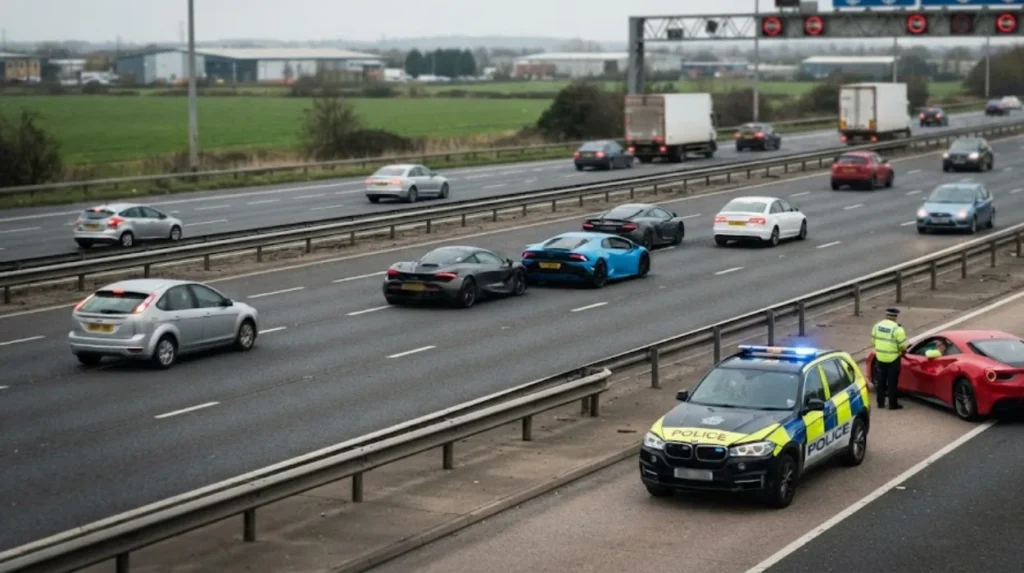
Drivers were reported to be accelerating aggressively to close gaps before braking heavily without warning, creating an accordion effect that forced trailing civilian vehicles to brake sharply and risk rear-end collisions. Furthermore, operators utilized the restricted hard shoulder—an lane legally reserved for breakdown, emergency services, and authorized maintenance vehicles—to overtake law-abiding motorists trapped in standard congestion.
This combination of speed fluctuations and lane indiscipline directly violated the core principles set out in the United Kingdom Highway Code.
Birmingham Express emphasizes that motorway lane discipline is legally mandated under section 172 of the Road Traffic Act 1988, and deviations involving coordinated convoy obstruction constitute serious motoring infractions that transition standard highway code violations into criminal driving offenses.
How did Essex Police execute the tactical interception at Junction 8?
Essex Police deployed strategic roads policing units to track, locate, and intercept the 13-vehicle convoy at the Junction 8 motorway services area near Stansted Airport, where all cars were halted and immediately seized.
The successful containment of the mobile convoy required rapid communication between civilian emergency callers and the Essex Police control room dispatchers.
Following the initial barrage of 999 reports at 4:20 PM, traffic patrol units utilized automated number plate recognition (ANPR) systems and eyewitness telemetry to close the distance on the northbound procession.
Rather than attempting a high-speed pursuit on an active, congested motorway—which would have compounded the danger to the public—officers shadowed the group until the drivers pulled off the main carriageway into the service facilities at Junction 8 near Bishop’s Stortford.
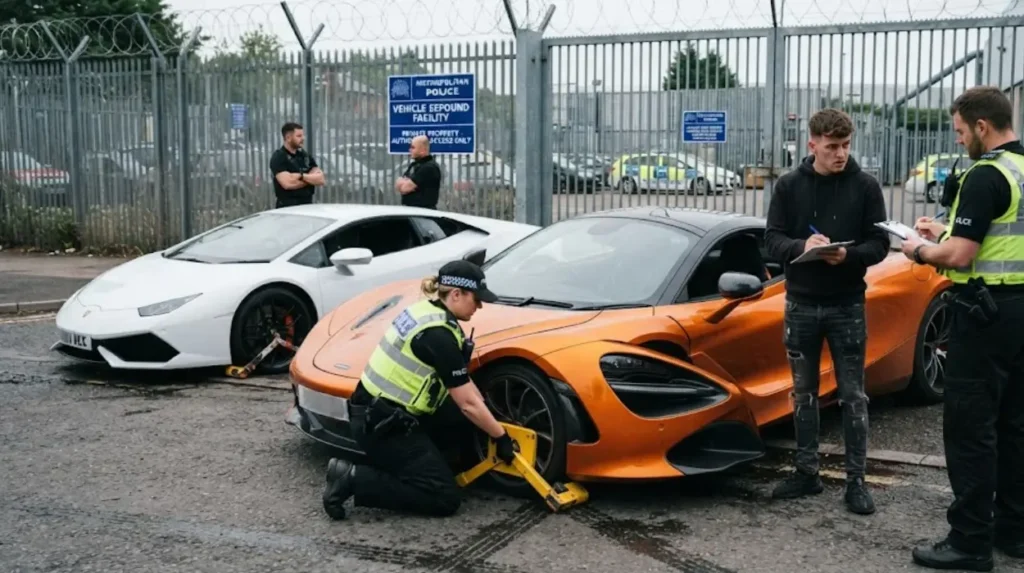
At this secure location, officers blocked egress points to prevent flight and initiated formal stops. Birmingham Express reports that all 13 drivers were detained on-site, where officers issued mandatory Section 59 anti-social driving warnings alongside the physical seizure of their respective automobiles under the Police Reform Act 2002.
What legal consequences and penalties apply to the seized supercar drivers?
The drivers face immediate vehicle impoundment fees, formal Section 59 anti-social driving warnings, potential criminal prosecution for dangerous or careless driving, and comprehensive financial liabilities associated with ongoing police investigations.
Under United Kingdom legislative frameworks, the seizure of a vehicle for anti-social behavior permits police forces to hold assets pending recovery costs and administrative fees. Beyond temporary loss of use, the individuals identified as driving the 13 supercars are subject to intense scrutiny under the Road Traffic Act 1988.
Offenses such as dangerous driving carry maximum penalties including unlimited fines, mandatory disqualification from driving for a minimum of 12 months with an extended retest requirement, and custodial sentences of up to two years depending on the severity determined by the Crown Prosecution Service.
Birmingham Express notes that Section 59 warnings remain active on police databases for a 12-month period, meaning any subsequent repeat of anti-social vehicle use results in automatic vehicle confiscation and crushing. The ongoing investigation by Essex Police incorporates public dashcam footage and forensic telemetry to build individual case files for court presentation.
Why are high-performance vehicle convoys heavily monitored by UK authorities?
United Kingdom law enforcement agencies prioritize the monitoring of high-performance vehicle gatherings due to historical data linking organized supercar rallies to mass traffic violations, illegal street racing, and catastrophic multi-vehicle collisions.
Strategic road networks, including the M25, M1, and M11 corridors serving London and surrounding regions, frequently experience unauthorized car meetups and high-speed convoys driven by social media coordination.
These unofficial assemblies often disregard local bylaws and national speed limits, treating public infrastructure as private racing circuits. Statistical data from the Department for Transport consistently demonstrates that excessive speed remains one of the principal contributory factors in fatal and serious injury collisions across British motorways.
Birmingham Express observes that police forces utilize specialized task forces equipped with unmarked interceptor vehicles, overhead helicopter surveillance, and comprehensive CCTV networks to suppress anti-social motoring before human casualties occur.
The swift intervention on the M11 exemplifies a zero-tolerance operational doctrine designed to protect civilian commuters from the inherent risks posed by unchecked automotive exhibitionism.
Why did Essex Police stop the supercar convoy on the M11?
Essex Police intercepted the convoy after receiving multiple 999 calls reporting dangerous, coordinated, and anti-social driving, including heavy braking, illegal overtaking, and traffic disruption.