One of Birmingham’s longest-standing community hubs could be demolished under proposals linked to a new £1.75 billion railway project, with campaigners warning that decades of activism and valuable communal space are at risk.
The Warehouse in Digbeth, owned by the climate justice organisation Birmingham Friends of the Earth (BFOE), has served as the group’s headquarters for more than 50 years. It is also home to a range of charities, campaign groups, meeting spaces, and a café.
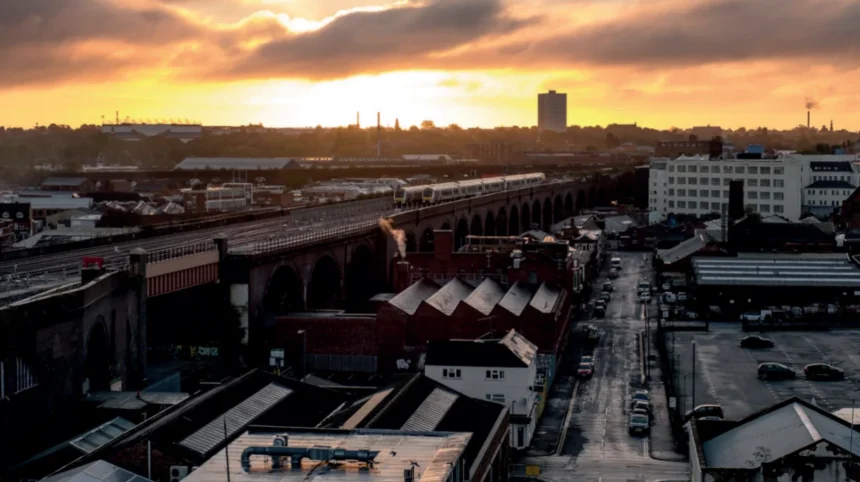
The Victorian building has specifically come under threat from plans to widen sections of the Bordesley Viaduct to increase rail capacity into Birmingham Moor Street station.
The proposals form part of the Midlands Rail Hub scheme. Once complete, the project is expected to enable up to 300 additional train services a day, improve connections to over 50 destinations, and reduce congestion at Birmingham New Street.
Mark Cuzner, Midlands Rail Hub Alliance director, described the proposed expansion of Moor Street as
“a key element of the wider vision for the Midlands Rail Hub and its transformational potential to enable growth, improved connectivity, and opportunities for millions of people”.
He added that the current consultation period will allow residents, businesses, and community groups to
“provide their views and feedback to shape our detailed plans”.
However, campaigners say those improvements come at the cost of one of Birmingham’s most vital community spaces.
Speaking to Birmingham Express, BFOE chief executive Karen Leach said she was shocked when she discovered the scale of the proposals.
“We heard it directly from MRHA,”
“They said we might be at risk of a number of things, including potential land acquisition. But we thought, ‘Well, it’s not going to be that, is it?'”
“It was only when we had a meeting with them that we discovered they were proposing to actually demolish the building, which was a shock.”
“We were utterly devastated.”
Leach stressed that Birmingham Friends of the Earth is not opposed to the rail improvements themselves, having previously campaigned in support of better public transport infrastructure.
However, she questions the scale of land acquisition proposed by the project, arguing that widening the viaduct by around 15 metres is disproportionate.
Instead, she believes alternative engineering solutions should be explored before demolition is considered, arguing that a more streamlined design could deliver the additional capacity without demolishing The Warehouse — a compromise she believes MRHA has yet to properly explore.
For Leach, the threat of demolition extends far beyond a single building.
She has been involved with The Warehouse since 1996, first as a BFOE volunteer and then as chief executive. She says the building itself tells the story of continuous community effort.
“When we moved into it, it was full of – ironically – rotting lentils,”
“Volunteers had to shovel them all out just to make space.”
“Gradually over time we’ve turned it into what it is. It’s been five decades of volunteering, people coming together, and raising funding from the community.”
In 2017, supporters helped raise around £300,000 through a community share offer to renovate the building, creating accessible facilities, expanding meeting spaces, and improving energy efficiency. More recently, a further £100,000 has been invested to replace roofs and install solar panels.
“That’s all just been finished,”
“The idea that somebody is going to demolish it to make room for a work site is just incredible.”
The Warehouse hosts organisations ranging from the National Trust to Extinction Rebellion, the Environment Agency, and the National Flood Forum, alongside numerous smaller community groups.
It has also housed a vegetarian café since the 1990s, now run by the Birmingham Race Impact Group (BRIG) — one of the city’s leading anti-racism organisations.
In conversation with Birmingham Express, a BRIG spokesperson described the venue as
“a living, breathing community hub rooted in racial and social justice”.
They warned that losing the café would disproportionately affect grassroots organisations, particularly racial minority community groups who rely on affordable, non-commercial spaces to meet.
“We loved the idea of bringing together green activism and Black activism,”
Leach said, adding that the partnership with BRIG has strengthened BFOE’s anti-racist work and its links to campaigns such as Unite the People.
The Warehouse is also part of the UK’s Climate Emergency Centre network — shared spaces designed to help people learn about climate change and environmental action. Leach said Birmingham is considered “extremely lucky” within the network because it has a permanent home in Digbeth.
Leach believes relocating would come at a huge cost.
“If you think about the networks of activists, community organisations, volunteers, and individuals that use it, they form almost this ecosystem,”
“If you were to transplant that somewhere else, you’d lose a lot.”
BFOE also fears relocation would undermine the security it has gained by owning the building’s freehold.
“All over Digbeth we’re hearing from organisations that have been here for 20 or 25 years but haven’t bought their buildings, and they’re being kicked out,”
Leach said.
Leach further raised concerns about local businesses already affected by HS2 works and the West Midlands Metro extension, warning that another prolonged construction project could place additional pressure on independent venues.
Despite those concerns, she said the support the campaign has received has left her feeling more hopeful.
“We’ve just been so overwhelmed by the level of support,”
“So many groups have marched into consultation meetings saying, ‘You can’t take away this building, that’s outrageous!'”
“We didn’t know people cared so much. It’s been really, really heartwarming to see.”
The Midlands Rail Hub Alliance says the consultation is intended to gather feedback before detailed plans are finalised, with any demolition, if approved, not expected to begin until around 2030.
Campaigners are urging residents, businesses and community organisations to take part while the proposals remain subject to change.