Key Points
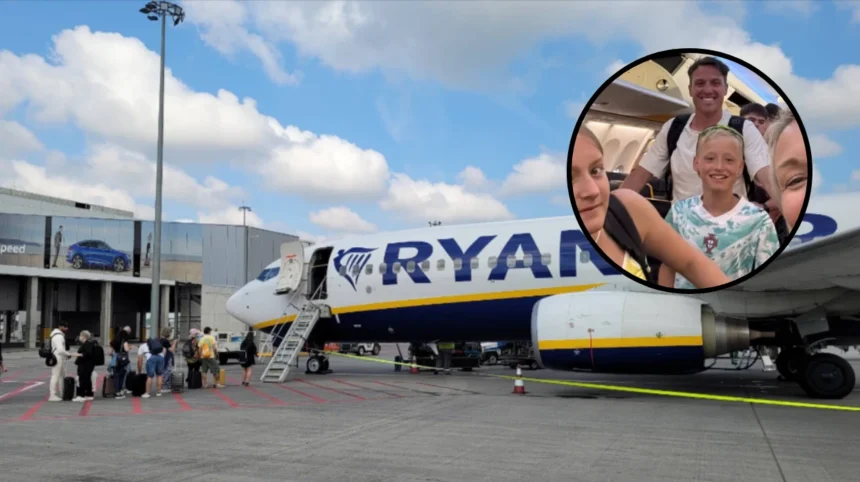
- A Ryanair flight traveling from Faro, Portugal, to Exeter, England, was forced to divert mid-air following a reported problem with the aircraft.
- Flight FR8030 was scheduled to land at Exeter Airport at 6:55 pm on Wednesday evening but was redirected over 150 miles away to Birmingham.
- Passenger Davina, speaking to DevonLive, stated that the pilot announced a landing within five minutes before the aircraft unexpectedly ascended and circled multiple times.
- Passengers were later informed via an announcement that a longer runway was required due to an aircraft issue, prompting the diversion to Birmingham.
- Flight tracking data and social media spotter groups indicated that a squawk 7700 distress signal—signifying an emergency situation—was communicated to air traffic controllers.
- Upon landing safely at Birmingham Airport, the aircraft was immediately trailed by blue-light landing-precaution vehicles, and ground crews were later seen inspecting the plane’s wing.
- Ryanair confirmed in a statement to passengers that the flight was forced to divert due to a minor technical issue, while Ryanair and Exeter Airport arranged ground transportation, including coaches, to take passengers back to Exeter.
Exeter (Birmingham Express) July 23, 2026 — Passengers aboard a routine evening service experienced high-tension moments on Wednesday when a Ryanair flight bound for the West Country was forced into an emergency diversion hundreds of miles off course. Flight FR8030, which had departed from Faro in Portugal’s Algarve region, was mere moments away from touching down at Exeter Airport before a sudden operational change threw travelers into uncertainty. According to reports gathered across regional titles, the aircraft was redirected toward the Midlands following an unexpected technical complication, triggering a full safety response on the ground.
What Happened on Ryanair Flight FR8030?
The scheduled service, cataloged as Ryanair flight FR8030, took off smoothly from Faro with an intended arrival time of 6:55 pm at Exeter Airport. However, as detailed by DevonLive journalists and further covered by Birmingham Live and the Irish Mirror, the routine approach unraveled in the final stages of the journey.
As reported by Molly Seaman and Adam Care of Birmingham Live, travelers expected a standard landing in Devon before the aircraft abruptly altered its trajectory. Flight tracking intelligence and aviation enthusiasts monitoring social media channels noted that a squawk 7700 emergency code—an international distress signal alerting air traffic control to an onboard emergency—was transmitted from the cockpit. This priority classification ensures immediate clearance and prompts emergency services to mobilize on the tarmac.
Why Did the Pilot Abort the Exeter Landing?
The transition from a routine descent to an emergency diversion unfolded rapidly above English airspace. Speaking to regional news outlet DevonLive, a passenger on board named Davina recalled the tense sequence of events.
As reported by DevonLive, Davina stated that the pilot originally “made an announcement we were landing in five minutes” before the aircraft unexpectedly changed pitch, ascended, and began circling the area several times.
Davina further detailed to DevonLive that:
“Then an announcement was made that due to a problem with the aircraft, we needed a longer runway and we were being diverted to Birmingham.”
Despite the acute anxiety inside the cabin, passengers praised the personnel handling the crisis. Davina added in her interview with DevonLive that “the pilot and cabin crew were very professional and helpful, but tensions were very high.”
Explore More UK News
Man Fined £4,000 for Illegal Waste Dumping in Barkingside 2026
Clifton Medical Centre Rated Among Worst in GP Patient Survey 2026
How Did Aviation Tracking and Airport Authorities Respond?
Following the aborted landing over Devon, flight telemetry indicated that the Boeing aircraft tracked northwards toward the West Midlands. Visual media captured at Birmingham Airport subsequently displayed ground teams closely evaluating the structural integrity of the aircraft’s wing.
As observed by reporters across multiple titles, the moment the wheels touched down on the tarmac in Birmingham, a convoy of blue-light safety vehicles and emergency precaution units immediately shadowed the aircraft. These protocols are standard procedure when a squawk 7700 is active, ensuring rapid containment should any fire, structural failure, or system malfunction manifest upon landing.
What Was Ryanair’s Official Statement on the Incident?
In the aftermath of the unscheduled landing, transport logistics had to be rapidly coordinated for nearly two hundred displaced passengers. According to regional updates provided to Bristol Post and Dublin Live, Ryanair organized dedicated coaches at Birmingham Airport to ferry the weary travelers back down to Exeter.
In an official statement issued directly to passengers and media outlets, Ryanair confirmed that the flight was “forced to divert to Birmingham” due to what the airline characterized internally as a “minor technical issue.” While corporate communications stopped short of elaborating extensively on the exact mechanical nature of the wing-related concern, the carrier emphasized that safety remained paramount throughout the diversion protocol. Both Ryanair and Exeter Airport representatives faced subsequent media inquiries as aviation safety bodies reviewed the flight logs of FR8030.