Birmingham transforms after sunset into one of England’s most dynamic cultural destinations. As Britain’s second-largest city, Birmingham combines centuries of industrial heritage with modern entertainment, creating an evening experience that reflects its historical evolution. Victorian theatres, historic canal basins, restored industrial districts, landmark concert halls, illuminated public squares, and award-winning dining venues all contribute to a diverse nighttime landscape.
- Why is Birmingham one of England’s best cities for evening and nighttime activities?
- What makes Birmingham’s canal network especially attractive after sunset?
- Why does Brindleyplace become a major evening destination?
- Why is Birmingham’s Theatre District important for evening culture?
- Why is Symphony Hall internationally recognised for evening performances?
- What makes the Jewellery Quarter especially interesting at night?
- Why are Birmingham’s historic pubs part of the city’s heritage?
- Why is Victoria Square particularly impressive after dark?
- Why does Birmingham’s dining scene reflect the city’s multicultural history?
- How do Birmingham’s museums and galleries contribute to evening culture?
- How has Birmingham preserved its historic character while developing a modern nightlife?
The city’s evening economy developed alongside the Industrial Revolution. During the eighteenth and nineteenth centuries, Birmingham’s workshops, factories, and canals operated around the clock. Workers, merchants, and craftsmen created demand for theatres, taverns, music venues, coffee houses, and public meeting spaces. Many of today’s most popular nighttime attractions occupy historic buildings or districts shaped by that industrial expansion.
Modern Birmingham welcomes millions of visitors annually, with its uk/local/city-centre/">city centre entertainment districts, cultural institutions, restaurants, canals, and live performance venues contributing significantly to the West Midlands visitor economy. The city’s investment in heritage preservation ensures that historic architecture remains central to contemporary nightlife while supporting tourism, education, and local identity.
To experience Birmingham after dark fully, visitors benefit from understanding how history shaped today’s attractions.
Why is Birmingham one of England’s best cities for evening and nighttime activities?
Birmingham combines Industrial Revolution heritage, Victorian architecture, internationally recognised cultural venues, illuminated canals, award-winning restaurants, and vibrant entertainment districts. This combination creates an evening experience where historic landmarks and contemporary attractions operate together within one walkable city centre.
Birmingham’s reputation as an evening destination reflects more than modern entertainment. The city’s historic development established districts that continue serving cultural purposes centuries later.
During the eighteenth century, Birmingham expanded rapidly as Britain’s leading manufacturing centre. Metalworking, jewellery production, engineering, and canal transport generated prosperity that funded theatres, assembly rooms, churches, libraries, and civic institutions. Evening entertainment became an essential part of urban life as workers and business owners gathered after the working day.
Victorian civic leaders invested heavily in public architecture. Buildings constructed between the 1830s and early twentieth century still dominate Birmingham’s skyline. Many remain active as concert halls, museums, performance venues, restaurants, or public spaces.
The city centre also benefits from compact urban planning. Major attractions lie within walking distance, allowing visitors to experience historic squares, canals, theatres, restaurants, and cultural institutions during a single evening.
To experience these districts in greater detail during daylight and beyond, consult our comprehensive [How to Enjoy Birmingham’s Nightlife Safely and Affordably] for itineraries and visiting parameters.
What makes Birmingham’s canal network especially attractive after sunset?
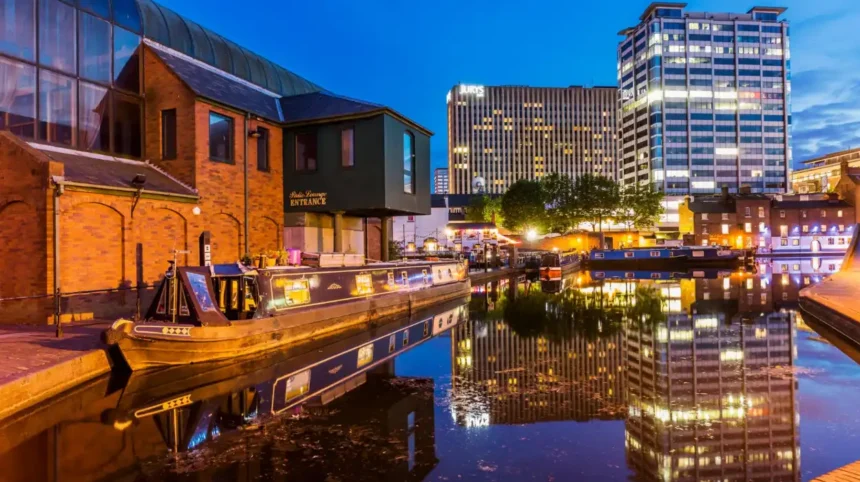
Birmingham’s historic canals become illuminated public spaces after sunset. Restored warehouses, bridges, towpaths, restaurants, and waterfront developments preserve nineteenth-century industrial infrastructure while creating one of Britain’s most distinctive evening walking environments and cultural landscapes.
Birmingham contains more than 35 miles (56 kilometres) of navigable canals within the city, exceeding the canal mileage found in Venice. These waterways formed the logistical backbone of Britain’s Industrial Revolution.
Construction accelerated after the Birmingham Canal Navigations expanded during the late eighteenth century. Coal, iron, finished goods, and raw materials moved continuously between factories and regional markets.
Modern regeneration has transformed former industrial basins into leisure districts while preserving original engineering features. Historic brick bridges, lock systems, warehouses, wharves, and towpaths remain visible throughout the canal network.
How did the canals evolve into evening leisure destinations?
Large-scale regeneration began during the late twentieth century.
Former warehouses became restaurants, apartments, offices, hotels, and cultural venues. Careful restoration maintained historic brickwork, cast-iron features, loading bays, and canal engineering.
Gas Street Basin illustrates this transformation particularly well. Once one of Britain’s busiest inland transport centres, it now functions as a lively waterfront destination where historic narrowboats share space with cafés and restaurants.
Illuminated reflections on the water create an atmosphere unlike any other British city centre.
Why does Brindleyplace become a major evening destination?
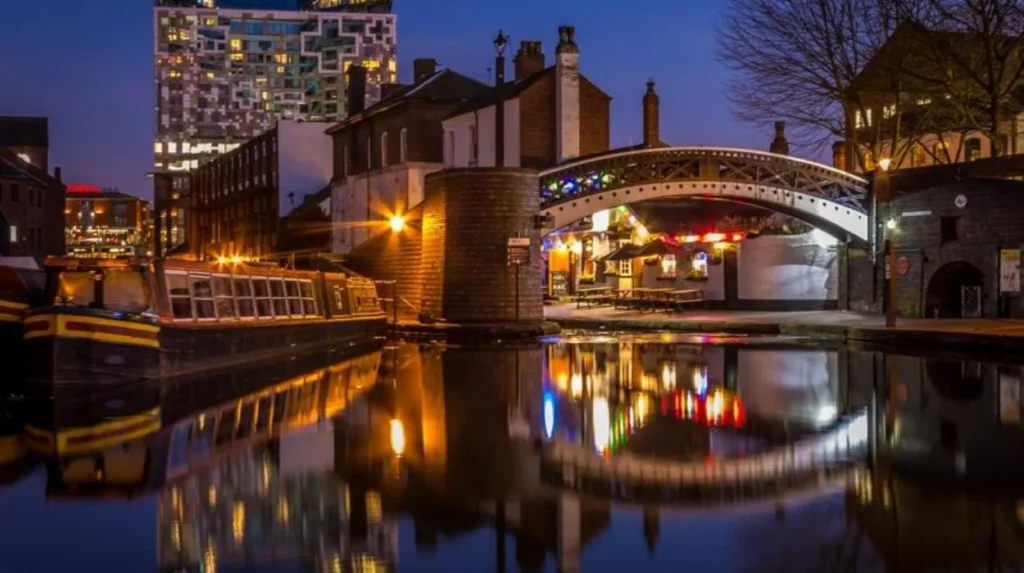
Brindleyplace occupies former industrial land beside Birmingham’s historic canals. Modern redevelopment preserved important heritage features while introducing restaurants, public squares, offices, cultural venues, and landscaped spaces that attract visitors throughout the evening.
Brindleyplace demonstrates successful urban regeneration built upon historical preservation.
Named after eighteenth-century canal engineer James Brindley, the district reflects Birmingham’s industrial origins while supporting a contemporary visitor economy.
Development began during the 1990s after decades of industrial decline. Architects retained historic canal alignments while introducing new public spaces that respected the area’s heritage.
Wide pedestrian routes connect visitors with canal bridges, landscaped courtyards, public art installations, restaurants, and outdoor seating.
What historical features remain visible today?
Several original canal engineering structures survive.
Historic lock systems continue operating.
Brick retaining walls reflect nineteenth-century construction methods.
Former industrial plots remain identifiable despite modern redevelopment.
The combination of preserved infrastructure and contemporary architecture creates an educational example of adaptive urban reuse.
Why is Birmingham’s Theatre District important for evening culture?
Birmingham’s theatre district reflects more than two centuries of performing arts history. Historic venues continue presenting drama, musicals, ballet, opera, comedy, and orchestral performances while preserving significant examples of Victorian and twentieth-century architecture.
Live performance has shaped Birmingham’s cultural identity since the eighteenth century.
Growing industrial wealth created demand for theatres capable of hosting touring productions from London and Europe.
During the Victorian era, theatre attendance became an important element of middle-class social life.
Today, venues continue that tradition through year-round programming.
Which historic theatres define Birmingham’s evening entertainment?
The Birmingham Hippodrome stands as one of Britain’s busiest theatres.
Originally opening in 1895 before later redevelopment, it presents ballet, opera, musicals, dance, and international touring productions.
The Alexandra Theatre dates from 1901 and preserves Edwardian theatrical traditions while accommodating modern productions.
The Birmingham Repertory Theatre, established in 1913, became one of Britain’s most influential producing theatres. It pioneered repertory performance outside London and helped shape modern British drama.
Together these institutions welcome hundreds of thousands of visitors annually while maintaining Birmingham’s longstanding theatrical heritage.
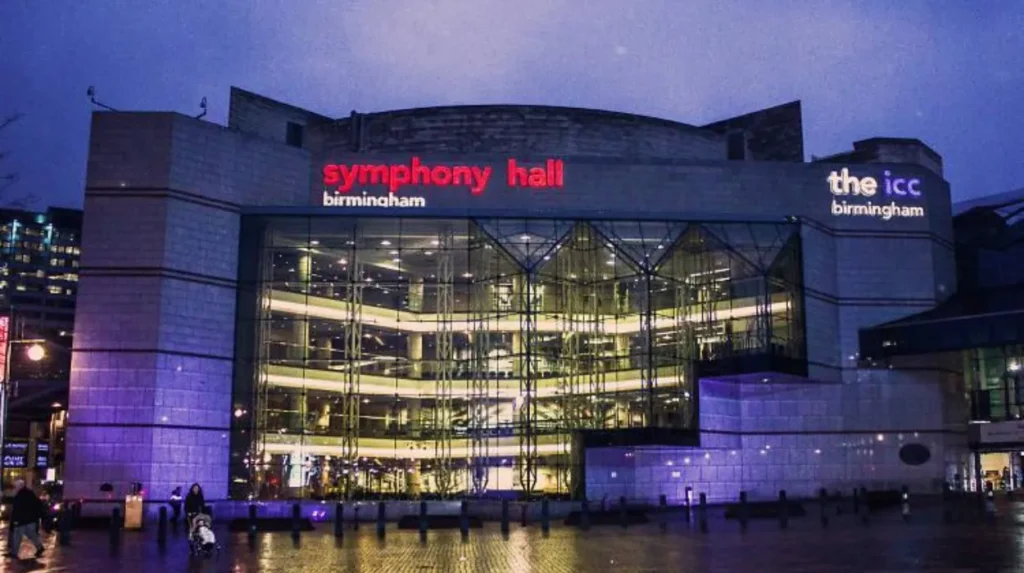
Why is Symphony Hall internationally recognised for evening performances?
Symphony Hall combines world-class acoustics, architectural innovation, and Birmingham’s musical heritage. Evening performances attract international audiences while continuing the city’s long tradition of investment in public music, education, and cultural excellence.
Opened in 1991, Symphony Hall quickly gained recognition among the world’s leading concert venues.
The hall accommodates approximately 2,200 audience members.
Its adjustable acoustic systems enable performances ranging from chamber music to large orchestral works.
The venue serves as the home of the internationally acclaimed City of Birmingham Symphony Orchestra.
How does Symphony Hall connect with Birmingham’s historical development?
Public investment in music predates Symphony Hall by more than a century.
Victorian Birmingham supported choral festivals, civic orchestras, educational institutions, and public concerts.
Industrial prosperity financed libraries, museums, concert halls, and educational programmes designed to improve public life.
Symphony Hall continues this tradition through concerts, educational outreach, international festivals, and cultural partnerships.
Evening performances contribute significantly to Birmingham’s cultural reputation across Europe.
What makes the Jewellery Quarter especially interesting at night?
The Jewellery Quarter preserves one of Europe’s largest historic jewellery manufacturing districts. Evening visitors experience Victorian streets, listed industrial buildings, independent restaurants, historic pubs, galleries, and creative businesses within an exceptionally well-preserved urban landscape.
The Jewellery Quarter emerged during the eighteenth century.
Generations of skilled craftspeople produced jewellery, watches, silverware, medals, and precision metalwork.
The district eventually manufactured around 40 percent of Britain’s jewellery.
Its historic significance earned Conservation Area designation in 1971.
How has preservation shaped today’s evening experience?
More than 200 listed buildings survive.
Former workshops now house restaurants, cafés, artisan studios, galleries, and boutique businesses.
Historic public houses continue serving residents and visitors within buildings dating to the Georgian and Victorian periods.
Evening walks reveal original street layouts, brick industrial architecture, and preserved factory façades rarely found elsewhere in Britain.
Why are Birmingham’s historic pubs part of the city’s heritage?
Historic pubs preserve Birmingham’s social history by occupying centuries-old buildings that served workers, merchants, manufacturers, and local communities. Many retain original architectural features while continuing their traditional hospitality functions during evening hours.
Public houses played an essential role throughout Birmingham’s industrial expansion.
They hosted business meetings, political discussions, trade union gatherings, and community celebrations.
Many buildings display Victorian brickwork, timber interiors, decorative tiling, etched glass, and traditional bar layouts.
How do these buildings contribute to historical understanding?
Historic interiors illustrate changing patterns of social life.
Architectural details reveal evolving construction methods.
Brewing traditions demonstrate regional economic development.
Many establishments occupy buildings protected through heritage listing, ensuring preservation of their historical character.
Visitors experience both living history and contemporary hospitality within the same environment.
Why is Victoria Square particularly impressive after dark?
Victoria Square combines civic architecture, illuminated public art, historic monuments, and landmark government buildings. Evening lighting highlights Birmingham’s Victorian identity while creating one of the city’s principal public gathering spaces.
Victoria Square developed during the nineteenth century as Birmingham expanded into a major civic centre.
It honours Queen Victoria, whose reign coincided with Birmingham’s greatest industrial growth.
Important surrounding buildings include Birmingham Town Hall and the Council House.
Architectural styles reflect Victorian confidence, municipal ambition, and civic investment.
What monuments define the square?
Public sculptures commemorate important historical figures.
The famous Iron Man sculpture by Antony Gormley introduces contemporary artistic interpretation into the historic setting.
Seasonal events regularly transform the square into an evening gathering place while respecting its heritage significance.
Carefully designed lighting enhances architectural details without compromising conservation objectives.
Why does Birmingham’s dining scene reflect the city’s multicultural history?
Birmingham’s evening dining culture developed through centuries of migration, industrial employment, international trade, and cultural exchange. Historic communities introduced culinary traditions that now define one of Britain’s most diverse restaurant destinations.
Industrial expansion attracted workers from across Britain and later from South Asia, the Caribbean, Ireland, Eastern Europe, and many other regions.
Each community contributed food traditions that gradually became embedded within Birmingham’s identity.
The famous Balti originated in Birmingham during the late twentieth century, reflecting South Asian culinary influence adapted to local tastes.
Today, historic districts support independent restaurants representing dozens of international cuisines.
This diversity reflects Birmingham’s continuing role as one of Britain’s most multicultural cities.
How do Birmingham’s museums and galleries contribute to evening culture?
Several Birmingham museums and cultural institutions extend evening programming through exhibitions, lectures, performances, and special events. These activities connect historical collections with contemporary audiences while supporting lifelong learning and heritage preservation.
Museums increasingly recognise that evening access broadens public participation.
Special exhibitions frequently remain open beyond standard daytime hours.
Educational lectures, gallery talks, conservation demonstrations, and cultural festivals encourage visitors to engage with history after normal working hours.
Institutions also collaborate with universities, researchers, artists, and local communities.
Evening cultural programming supports Birmingham’s reputation as a city where education and entertainment complement one another.
How has Birmingham preserved its historic character while developing a modern nightlife?
Birmingham balances conservation and redevelopment through heritage protection, adaptive reuse, planning regulations, and public investment. Historic buildings continue serving contemporary functions while preserving architectural significance, educational value, and cultural identity for future generations.
Urban regeneration has transformed former industrial districts without erasing their historical foundations.
Listed building legislation protects architecturally significant structures.
Conservation Areas preserve entire historic neighbourhoods.
Adaptive reuse allows warehouses, factories, workshops, churches, and civic buildings to remain economically sustainable.
This approach prevents demolition while encouraging continued public use.
The city’s canals illustrate this philosophy particularly well.
Industrial infrastructure continues functioning as a defining landscape feature despite changing economic activity.
Historic theatres still host live performances.
Victorian civic buildings continue serving governmental and cultural purposes.
Former factories accommodate creative industries rather than remaining abandoned.
Educational institutions also contribute through archaeological research, architectural surveys, conservation science, and public history projects.
These partnerships improve understanding of Birmingham’s industrial past while informing future preservation.
As climate resilience and sustainable urban planning become increasingly important, adaptive reuse of historic buildings reduces demolition waste and conserves embodied construction materials. Birmingham’s heritage therefore contributes both cultural and environmental value.
The city’s evening economy demonstrates that preservation and economic development reinforce one another. Visitors spend time within restored historic districts, supporting businesses that occupy protected buildings. Tourism revenue encourages continued investment in conservation, interpretation, and public access.
Birmingham’s nighttime identity therefore rests upon centuries of historical development rather than recent entertainment trends. Every illuminated canal bridge, restored warehouse, Victorian theatre, civic square, concert hall, historic pub, and preserved industrial street reflects decisions made across generations.
For visitors, educators, students, and heritage researchers, Birmingham offers more than an enjoyable evening. It provides direct access to Britain’s industrial, architectural, cultural, and social history within a modern city that continues respecting its remarkable past.
What are the best things to do in Birmingham at night?
Some of the best evening activities include walking along the illuminated canals at Gas Street Basin, dining in Brindleyplace, watching a show at the Birmingham Hippodrome, attending a concert at Symphony Hall, exploring the Jewellery Quarter, and visiting historic pubs.