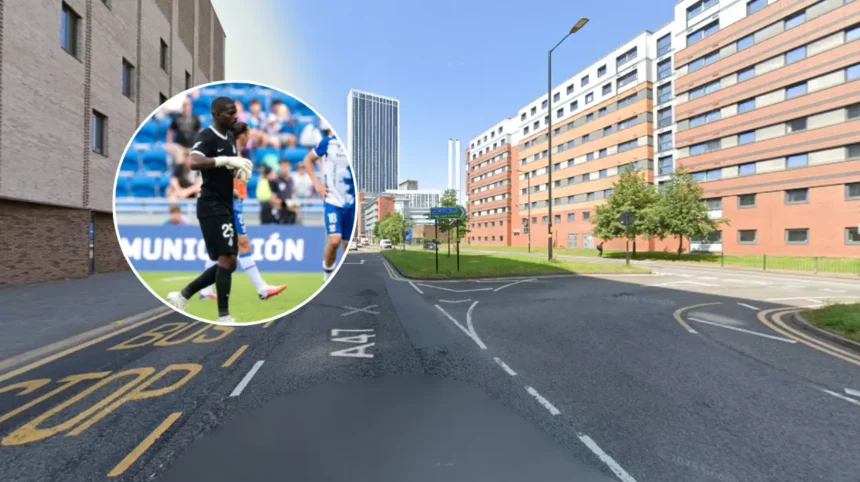
Key Points
- FC Andorra goalkeeper Jesus Owono collided with CD Tenerife forward Jesus de Miguel during a Segunda Division match.
- De Miguel died at 8:00 a.m. local time on Tuesday at age 30 after suffering severe head and chest injuries that led to cardiac arrest.
- Owono said he feels “enormous pain” following de Miguel’s death and described the aftermath as the most difficult days of his career.
- Authorities have opened an involuntary homicide investigation into the incident, and Spanish football officials suspended scheduled matches following de Miguel’s death.
Santa Cruz de Tenerife (Birmingham Express) November 4, 2026 — Spanish football has been plunged into profound mourning following the tragic demise of 30-year-old CD Tenerife forward Jesus de Miguel, who lost his life on Tuesday morning after sustaining fatal injuries during a league fixture against FC Andorra on Monday evening.
The fateful incident occurred in the seventh minute of stoppage time at the Estadio Heliodoro Rodriguez Lopez, with the scoreboard locked at 2-2. Rushing far outside his penalty area towards the halfway line to clear a long aerial ball, 25-year-old FC Andorra and Equatorial Guinea international goalkeeper Jesus Owono collided heavily with de Miguel.
Medical personnel rushed onto the pitch as players frantically motioned for urgent emergency support. De Miguel suffered severe head and chest trauma, which triggered a fatal cardiac arrest. Despite emergency medical interventions at the scene and subsequent care at the Nuestra Senora de Candelaria University Hospital, he was tragically pronounced dead at 8:00 a.m. on Tuesday.
What did goalkeeper Jesus Owono say regarding the fatal incident?
Breaking his silence during an immensely harrowing period, FC Andorra goalkeeper Jesus Owono shared the profound emotional toll the event has inflicted upon him, describing these hours as the most painful experience of his life.
As reported by Charlie Gordon of Express Sport, Owono stated that “he feels an enormous pain” after the pitch tragedy that ultimately claimed the life of the Spanish forward.
The Equatorial Guinea international deactivated his official social media accounts amidst an overwhelming wave of public attention and skipped a voluntary club training session to process the severe trauma of the collision.
Defending his teammate’s state of mind and character, FC Andorra player Lautaro Spatz addressed media queries regarding Owono’s condition in the dressing room.
As reported by the editorial staff of Legit.ng, Lautaro Spatz stated that “Owono was completely shattered in the dressing room and is suffering deeply over the tragic outcome”.
How did CD Tenerife and Spanish football authorities react?
The news of Jesus de Miguel’s passing sent shockwaves throughout the entirety of European football, leading to widespread tributes and the temporary halt of domestic cup competitions.
CD Tenerife released a heartbreaking official announcement confirming the death of their striker, who had established himself as a fan favourite since joining the club.
As reported by sports journalists at Al Jazeera, CD Tenerife stated that:
“Broken with pain, with a lump in our throat and unable to believe that this is true, we communicate the tragic death of Jesus de Miguel Alameda. There are no words of comfort. There is absolutely nothing to mitigate this feeling full of sadness.”
Following the tragedy, the Royal Spanish Football Federation (RFEF) suspended all official match activities scheduled for Tuesday, including Copa del Rey fixtures, whilst UEFA mandated moments of silence across international competitions.
Background of the particular development
Jesus de Miguel enjoyed a commendable career across Spanish football, featuring for nine different clubs after making his senior debut with Leganes B in 2015. He achieved significant prominence during the 2023-2024 campaign by scoring 16 goals to earn CD Castellon promotion to the second division, before earning a three-year contract at CD Tenerife in 2025.
On-field collisions resulting in fatal complications remain exceptionally rare in modern professional football due to rigorous pitchside medical protocols. However, the speed and physical intensity of modern competition continue to pose inherent collision risks, particularly when goalkeepers contest contested aerial balls outside their designated penalty boundaries.
Prediction: How this development can affect professional footballers and sporting governance
This tragic incident is anticipated to prompt rigorous structural reviews across global football governance regarding medical interventions, pitch collision safety, and matchday officiating standards.
For professional football players—particularly goalkeepers and outfield attackers—this event will likely instil heightened awareness and caution during high-speed aerial challenges outside the penalty box. Furthermore, FIFA and IFAB may evaluate stricter protocols regarding goalkeeper outings beyond the 18-yard box, potentially introducing clearer guidelines or penalty measures for reckless high-velocity challenges in outfield zones.
Legal and regulatory scrutiny will also intensify. With local Spanish authorities opening an investigation into involuntary homicide, the legal boundary between competitive sporting accidents and criminal negligence could see precedent-setting discussions within sports law. Clubs will likely expand psychiatric and grief counseling frameworks for players, ensuring long-term psychological support for individuals affected by pitchside trauma.