Key Points
- British Transport Police, West Midlands Ambulance Service, West Midlands Fire Service, and the Midlands Air Ambulance attended the railway line near Five Ways station.
- Emergency crews responded to reports of a casualty on the tracks.
- Emergency services received the initial report shortly after 9:00 PM on Saturday, 26 September 2026.
- Lines closed entirely, causing cancellations and delays of up to 60 minutes on CrossCity and regional trains between Birmingham New Street, Bromsgrove, Redditch, and Hereford.
- British Transport Police confirmed officers cleared the tracks, allowing Network Rail to reopen lines and resume services.
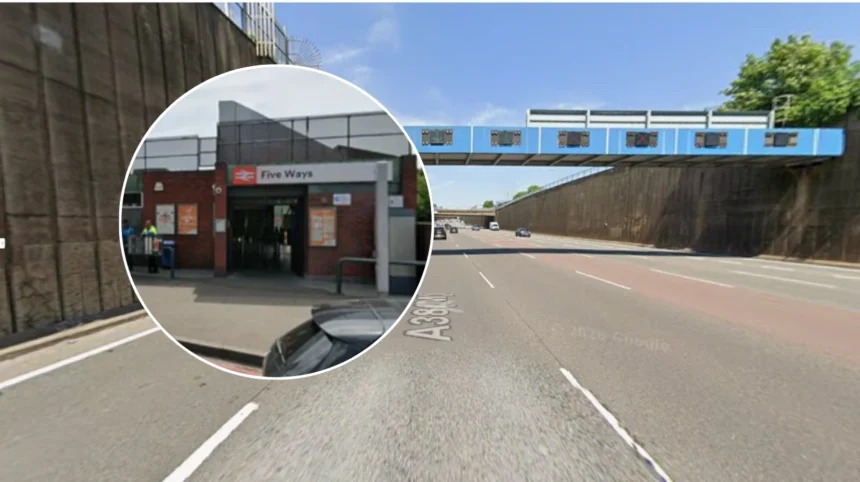
Birmingham (Birmingham Express) September 28, 2026 – As reported by Senior Reporter Ben Perrin of Birmingham Live, British Transport Police issued a formal update after emergency services rushed to Five Ways train station in Birmingham over the weekend following reports of a casualty on the railway tracks. Emergency first responders were dispatched to the line situated between Birmingham New Street and University stations shortly after 9:00 PM on Saturday, 26 September 2026.
The incident triggered an extensive multi-agency emergency deployment outside Five Ways station. Local eye-witnesses and emergency logs confirmed the presence of British Transport Police, West Midlands Police officers, at least two appliances from West Midlands Fire Service, land ambulances, and the Midlands Air Ambulance unit attending to the scene.
How did National Rail and rail operators respond to line closures?
As reported by Audience Editor Katy Hallam of Birmingham Live, National Rail confirmed that all lines between Birmingham New Street and University stations were closed while emergency crews conducted their work on the tracks. National Rail advised passengers that services running through Five Ways were subject to cancellation, severe revisions, or delays reaching up to 60 minutes.
The disruption impacted vital commuter and regional connections, specifically routes operating between Birmingham New Street, Bromsgrove, Redditch, and Hereford. To mitigate passenger disruption, rail operators arranged emergency road transport, including replacement coach services and acceptance of rail tickets on National Express bus networks across the West Midlands region.
Following the conclusion of on-site emergency procedures, British Transport Police cleared the railway tracks, allowing Network Rail engineers to safely reopen the line and restore normal scheduled services.
Background of the Five Ways emergency incident
Five Ways railway station is a key inner-city stop on the Cross-City Line in Birmingham, located between Birmingham New Street and University station (serving the University of Birmingham and Queen Elizabeth Hospital).
Due to its high train density and location on a crucial artery connecting the West Midlands to Worcestershire, any physical disruption on the tracks between New Street and Five Ways creates immediate knock-on effects across the regional rail infrastructure.
The response protocols established between British Transport Police, local blue-light services, and Network Rail ensure that incidents involving potential casualties on the track are handled with immediate line stoppages to secure safety for medical personnel and investigate the scene.
Prediction: How will this development affect West Midlands rail commuters and local infrastructure?
In the short term, rail commuters traveling via Five Ways and the wider Cross-City line can expect scheduled services to resume normal operations, though temporary fleet displaced during Saturday’s line closure has now realigned.
For regular passengers, hospital visitors traveling to University station, and students commuting across the Birmingham network, the quick resolution and established ticket-acceptance partnerships with National Express West Midlands highlight the emergency contingency measures available during sudden track incidents.
Longer-term, such incidents frequently prompt British Transport Police and Network Rail to review safety measures, physical perimeter barriers, and station surveillance around key urban hubs like Five Ways to reduce emergency track disruptions and maintain safety standards across the West Midlands transport corridor.