Key Points
- Emergency crews responded to a collision between a West Midlands Metro tram and a pedestrian in Birmingham.
- Officers from British Transport Police and West Midlands Police, along with West Midlands Ambulance Service paramedics, attended the scene.
- West Midlands Metro suspended and diverted service along the line while police secured the area for investigation.
- Passengers were transferred to local buses and train lines, with tickets accepted on National Express West Midlands and West Midlands Railway services.
- Transport authorities are investigating the cause of the crash.
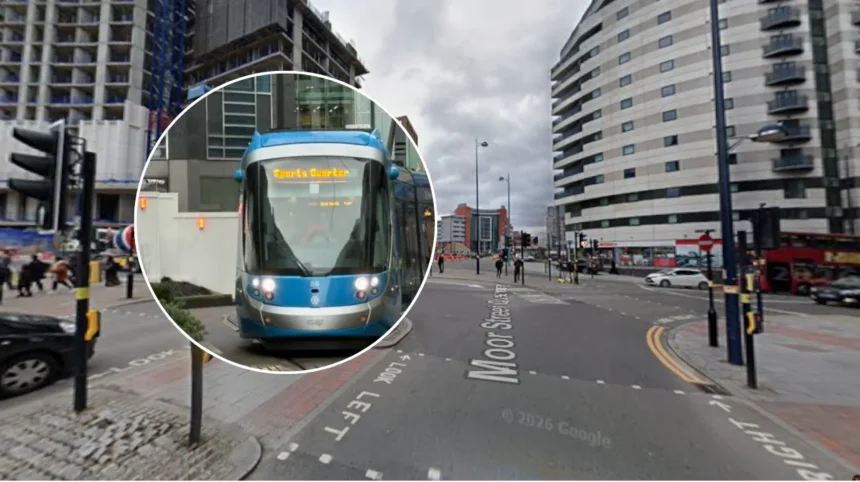
WEST MIDLANDS (Birmingham Express) September 22, 2026 — A severe collision involving a West Midlands Metro tram and a pedestrian in the Birmingham urban network resulted in a broad suspension of light rail services and a multi-agency emergency response.
As reported by Kelly Ashmore of BirminghamLive, emergency response crews—including units from the British Transport Police, West Midlands Police, and the West Midlands Ambulance Service—were dispatched following urgent calls regarding a individual being struck on the trackway. Emergency personnel established a secured cordon around the immediate tracks to administer urgent medical treatment and assess the circumstances surrounding the incident.
As reported by Graham Young of BirminghamLive, the presence of emergency vehicles and forensic teams necessitated an immediate halt to regular tram movements across adjacent track sectors to protect first responders working alongside the line. Transport for West Midlands confirmed that blue-light services coordinated closely with light rail control rooms to isolate electrical traction power near the affected zone.
How Were West Midlands Metro Services Affected Across the Network?
As reported by Charlotte Paxton of BirminghamLive, the incident caused immediate and widespread operational disruption, forcing network operators to shorten routes and terminate services prematurely at intermediate stops.
West Midlands Metro issued formal travel alerts informing passengers that trams were unable to operate through the incident zone. A spokesperson for West Midlands Metro stated via social media channels: “Due to an emergency services incident, there is no service operating between designated key stops. Trams are continuing to turn back at intermediate locations while emergency teams remain at the scene.”
To mitigate the impact on thousands of morning commuters across the West Midlands, transit operators enacted ticket-acceptance agreements. As reported by transport reporters at BirminghamLive, West Midlands Metro confirmed that standard tickets and travel passes were accepted on alternative modes of travel, including National Express West Midlands bus routes and local rail services operated by West Midlands Railway.
Network engineers and track supervisors remained on site to assist emergency personnel and perform manual safety checks on line switches before full service could be restored.
What Statements Have Authorities Provided Regarding the Investigation?
As reported by local news desk journalists at BirminghamLive, official agencies have initiated standard investigative procedures to determine how the pedestrian entered the track area prior to the collision.
A spokesperson for the British Transport Police stated: “Officers were called to reports of a collision involving a tram and a pedestrian. Paramedics and local police colleagues also attended. A forensic scene has been preserved while officers work to establish the full circumstances leading to the incident.”
A spokesperson for the West Midlands Ambulance Service confirmed: “Ambulance crews, including paramedic officers and specialized trauma teams, were dispatched to the scene to provide immediate emergency medical care upon arrival.”
Operational monitoring bodies, including the Light Rail Safety and Standards Board (LRSSB) and the Rail Accident Investigation Branch (RAIB), maintain standing protocols to review collision data, including tram onboard closed-circuit television (CCTV) footage and speed telemetry records.
Background of the Development
The West Midlands Metro network serves as an essential light rail artery connecting Wolverhampton, Sandwell, and Birmingham city centre. Over recent years, the light rail network has undergone continuous expansion, bringing trams into increasingly dense pedestrian zones and shared street environments.
While light rail transit is statistically one of the safest forms of urban mass transit in the United Kingdom, collisions involving pedestrians and vehicles on shared alignments remain an ongoing focus for safety regulators. The Rail Accident Investigation Branch (RAIB) routinely reviews pedestrian interactions with tramways across the UK, emphasizing the importance of warning systems, sightlines at designated pedestrian crossings, line speeds, and audible warning devices.
Major incidents of this nature automatically trigger joint operational audits between tram operators, local highway authorities, and safety boards to verify whether infrastructure design, fencing, signal timings, or warning signage played a contributing role.
Prediction: How This Development Can Affect Passengers and Regional Transit Policy
Impact on Passengers and Commuters
In the immediate aftermath, commuters across Birmingham and the wider West Midlands will continue to experience residual delays and potential timetable modifications while vehicle fleets are repositioned. Passengers may encounter localized crowd congestion at key interchange stations, such as Birmingham New Street / Grand Central, Edgbaston Village, and Wolverhampton, as well as higher passenger density on parallel National Express bus corridors.
Impact on Infrastructure and Safety Standards
From a broader public policy perspective, this incident is likely to prompt public safety evaluations regarding pedestrian access along the West Midlands Metro line. Transport for West Midlands and local authorities may face heightened public scrutiny regarding safety measures at track-adjacent footpaths and busy urban crossings. Potential long-term outcomes include:
- Retrospective safety audits of pedestrian crossings along shared light-rail corridors.
- Enhancements to audible warning systems or trackside visual warning signals.
- Increased public awareness campaigns targeting pedestrian alertness near active tram tracks.