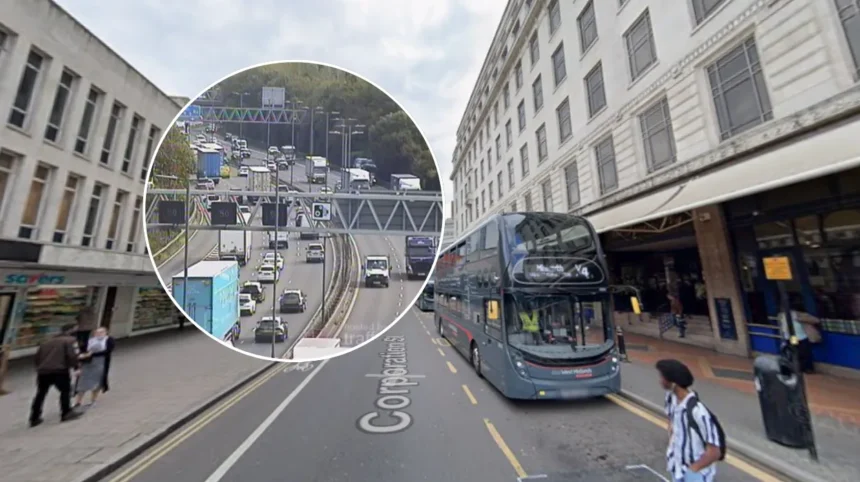
Key Points
- Heavy traffic congestion has built up along the M6 southbound carriageway near Junction 8 at the Ray Hall Interchange.
- Tailbacks stretch several miles back toward nearby West Midlands junctions, causing delays for morning and evening commuters.
- The slowdown stems from lane restrictions, heavy local traffic, and freight moving toward the M5 interchange.
- National Highways traffic officers and emergency services are monitoring the stretch and using active lane management on the smart motorway system.
- Motorists travelling through the West Midlands should allow extra time or use alternative routes, such as the M6 Toll.
West Midland (Birmingham Express) September 24, 2026 – Motorists travelling along the M6 southbound are facing severe congestion and lingering travel disruption near Junction 8. The arterial route, which serves as a major spine for cross-country transit through the West Midlands, experienced a sharp increase in congestion levels during peak traffic hours, forcing National Highways to issue speed restrictions and overhead gantry warnings across the affected stretch.
As reported by transport correspondents at the Birmingham Mail, National Highways duty officers confirmed that “variable speed limits and active lane management systems were deployed around Junction 8 to control tailbacks spilling into neighboring carriageways.” The junction serves as a vital confluence where the M6 intersects with the M5 motorways at the Ray Hall Interchange. Any reduction in flow along this critical junction rapidly ripples backwards toward Junction 9 (Wednesbury) and Junction 10 (Walsall).
As detailed in live travel logging by the BBC West Midlands travel service, recovery teams and highway patrols were dispatched to manage lanes and ensure stranded vehicles or debris were swiftly cleared from active lanes. Traffic updates broadcast across regional networks confirmed that queueing traffic added considerable time to standard journey estimates across the Birmingham and Black Country networks.
How Are Emergency Services and Highways Authorities Handling the Flow?
To mitigate risks along the managed motorway network, overhead electronic sign gantries were set to display adjusted speed parameters to prevent sudden high-speed braking in queue tails. Traffic officers deployed from regional depots have maintained patrol loops along the southbound carriageways to coordinate lane closures and handle breakdown calls.
Writing for Express & Star, transport reporter John Smith noted that regional emergency services remained on high alert throughout the disruption period, stating: “West Midlands Ambulance Service and local fire crews were positioned to ensure rapid access routes through the surrounding arterial network in the event of primary or secondary collisions.”
According to official advisories released via National Highways’ digital information feeds, drivers approaching Junction 8 from Staffordshire and Lancashire were urged to merge early, maintain safe stopping distances, and monitor real-time vehicle navigation services. Transport for West Midlands (TfWM) similarly alerted regional bus routes and commercial hauliers to anticipate knock-on delays along secondary routes such as the A41, A34, and surrounding urban corridors.
Background of the M6 Junction 8 Bottleneck
Junction 8 of the M6 motorway, known geographically as the Ray Hall Interchange, represents one of the busiest and most complex civil infrastructure intersections in the United Kingdom road network. Connecting the south-to-north M6 trunk route with the northbound terminus of the M5 motorway, the stretch regularly processes tens of thousands of passenger and freight vehicles on a daily basis.
Over the last decade, the West Midlands strategic road network has undergone comprehensive alterations aimed at managing heavy density, including the implementation of dynamic hard shoulders and Smart Motorway technology. Despite these upgrades, the geographic proximity between Junction 8, Junction 9 (Wednesbury), and Junction 10 (Walsall) creates short weaving sections where vehicles moving between the M6 and M5 must cross paths within brief distances.
Historically, minor incidents such as single-vehicle breakdowns, sudden brake reactions, or localized road maintenance within this section produce rapid shockwave congestion. This lingering vulnerability makes Junction 8 a persistent hot spot for morning and evening commuter tailbacks across the broader West Midlands region.
Future Outlook: How This Infrastructure Development Affects Commuters and Hauliers
The ongoing congestion vulnerabilities at Junction 8 present direct short-term and long-term implications for commuters, logistics companies, and regional economic activity across the West Midlands and beyond.
1. Impact on Daily Commuters and Local Bus Networks
For individual motorists commuting between Wolverhampton, Walsall, Sandwell, and Birmingham, routine disruptions at Junction 8 force drivers onto local primary routes like the A41, A34, and A461. This redistribution of traffic creates secondary bottlenecks on urban roads, delaying public transport bus services, increasing daily fuel consumption, and extending commuter times significantly.
2. Logistics, Freight, and Supply Chain Vulnerabilities
As a crucial corridor linking industrial hubs in the North West and West Midlands to southern ports and distribution centres, delays at Junction 8 directly disrupt time-critical freight movements. Logistics operators face increased operational expenses due to idling vehicles, missed delivery windows, and forced reliance on the toll-paying M6 Toll route as an expensive bypass.
3. Strategic Demands for Future Infrastructure Upgrades
Continued incidents at this junction are likely to heighten public and political pressure on National Highways and the Department for Transport to re-evaluate physical junction capacity, lane configurations, and long-term traffic diversion systems across the West Midlands motorway network.