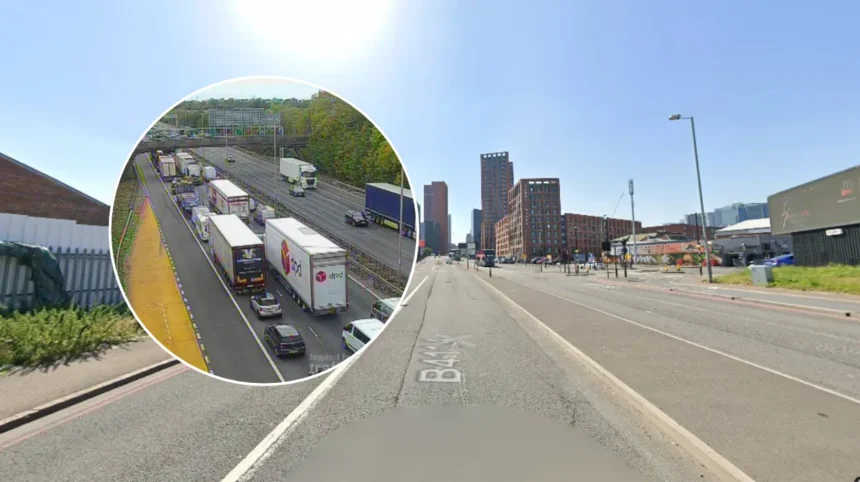
Key Points
- A multi-vehicle crash on the M6 near Birmingham caused miles of tailbacks and long delays during peak hours.
- West Midlands Police, West Midlands Ambulance Service, and National Highways traffic officers attended the scene.
- Officers closed several lanes so recovery crews could remove damaged vehicles and clear fuel and debris from the road.
- Traffic backed up onto surrounding routes, including the A38(M) Aston Expressway and local diversion roads.
- National Highways advised drivers to avoid the stretch, find alternative routes, and plan for extra travel time.
Birmingham (Birmingham Express) October 15, 2026 – A severe multi-vehicle collision on the M6 motorway near Birmingham has caused widespread disruption and tailbacks spanning several miles across the West Midlands road network today. Emergency services and traffic officers were dispatched to the scene to manage lane closures and administer immediate support.
- Key Points
- What Caused the Major Delays on the M6 Motorway?
- How Are Emergency Services and National Highways Responding?
- Which Diverted Routes Are Experiencing Secondary Traffic Congestion?
- Background of the Particular Development
- Prediction: How Will This Development Affect Commuters and Commercial Freight?
What Caused the Major Delays on the M6 Motorway?
The disruption originated on a busy stretch of the M6 carriageway near Birmingham after a multi-vehicle collision occurred during high-traffic hours. The incident left several damaged vehicles obstructing the main lanes, creating an immediate bottleneck for trailing traffic.
As reported by transport correspondents at local news outlets, emergency services, including police units and ambulance crews, arrived quickly to evaluate driver safety and manage emergency response procedures.
National Highways confirmed that emergency lane closures were put in place immediately following the crash. These measures were taken to establish a safe working perimeter for paramedics and recovery teams operating on the carriageway.
How Are Emergency Services and National Highways Responding?
Police and traffic officers coordinated efforts to control the flow of incoming traffic and secure the crash site. Fire crews were also called to assess potential hazards caused by compromised vehicle engines and leaking fluids on the road surface.
As reported by traffic safety correspondents, official spokespersons stated that “trapped traffic was released systematically as officers worked to open individual lanes safely while vehicle clearance continued.”
In addition to lane management, recovery vehicles were deployed to clear the damaged cars and lorries from the live lanes. Environmental cleanup crews were tasked with removing debris and treating fuel spills across the bitumen to ensure safe traction before full reopening.
Which Diverted Routes Are Experiencing Secondary Traffic Congestion?
The congestion rapidly extended beyond the M6 corridor, affecting interconnected motorways and regional arterial roads throughout the Greater Birmingham area. Diversions directed drivers towards alternative local roads, which quickly reached capacity under heavy commuter volumes.
Key feeder routes, including the A38(M) Aston Expressway and major junctions linking to the M5, saw severe queueing as motorists attempted to bypass the incident area.
As reported by regional travel reporters, transport controllers advised that “drivers should allow significant extra travel time or delay non-essential travel while recovery operations remain active on the network.”
Commuters on local bus services and regional freight vehicles were similarly impacted, with widespread delays reported across commercial transportation routes.
Background of the Particular Development
The M6 motorway serves as one of the most heavily used transport corridors in the United Kingdom, functioning as a vital arterial route for passenger vehicles and commercial freight linking the Midlands to the North and South.
The stretch surrounding Greater Birmingham is particularly susceptible to major traffic disruptions due to high vehicle density and complex junction interchanges, including the M5 link and the Aston Expressway.
Over recent years, recurring collisions on smart motorway sections and elevated carriageways around Birmingham have drawn increased scrutiny regarding traffic management, lane availability, and emergency response times.
National Highways and regional transport bodies have continuously implemented revised safety protocols, overhead gantry signaling, and dedicated traffic officer patrols to address incidents swiftly and mitigate regional gridlock.
Prediction: How Will This Development Affect Commuters and Commercial Freight?
In the short term, the collision and subsequent lane closures will lead to prolonged travel times for commuters, commercial hauliers, and regional transport networks across the West Midlands. High volumes of diverted traffic will likely maintain elevated congestion levels on secondary local roads throughout the remainder of the travel period.
Looking further ahead, recurring incidents of this magnitude on key motorways near major cities like Birmingham typically prompt transport authorities to re-evaluate regional bottleneck management, speed limit enforcement on smart motorways, and speed of clearance procedures.
For local businesses relying on just-in-time supply chains, continuous delays on the M6 demonstrate the vulnerability of central UK freight routes, potentially accelerating calls for enhanced road infrastructure resilience and expanded real-time routing systems across the Midlands.