Key Points
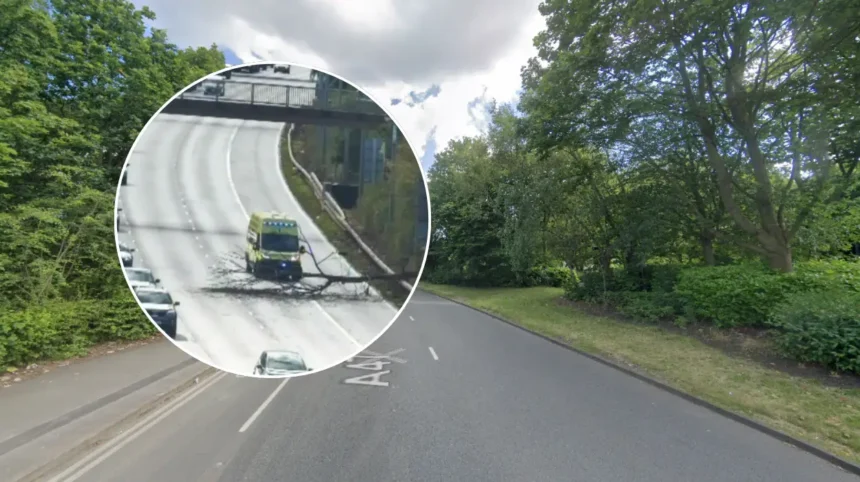
- A large tree branch fell across the M42 northbound between Junction 4 at Shirley and Junction 5 at Solihull.
- The branch blocked three of the four lanes, causing long tailbacks through the West Midlands.
- Delays reached at least 30 minutes at the peak of the congestion.
- Emergency services and National Highways officers went to the scene to clear the road and direct traffic.
- Crews removed the branch and all lanes have since reopened to normal traffic.
Solihull (Birmingham Express) October 9, 2026 — Three lanes on the M42 northbound carriageway near Solihull were closed to traffic today following an incident involving a large fallen tree branch that landed across the road surface.
The partial road closure took place on the busy stretch between Junction 4, serving Shirley, and Junction 5, serving Solihull, resulting in substantial queueing traffic and delays of up to 30 minutes during peak travel hours.
What Caused the Obstruction on the M42 Northbound?
As reported by Alexander Smith of Birmingham Now, the obstruction was created when a substantial tree branch dropped directly onto the live lanes of the northbound carriageway. The incident temporarily reduced the four-lane motorway section down to a single operational lane, severely restricting capacity.
Emergency service teams and traffic officers from National Highways were quickly deployed to the scene to assess the hazard and secure the affected perimeter.
As reported by Alexander Smith of Birmingham Now, National Highways West Midlands confirmed the lane closures via official channels, advising motorists to approach the area with heightened caution.
The authority highlighted that the combination of heavy lane restrictions and high vehicle volumes caused tailbacks to build rapidly along the northbound route, impacting local road networks connecting Shirley and Solihull.
How Did Emergency Teams Clear the Carriageway?
Specialist contractors and motorway maintenance teams worked on-site to break down the fallen limb and clear the remaining debris from the tarmac. Due to the physical dimensions of the branch, specialist equipment was deployed to ensure the safe removal of wood and organic material from the live lanes.
As reported by Lexie Weston of Stourbridge News, field updates from the scene confirmed that motorway traffic was heavily choked between the Solihull stretch and the A45 junction before maintenance workers completed the clearance operation. The emergency teams successfully cleared the roadway, allowing National Highways to reopen all three closed lanes and safely restore the route to usual traffic conditions.
Background of the Particular Development
The M42 motorway serves as a pivotal strategic corridor within the West Midlands transport infrastructure, linking the southern regions of Birmingham to key hub networks including Birmingham Airport, the National Exhibition Centre (NEC), and major interconnecting routes such as the M6 and A45.
The specific segment between Junction 4 (Shirley) and Junction 5 (Solihull) consistently carries high volumes of local commuter traffic and long-distance freight movement.
Because this corridor operates at near-capacity during morning and afternoon peak windows, any sudden obstruction on the carriageway—such as fallen trees, vehicle breakdowns, or minor collisions—frequently triggers severe bottlenecking.
Furthermore, environmental conditions such as autumnal leaf drop, high seasonal winds, and tree age along the motorway embankments present ongoing vegetation management demands for National Highways.
Incidents of vegetation falling onto major routes highlight the continuous requirement for routine inspection and arboricultural maintenance along major trunk roads across the United Kingdom.
Prediction: How This Development Can Affect Motorists and Local Businesses
The temporary disruption along the M42 northbound carriageway carries immediate and secondary implications for various regional groups:
- Commuters and Private Drivers: Motorists who rely on the M42 for daily travel through Solihull, Shirley, and toward central Birmingham face ongoing risk of localized congestion following lane re-openings as queueing vehicles dissipate. Recurring incidents of this nature often lead drivers to seek alternative secondary routes through residential arterial roads, increasing local urban traffic density.
- Commercial Transport and Logistics Sector: Transport operators and delivery fleets navigating the West Midlands network incur incremental operational delays and increased fuel consumption when major thoroughfares suffer multi-lane closures. Timetable disruptions can impact regional supply chains and time-sensitive logistics routes connected to nearby freight corridors.
- Regional Business Hubs and Visitors: Venue visitors and travelers heading toward Birmingham Airport or the NEC via the M42 northbound route face potential travel delays during major road events. Freight and passenger access dependent on Junctions 4 and 5 remains vulnerable whenever sudden lane restrictions occur along this section of the motorway network.