Key Points
- Former RUC Chief Constable Sir Ronnie Flanagan gave evidence to the Omagh Bombing Inquiry in Belfast.
- Sir Ronnie said he still believes police fulfilled their pledge to leave “no stone unturned” in the murder investigation.
- An RUC policy log presented by inquiry counsel showed staffing and operational hours in the incident room were cut six weeks after the August 1998 attack.
- Sir Ronnie told the inquiry he did not know about or approve the reduction in personnel and hours.
- He said he would have required assurances from the Senior Investigating Officer before approving any cuts if the decision had been brought to him.
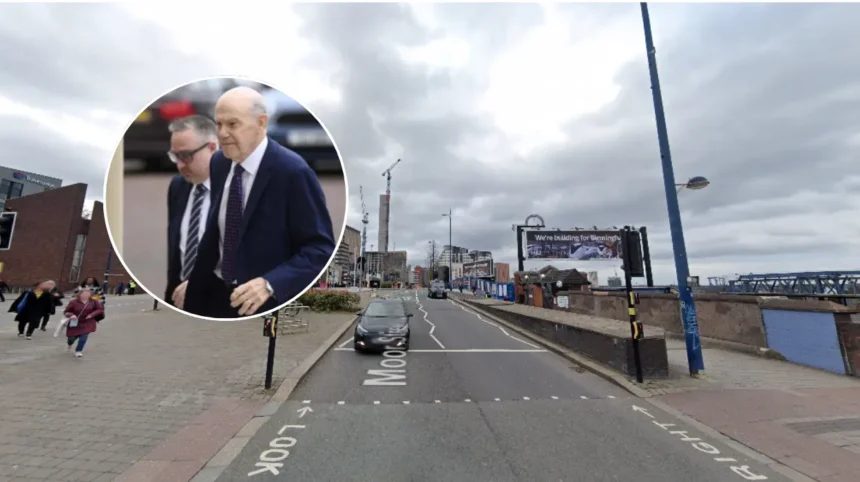
Belfast (Birmingham Express) November 9, 2026 – Former Royal Ulster Constabulary Chief Constable Sir Ronnie Flanagan has insisted that police upheld their commitment to leave no stone unturned following the 1998 Omagh bombing.
- Key Points
- Did the RUC keep its promise to leave no stone unturned during the Omagh investigation?
- Was manpower reduced in the Omagh incident room without chief constable approval?
- Why is the Omagh Bombing Inquiry examining state actions in Belfast?
- Background to the Omagh Bombing Inquiry
- How will these proceedings affect the victims’ families and future security reviews?
Testifying before the statutory public inquiry in Belfast, the former senior officer addressed probing questions regarding police resources, operational decisions, and the intelligence handling surrounding the single deadliest atrocity of the Northern Ireland Troubles.
Did the RUC keep its promise to leave no stone unturned during the Omagh investigation?
As reported by Jonathan McCambridge of The Independent, lead counsel to the inquiry decision-making process examined whether the initial police operation matched the high-profile public commitments made to victims’ families.
During cross-examination, counsel to the inquiry inquiry team pressed Sir Ronnie on whether the force had lived up to its primary pledge in the aftermath of the Real IRA attack that killed 29 people, including a woman pregnant with twins.
Counsel to the inquiry inquiry legal representative asked: “The question is sitting there now, with the knowledge of all that you know, and whatever the commitment that you made to the investigation, do you consider that the investigation, while you were chief constable, kept faith with the promise to leave no stone unturned?”
Sir Ronnie Flanagan responded directly to the inquiry panel, stating: “That’s my feeling. Yes.”
Was manpower reduced in the Omagh incident room without chief constable approval?
The inquiry reviewed official internal RUC documentation from late 1998 regarding the administrative management of the murder inquiry.
Counsel pointed to an RUC policy log indicating that just six weeks and two days after the explosion, the Senior Investigating Officer (SIO) made an operational decision to reduce both the hours of operation and the number of personnel deployed in the main incident room.
When asked by inquiry counsel whether the reduction in operational hours and staffing took place with his direct knowledge, Sir Ronnie Flanagan stated: “No, it did not.”
In response to a follow-up question regarding what his action would have been had the proposed reductions been brought to his attention, Sir Ronnie added: “I would have sought assurance from the SIO that he was content that the incident room could be managed effectively by these new measures.”
The former chief constable also addressed questions concerning whether additional external resources or specialist assistance had been requested to bolster the investigation team during the critical early months.
Sir Ronnie confirmed to the panel: “No such request for additional resources or help or assistance was ever forwarded to me on those lines.”
Why is the Omagh Bombing Inquiry examining state actions in Belfast?
Background to the Omagh Bombing Inquiry
The Omagh Bombing Inquiry was formally established as an independent statutory inquiry under the Inquiries Act 2005 to examine whether the August 15, 1998 bombing by the Real IRA could reasonably have been prevented by UK state authorities.
The establishment of the public inquiry followed a 2021 High Court ruling which recommended an independent review into state intelligence handling, mobile phone tracking analysis, advance warning indicators, and disruption operations.
The investigation has scrutinised historical friction between RUC Special Branch and CID investigators, past findings by former Police Ombudsman Baroness Nuala O’Loan, and the extent to which cross-border intelligence was shared between agencies at the time of the dissident republican campaign.
How will these proceedings affect the victims’ families and future security reviews?
The testimonies delivered at the Belfast hearings provide long-awaited transparency for the bereaved families, survivors, and the broader Northern Ireland community who have campaigned for decades for a comprehensive public accounting of the events of August 1998.
By scrutinising operational decisions, internal logbooks, and intelligence management, the inquiry aims to reach definitive findings regarding state preparedness and administrative oversight during critical emergency responses.
For policing oversight bodies and UK security services, the inquiry’s eventual conclusions are expected to inform future protocols on cross-departmental intelligence sharing, incident room resourcing during major crisis investigations, and accountability measures for senior command structures during high-profile national security events.