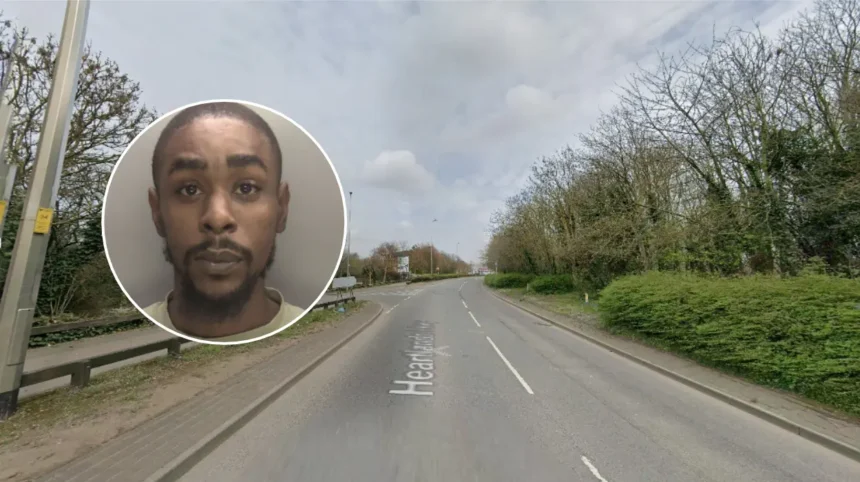
Key Points
- David Campbell, 37, of Bridgeburn Road, Birmingham, received a prison sentence of four years and eight months.
- A 13-year-old girl suffered a brain bleed and major injuries when a car hit her while she was waiting to cross the road.
- Toxicological tests showed Campbell had cocaine and traces of cannabis in his system during the crash.
- Campbell did not take his prescribed epilepsy medication, ignored medical advice telling him not to drive, and failed to inform the DVLA of his condition.
- Bystanders held Campbell at the scene after he tried to swallow drugs to hide evidence from police.
- The court banned Campbell from driving for six years and two months, starting from the date of his release from prison.
Northfield (Birmingham Express) October 19, 2026 – A 37-year-old motorist has been jailed for more than four years after losing control of his vehicle whilst under the influence of drugs, causing severe life-altering injuries to a 13-year-old pedestrian.
David Campbell, of Bridgeburn Road, Birmingham, was sentenced at court after pleading guilty to multiple serious traffic and drug offences following a devastating incident on Bell Hill in Northfield.
What Happened During The Bell Hill Crash Incident?
The incident occurred when Campbell lost control of his car and mounted the pavement, pinning a 13-year-old girl against roadside railings while she was simply waiting to cross the street.
As reported by Reuben Virk of Birmingham Now, the young victim sustained a serious bleed on the brain as a consequence of the impact. Bystanders immediately rushed to the scene to assist the injured teenager and prevent Campbell from fleeing.
When police officers arrived at the crash site, they observed Campbell attempting to swallow packets of illegal substances in a bid to dispose of evidence. Officers intervened, detained him, and successfully recovered the illicit substances from his possession.
What Excuses Did The Offender Make To Police?
During formal police interrogations, Campbell asserted that the collision occurred because he had suffered an epileptic seizure behind the wheel, claiming he had no recollection of the event.
However, comprehensive police investigations quickly discredited his defense. Toxicological analysis revealed no traces of anti-epileptic medication in his blood, confirming he had failed to follow medical treatment.
Instead, tests confirmed high levels of cocaine along with traces of cannabis in his system. Officers further established that Campbell had repeatedly ignored explicit warnings from medical professionals instructing him not to drive, while also failing to inform the Driver and Vehicle Licensing Agency (DVLA) of his medical condition.
“Campbell had a choice that day and he chose to drive under the influence of drugs. He also knew that he was not taking his epilepsy medication and had chosen to ignore the advice of doctors,” stated PC Aroon Aftab of the Road Traffic Investigation Team.
What Charges Did David Campbell Face In Court?
At court, Campbell entered guilty pleas to a catalogue of serious offences, including causing serious injury by dangerous driving, driving whilst unfit through drugs, driving with a proportion of a controlled drug over the legal limit, possession of class A drugs, and possession of an offensive weapon.
On Wednesday, October 14, he was handed a total sentence of four years and eight months in prison.
In addition to his custodial sentence, the court handed down a driving disqualification of six years and two months, structured to commence only after his release from prison.
“The choices he made, and his selfish actions caused serious injury to a young girl who was just going about her day waiting to cross the road,” stated PC Aroon Aftab. “I want to thank the members of the public who helped that day. They helped to keep the young girl calm in what must have been a terrifying ordeal for her. I hope that this sentence is a lesson for people to think and make the right choice before they drive.”
Background To The Particular Development
Dangerous and drug-impaired driving remains a persistent safety concern across the West Midlands and the wider United Kingdom. Under UK motoring law, drivers diagnosed with medical conditions such as epilepsy are legally obligated to notify the Driver and Vehicle Licensing Agency (DVLA) and cease driving until given official medical clearance.
Furthermore, police forces across the UK have intensified targeted operations using roadside drug-testing kits (DrugWipes) to detect drivers under the influence of narcotics such as cocaine and cannabis.
Courts have increasingly applied strict custodial sentences and long-term driving bans under the Sentencing Council guidelines for drivers whose deliberate negligence or illegal substance abuse results in serious injury or death.
Prediction: How This Development Can Affect Local Communities And Road Users
This legal outcome is likely to affect local residents, road users, and medical practitioners across the region in several key ways:
- Increased Public Awareness On Medical Reporting: The case serves as a stark warning to individuals with diagnosed medical conditions, reinforcing that ignoring medical instructions or failing to inform the DVLA carries severe criminal liability if a crash occurs.
- Greater Local Vigilance and Support: The critical intervention of bystanders in Northfield demonstrates how prompt community action and cooperation with police can assist in holding dangerous drivers accountable and securing vital evidence at crash sites.
- Stricter Road Enforcement Measures: In light of repeated dangerous driving incidents across South Birmingham, West Midlands Police are expected to maintain stringent roadside drug checks and high-visibility traffic enforcement along major thoroughfares such as Bell Hill.