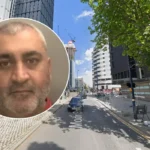
Key Points
- Norwegian national Johannes Kongsnes Natland, 19, received a 20-year detention sentence for plotting a contract killing in Britain.
- The proscribed, Iran-backed Swedish Foxtrot gang recruited the teenager to shoot an unidentified target for €25,000 (£21,500).
- Armed counter-terrorism officers seized two loaded firearms and live ammunition when they arrested Natland at the Briar Court Hotel in Huddersfield, West Yorkshire.
- Mrs Justice Cheema-Grubb passed sentence at Woolwich Crown Court during a televised hearing following a retrial at the Old Bailey.
- An adolescent known as “Generalen” recruited Natland, who took operational directions from an unidentified handler using the name “Agent 47”.
West Yorkshire (Birmingham Express) October 16, 2026 – A 19-year-old former youth footballer from Norway has been sentenced to 20 years of detention after travelling to the United Kingdom to carry out a targeted assassination on behalf of an international crime syndicate linked to the Iranian regime.
Johannes Kongsnes Natland, originating from Stavanger, accepted a contract worth €25,000 (£21,500) to execute an unnamed target on British soil.
His plot was halted when armed police raided his hotel room in Huddersfield, recovering two handguns, live ammunition, and thousands of pounds in cash.
As reported by Emily Pennink and Rich Booth of The Independent, Natland was recruited in Norway by a 17-year-old associate known under the moniker “Generalen”, who operated on behalf of the Swedish-based Foxtrot gang.
The proscribed criminal network is known to act as a proxy force for Iranian intelligence agencies and frequently utilizes young operatives, including minors, for high-risk criminal assignments across Europe.
Following a retrial at the Old Bailey, an English jury convicted Natland of conspiracy to commit murder. In a televised sentencing hearing held at Woolwich Crown Court, presiding judge Mrs Justice Cheema-Grubb ordered the teenager to serve two decades in custody. Highlighting the severity of the offense, the judge remarked during sentencing:
“You were recruited in Norway to travel to England and kill an unidentified target.”
How did British law enforcement intercept the plot before the execution?
According to court reports from ITV News, Natland was directed throughout the operation by an English-speaking handler using the alias “Agent 47”, a moniker referencing the popular Hitman video game franchise. Acting under direct orders from “Agent 47”, Natland flew on a temporary passport from Stavanger to Manchester Airport.
Upon arrival, Border Force officers initially detained Natland due to documentation issues. However, he was granted temporary bail with instructions to return to the airport to board a return flight to Norway. Instead of departing the country, Natland breached his bail conditions and boarded a taxi to Huddersfield, West Yorkshire.
Once in Huddersfield, Natland collected a cash sum of £2,000 alongside two functional firearms—a semi-automatic pistol and a revolver—along with 12 rounds of live ammunition. He was also directed to a stolen Nissan vehicle fitted with fraudulent registration plates, which was intended to serve as the getaway vehicle for the hit.
Natland established his base at the Briar Court Hotel in Huddersfield, where he posed with the weapons and money, sending bragful messages and images to his acquaintances. As documented by The Evening Standard, Natland sent messages to his girlfriend stating he had the “bangs in the bag”.
Counter-terrorism officers raided his room at 5:15 am the following morning. Upon emerging in his underwear, Natland gestured towards the armed officers, mimicking a firearm with his hands.
What evidence was presented during the Old Bailey retrial?
During trial proceedings, prosecutor Alistair Richardson outlined the extent of Natland’s willingness to participate in the plot, describing him as a dangerous individual driven by monetary gain. Text messages presented to the jury revealed that Natland had boasted to his girlfriend prior to leaving Norway.
As reported by ITV News, Natland’s girlfriend confirmed in her statements that he expressed excitement regarding the hit. The prosecution presented communications where Natland stated:
“Now I can finally kill someone and it’s perfect as I get money to do it. I can kill someone and life will be wonderful.”
A former teammate of Natland’s also testified that the defendant had openly discussed the “Swedish Foxes” (referencing the Foxtrot network), telling him prior to his departure: “I’m going to get a lot of money and somebody is going to die”.
Taking the witness stand in his own defense, Natland claimed that his communications were merely posturing and bravado. He told the court that he was struggling with drug addiction and had originally believed the assignment was a scam or a joke to obtain fast cash.
Natland alleged that upon realizing the reality of the situation, he intended to shoot himself in the foot to avoid carrying out the murder while escaping retaliation from his handlers.
Defense barrister Mr Hynes argued that the young defendant was humbled and terrified by the experience, asserting he did not represent a ongoing threat to society. The jury rejected these defense arguments, finding him guilty of conspiracy to murder.
Background of the particular development
The conviction and sentencing of Johannes Kongsnes Natland highlight an emerging trend in international crime: the convergence of state-backed intelligence operations with European organized crime syndicates.
The Foxtrot network, led by Swedish-Iraqi fugitive Rawa Majid (known as the “Kurdish Fox”), has been identified by European law enforcement and intelligence agencies as a key proxy operator for the Iranian state.
In recent years, intelligence reports across Sweden, Norway, and the United Kingdom have detailed how Iranian state actors outsource lethal operations, surveillance, and harassment of dissidents to foreign gang networks.
These criminal organizations routinely recruit impressionable adolescents and young adults through encrypted messaging platforms like Telegram, leveraging online gaming cultures, gang prestige, and fast financial compensation.
Prior to Natland’s arrest, his Norwegian recruiter “Generalen” was convicted in Norway for attempting to contribute to murder.
Investigations into the broader network remain active across multiple jurisdictions, with additional suspects facing inquiries in Norway and West Yorkshire regarding stolen vehicles and logistical support. However, the primary operative directing the British leg of the operation, “Agent 47”, remains unidentified and at large.
Prediction: How this development can affect international security and border control authorities
This development is likely to accelerate cross-border intelligence integration and stricter border monitoring protocols across the UK and the Schengen Area.
The fact that an individual under immigration bail was able to evade surveillance at Manchester Airport and collect loaded firearms in West Yorkshire within hours will force the UK Border Force and counter-terrorism units to review border interception procedures for high-risk arrivals.
For law enforcement and intelligence agencies, the case underscores the evolving challenge of state-sponsored proxy violence. Western authorities are anticipated to increase regulatory scrutiny and intelligence tracking on encrypted communication platforms used by transnational networks like Foxtrot.
Additionally, European criminal justice systems may face growing pressure to implement harsher statutory minimum sentences for minors and young adults who are co-opted into foreign-backed contract violence, as security services seek to disrupt the talent pipeline utilized by state actors.