Key Points
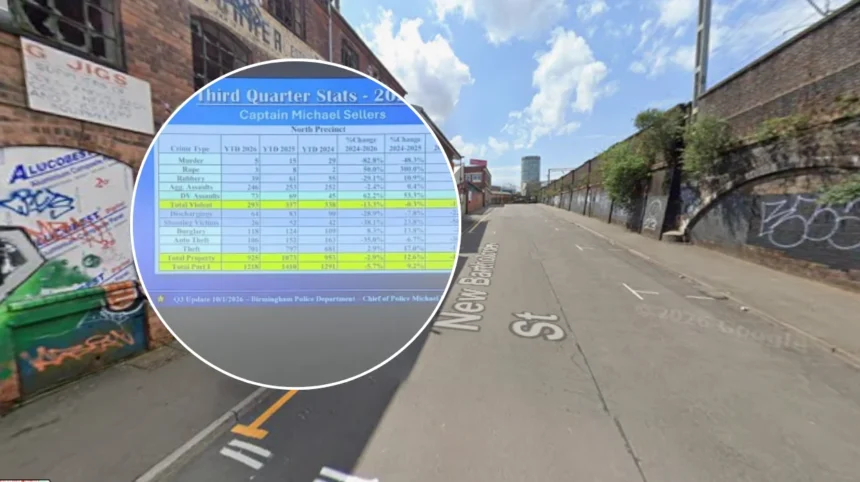
- Birmingham Police Department recorded a 35% to 50% drop in homicides in 2026 compared to previous years.
- Total crime across the municipality fell by nearly 12%, with overall violent crime dropping between 14% and 16%.
- Officers made arrests and solved nearly 80% of homicide cases this year, above the national average.
- Domestic violence reports and related calls increased across the city.
- Officials said intelligence-led policing, targeted violence intervention programmes, and community partnerships led to the drop in street violence.
Birmingham (Birmingham Express) October 2, 2026 — As reported by local news outlets covering the briefing from ABC 33/40 and WBRC 6 News, Birmingham Police Chief Michael Pickett addressed the city’s latest crime metrics, outlining a clear shift in public safety trends across the metro area. Chief Pickett confirmed that homicides in the city have experienced a steep decline, dropping by approximately 35% to 50% compared to the same period in previous years, while overall municipal crime fell by nearly 12%.
As reported by Carol Robinson of The Birmingham News, intelligence-led policing strategies, improved department staffing levels, and enhanced coordination with regional law enforcement partners played a pivotal role in curbing firearm-related homicides. Speaking at the public update, Chief Pickett stated: “We have to make criminals uncomfortable in our city. I think we have shown that. We will continue to show that.”
Law enforcement officials highlighted that investigator clearance rates have also risen considerably. The department has successfully made arrests in nearly 80% of 2026 homicide cases, a figure well above the United States national average.
What factors are driving the rise in domestic violence across the municipality?
As reported by the reporting staff at WBRC 6 News, while street level violent offenses and property crimes have dropped, domestic violence reports and intimate partner disputes have steadily escalated throughout 2026. Law enforcement officers noted that while targeted patrols and intelligence intervention disrupt public gang activity and street confrontations, domestic disputes occur predominantly within private residences, making proactive police prevention substantially more complex.
As reported by Mary Claire Wooten of the Alabama Political Reporter, municipal leaders and law enforcement executives are reassessing resource allocation to deal directly with household violence. Chief Pickett emphasized that addressing domestic friction before it escalates into lethal violence remains one of the department’s top priorities for the remainder of the year.
As reported by Mayor Randall Woodfin during municipal updates, the city continues to fund conflict resolution schemes, hospital-based violence intervention programs, and school safety networks to address violence at its root cause. Mayor Woodfin noted that while the overall drop in violent crime demonstrates progress, the ongoing surge in domestic incidents highlights the urgent necessity of persistent community-level support.
What is the background of this law enforcement development?
Over the past several years, Birmingham faced elevated homicide numbers, reaching historic peaks in 2022 and maintaining elevated violent crime levels into 2024. In response, municipal leaders formed specialized advisory commissions, studied operational models from other American metropolitan centers, and invested heavily in technology, intelligence infrastructure, and community outreach schemes.
By early 2026, these structural changes began yielding measurable returns, marked by a 42% drop in quarterly homicides during the first three months of the year, followed by sustained double-digit declines through the mid-year mark.
However, the shift in crime dynamics—from public street violence to interpersonal domestic conflicts—presents a distinct challenge for city leaders who must now balance traditional tactical law enforcement with social services, domestic shelter support, and targeted crisis intervention teams.
What is the prediction for local residents and community stakeholders?
This development is expected to directly impact Birmingham residents, local business owners, and victim advocacy groups in several distinct ways:
- Increased neighborhood safety and public confidence: The significant drop in street homicides and general property crime is likely to foster greater confidence among local residents and business owners, encouraging foot traffic and commercial investment in historically high-crime corridors.
- Shift in law enforcement resource allocation: Residents can expect the Birmingham Police Department to redirect specialized detail units toward domestic crisis response, follow-up wellness checks, and closer coordination with social service agencies to manage intimate partner disputes.
- Higher demand for support services: As domestic violence reporting increases, local victim advocacy organisations, emergency shelters, and legal aid clinics will face heightened demand for temporary housing, protective orders, and counseling services, necessitating increased municipal or state grant funding.