Key Points
- More than 100 Tidbury Green residents walked a 1.6-mile protest route on 30 August 2026, holding signs including “Green Belt Not Grey.”
- Campaign groups are opposing development proposals that could place more than 1,000 homes on green belt land around the Solihull village.
- Central government mandates require Solihull Metropolitan Borough Council to build 8,500 new homes across the borough by 2029.
- Council planners recently granted approval for developer Rainier Developments Limited to build 110 homes on Rumbush Lane.
- Solihull MP Dr Neil Shastri-Hurst attended the march and stated that large-scale proposals risk changing the character of the area.
- Tidbury Green Community Action and Ward Councillor Keith Green said they will keep fighting green belt allocations, citing concerns over flooding and local infrastructure capacity.
Tidbury Green (Birmingham Express) September 1, 2026 – Villagers angry over the potential building of homes on the green belt surrounding their Solihull village took to the streets for their latest campaign event on Sunday. As reported by Sam Greenway, Local Democracy Reporter for Birmingham Live, furiously opposed residents in Tidbury Green staged a 1.6-mile peaceful protest walk across the locality following growing concerns over potential development plans that could introduce more than 1,000 new housing units into the rural community.
- Key Points
- Why Are Tidbury Green Residents Protesting Green Belt Development?
- What Are Politicians And Local Community Leaders Saying About The Campaign?
- How Are Residents Reacting To The “Grey Belt” Reclassification?
- Background of the Tidbury Green Housing Development Controversy
- Prediction: How Will This Development Affect Local Residents and Developers?
Why Are Tidbury Green Residents Protesting Green Belt Development?
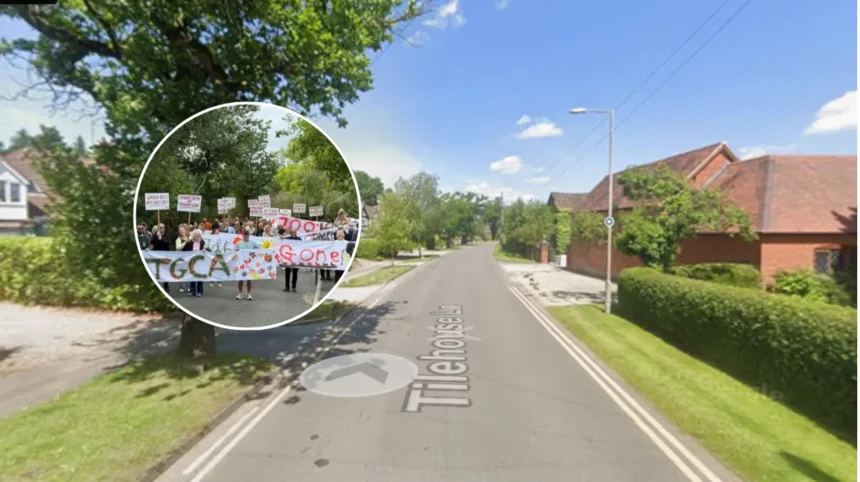
As reported by Sam Greenway of Birmingham Live, more than 100 residents assembled on 30 August 2026 to march through Tidbury Green, displaying hand-painted banners bearing messages such as “Green Belt Not Grey” alongside placards positioned outside front gardens across the village. Passing motorists sounded their horns in support of the procession as it traversed the 1.6-mile route.
The demonstration was organised by the Tidbury Green Community Action group. Speaking to the Local Democracy Reporting Service (LDRS), campaign organiser Chris Pugh-Zange stated that the gathering was a “peaceful, family-friendly protest” and confirmed that additional public demonstrations are actively being planned.
The action follows a previous public rally held on 18 August 2026, which saw more than 50 residents launch the campaign. Signs displayed outside village residences featured slogans including “Keep Tidbury Green”, “Green Belt Not Grey Belt”, and “1,700 homes who asked us”.
The anger stems from Solihull Metropolitan Borough Council’s requirement to meet updated national housing targets, which mandate the construction of 8,500 new homes across the borough before 2029. In response, an independent study identified several sites encircling Tidbury Green as potential “grey belt” land. Under national policy terminology, “grey belt” designates lower-quality or low-value sections of protected green belt land deemed suitable for residential development.
Tensions reached a high point after Solihull council planners granted approval to developer Rainier Developments Limited for a 110-home scheme on Rumbush Lane. Residents point out that this approval comes amidst separate proposals, including site applications that could add hundreds of additional units and potentially double the size of the historic village.
What Are Politicians And Local Community Leaders Saying About The Campaign?
The protest march saw direct involvement from local political figures who aligned themselves with the villagers’ concerns. As reported by Sam Greenway of Birmingham Live, member of Parliament for the constituency, Dr Neil Shastri-Hurst, attended the 30 August march and publicly backed the residents.
Dr Neil Shastri-Hurst stated:
“Residents are right to be concerned when proposals on this scale could fundamentally change the character of Tidbury Green. We all recognise we need more homes, but that does not mean every field should become a building site. New development must be in the right place, with the infrastructure to support it. I will continue to stand alongside residents.”
Speaking previously to the LDRS on 19 August 2026, Dr Shastri-Hurst reiterated that the national strategy prioritises the wrong locations:
“There is a strong sense among villagers this is the wrong move for the area. Nobody disagrees with the principle we need more homes, but we need to build them in the right place and that’s where the government has this wrong. We should be focusing on brownfield sites. It’s a tough battle and the government has made it harder. But I was in the Army, you don’t just walk away from a battle because it is tough.”
Local council representation has echoed similar pushback regarding the sheer volume of proposed homes. As reported by Sam Greenway for Solihull Nub News, Ward Councillor Keith Green raised alarm over the potential permanent destruction of local countryside:
“It’s the volume – 100 homes here or there would be one thing. But when you are talking about large sites like 800 it becomes unmanageable. The government is putting expectations on the council because of huge housing targets. But if they make a mistake you can’t go back, once the green belt is gone it is gone.”
How Are Residents Reacting To The “Grey Belt” Reclassification?
Local residents in Tidbury Green have voiced strong opposition to the designation of nearby fields as “grey belt” land, expressing worry over wildlife, surface water flooding, and infrastructure capacity.
As reported by Sam Greenway of Birmingham Live, local resident Amanda Beech highlighted the environmental threat, stating: “Once it’s gone, the wildlife will be gone.”
During LDRS interviews with villagers in August 2026, 50-year resident Lloyd Hudson addressed the severe strain on local public services:
“The infrastructure isn’t capable of handling what is here now. Unless they make major alterations it is going to be problematic. You won’t find anybody in favour of these houses being built.”
Another resident, who expressed anger over the classification of agricultural fields, stated to the LDRS reporter:
“I’m disgusted. They grow crops, corn, wheat round here – how is that land grey belt? We have been flooded before. If green belt is built on, the water is all going to come off, that’s what worries me.”
In response to growing public unrest, Solihull Metropolitan Borough Council addressed the legal status of the sites. As reported by Sam Greenway in Solihull Nub News, Councillor Andy Mackiewicz, Cabinet Member for Climate Change and Planning, clarified the council’s formal procedure:
“Decisions about whether any sites should be released from the green belt to meet future development needs across the borough will be made through the local plan process. The identification of potential grey belt land does not mean those areas are suitable for development. Nor does it mean entire land parcels assessed as containing grey belt would automatically be considered for development.”
Background of the Tidbury Green Housing Development Controversy
Tidbury Green is a semi-rural village situated within the Metropolitan Borough of Solihull in the West Midlands. Traditionally defined by its open farmland, hedgerows, and low-density residential structures, the village has come under growing development pressures due to its proximity to commuter transport routes into Birmingham and Solihull town centre.
Over recent years, the UK central government introduced revised planning policy frameworks aimed at tackling the national housing shortage. This included setting mandatory housing completion targets for local authorities. Solihull Metropolitan Borough Council was assigned a target to facilitate 8,500 new homes by 2029.
Because high proportions of the Solihull borough are designated as protected Metropolitan Green Belt, local planning authorities and independent land assessors were tasked with evaluating green belt parcels. This led to the introduction of the term “grey belt”, created to distinguish lower-quality, previously developed, or compromised green belt areas that could potentially be released for development.
However, the designation of several agricultural plots surrounding Tidbury Green as potential grey belt land triggered sharp pushback from villagers. Tensions mounted further following planning approvals for projects such as Rainier Developments Limited’s 110-home site at Rumbush Lane, alongside larger masterplans under consideration by major housebuilders. Residents formed the Tidbury Green Community Action group to legally and publicly challenge green belt reclassifications, citing the lack of school places, road capacity, and flood mitigation measures.
Prediction: How Will This Development Affect Local Residents and Developers?
The ongoing conflict between national housing mandates and local green belt protection in Tidbury Green is expected to have notable effects across multiple groups:
1. Local Residents and Homeowners
- Infrastructure Strain: If proposed developments exceeding 1,000 homes are approved in full, existing road networks (such as Rumbush Lane and Tilehouse Lane) are likely to experience increased traffic congestion. Local services, including Tidbury Green Primary School and GP surgeries, will face heightened capacity pressures.
- Environmental & Flooding Impact: The conversion of natural soakaway fields into residential concrete and tarmac may heighten localized surface water run-off and flooding risks for adjacent properties.
- Property Values & Village Character: The transition from a semi-rural village to a expanded suburban settlement could permanently alter local character. While property values might stabilize due to updated regional infrastructure, existing homeowners risk losing open countryside views and rural amenities.
2. Developers and Landowners
- Protracted Planning Battles: Developers targeting Tidbury Green will face organized opposition, leading to longer planning appeals, higher legal costs, and potential delays to construction timelines.
- Increased Developer Contributions: To win planning consent on controversial grey belt sites, housebuilders will likely be forced to fund substantial Section 106 infrastructure upgrades, including new road junctions, Sustainable Drainage Systems (SuDS), and dedicated green corridors.
3. Local Governance and Policy
- Political Pressure on Solihull Council: Solihull Borough Council will remain caught between central government penalties for failing to meet the 8,500-home target and strong pushback from voters and local MPs. This will make the formal adoption of the Solihull Local Plan a contentious political battleground leading up to 2029.